


AZ-140 Exam Dumps - PDF Questions and Testing Engine
AZ-140 Dumps - The Sure Way To Pass Exam
How to Register For Exam AZ-140: Configuring and Operating Microsoft Azure Virtual Desktop?
Schedule exam
Languages: English
Retirement date: none
This exam measures your ability to accomplish the following technical tasks: plan a Azure Virtual Desktop architecture; implement a Azure Virtual Desktop infrastructure; manage access and security; manage user environments and apps; and monitor and maintain a Azure Virtual Desktop infrastructure.
Skills measured
- Manage User Environments and Apps (20-25%)
- Manage Access and Security (10-15%)
- NOTE: The bullets that appear below each of the skills measured are intended to illustrate how we are assessing that skill. This list is NOT definitive or exhaustive.
- Monitor and Maintain an Azure Virtual Desktop Infrastructure (20-25%)
- Plan an Azure Virtual Desktop Architecture (10-15%)
- Implement an Azure Virtual Desktop Infrastructure (25-30%)
NEW QUESTION 43
You have a Windows Virtual Desktop deployment that contains the following:
* A host pool named Pool1
* Two session hosts named Host1 and Host2
* An application group named RemoteAppGroup1 that contains a RemoteApp named App1 You need to prevent users from copying and pasting between App1 and their local device.
What should you do?
- A. Modify the locks of RemoteAppGroup1.
- B. Modify the locks of RemoteAppGroup1.
- C. Create an AppLocker policy.
- D. Modify the RDP Properties of Pool1.
Answer: D
Explanation:
Reference:
https://docs.microsoft.com/en-us/azure/virtual-desktop/customize-rdp-properties
NEW QUESTION 44
Your company has a main office and two branch offices. Each office connects directly to the internet. The router in each branch office is configured as an endpoint for the following VPNs:
A VPN connection to the main office
A site-to-site VPN to Azure
The routers in each branch office have the Quality of Service (QoS) rules shown in the following table.
Users in the branch office report slow responses and connection errors when they attempt to connect to Windows Virtual Desktop resources.
You need to modify the QoS rules on the branch office routers to improve Windows Virtual Desktop performance.
For which rule should you increase the bandwidth allocation?
- A. Rule4
- B. Rule1
- C. Rule2
- D. Rule3
Answer: D
Explanation:
https://docs.microsoft.com/en-us/azure/virtual-desktop/safe-url-list
Any Remote Desktop clients you use must have access to the following URLs:
Remote Desktop clients
Address Outbound TCP port
*.wvd.microsoft.com 443
*.servicebus.windows.net 443
go.microsoft.com 443
aka.ms 443
docs.microsoft.com 443
privacy.microsoft.com 443
query.prod.cms.rt.microsoft.com 443
NEW QUESTION 45
You have a Windows Virtual Desktop deployment.
You plan to create the host pools shown in the following table.
You need to recommend the virtual machine size for each host pool. The solution must minimize costs.
Which size should you recommend for each pool? To answer, select the appropriate options in the answer area.
NOTE: Each correct selection is worth one point.
Answer:
Explanation:
Reference:
https://docs.microsoft.com/en-us/azure/virtual-machines/sizes
https://docs.microsoft.com/en-us/azure/virtual-machines/nvv3-series
https://docs.microsoft.com/en-us/azure/virtual-machines/dv4-dsv4-series
NEW QUESTION 46
You have a Windows Virtual Desktop deployment.
You have a session host named Host1 that has the disk layout shown in the exhibit. (Click the Exhibit tab.)
You plan to deploy an app that must be installed on D. The app requires 500 GB of disk space.
You need to add a new data disk that will be assigned the drive letter D. The solution must maintain the current performance of Host1.
Which four actions should you perform in sequence? To answer, move the appropriate actions from the list of actions to the answer area and arrange them in the correct order.
Answer:
Explanation:
1 - Move the page file to drive C.
2 - Change the drive letter of Temporary Storage (D:).
3 - Add the new disk and assign drive D.
4 - Move the page file to Temporary Storage.
Reference:
https://www.azurecorner.com/change-temporary-drive-azure-vm-use-d-persistent-data-disks/
NEW QUESTION 47
You have a Windows Virtual Desktop host pool named Pool1. Pool1 contains session hosts that use FSLogix profile containers hosted in Azure NetApp Files volumes.
You need to back up profile files by using snapshots.
Which three actions should you perform in sequence? To answer, move the appropriate actions from the list of actions to the answer area and arrange them in the correct order.
Answer:
Explanation:
1 - Register the Azure NetApp sbapshot policy feature.
2 - Create a snapshot policy.
3 - Apply a snapshot policy to a volume.
Reference:
https://docs.microsoft.com/en-us/azure/azure-netapp-files/azure-netapp-files-manage-snapshots
NEW QUESTION 48
Note: This question is part of a series of questions that present the same scenario. Each question in the series contains a unique solution that might meet the stated goals. Some question sets might have more than one correct solution, while others might not have a correct solution.
After you answer a question in this section, you will NOT be able to return to it. As a result, these questions will not appear in the review screen.
You have the following:
A Microsoft 365 E5 tenant
An on-premises Active Directory domain
A hybrid Azure Active Directory (Azure AD) tenant
An Azure Active Directory Domain Services (Azure AD DS) managed domain
An Azure Virtual Desktop deployment
The Azure Virtual Desktop deployment contains personal desktops that are hybrid joined to the on-premises domain and enrolled in Microsoft Intune.
You need to configure the security settings for the Microsoft Edge browsers on the personal desktops.
Solution: You configure a configuration profile in Intune.
Does this meet the goal?
- A. No
- B. Yes
Answer: B
Explanation:
Reference:
https://docs.microsoft.com/en-us/mem/intune/fundamentals/azure-virtual-desktop
NEW QUESTION 49
Which users can create Pool4, and which users can join session hosts to the domain? To answer, select the appropriate options in the answer area.
NOTE: Each correct selection is worth one point.
Answer:
Explanation:
Explanation
NEW QUESTION 50
You have an Azure Virtual Desktop deployment.
You need to recommend a solution to run containerized applications without installing the applications on the session hosts.
What should you include in the recommendation?
- A. APPX app packages
- B. EXE applications
- C. MSIX app packages
- D. MSI packages
Answer: C
Explanation:
Reference:
https://docs.microsoft.com/en-us/windows/msix/msix-container
NEW QUESTION 51
You have the devices shown in the following table.
You plan to deploy Windows Virtual Desktop for client access to remove virtualized apps.
Which devices support the Remote Desktop client?
- A. Device1, Device2, and Device3
- B. Device1 and Device2 only
- C. Device1 only
- D. Device1 and Device3 only
Answer: D
Explanation:
Reference:
https://docs.microsoft.com/en-us/windows-server/remote/remote-desktop-services/clients/windowsdesktop Applies to: Windows 10, Windows 10 IoT Enterprise, and Windows 7 You can use the Remote Desktop client for Windows Desktop to access Windows apps and desktops remotely from a different Windows device.
The new Remote Desktop client (MSRDC) supports Windows 10, Windows 10 IoT Enterprise, and Windows 7 client devices:
Windows 64-bit
Windows 32-bit
Windows ARM64
Topic 2, Contoso.
Existing Infrastructure
Active Directory
The network contains an on-premises Active Directory domain named contoso.com and an Azure Active Directory (Azure AD) tenant. One of the domain controllers runs as an Azure virtual machine and connects to a virtual network named VNET1. All internal name resolution is provided by DNS server that run on the domain controllers.
The on-premises Active Directory domain contains the organizational units (OUs) shown in the following table.
The on-premises Active Directory domain contains the users shown in the following table.
The Azure AD tenant contains the cloud-only users shown in the following table.
Existing Infrastructure. Network Infrastructure
All the Azure virtual networks are peered. The on-premises network connects to the virtual networks.
All servers run Windows Server 2019. All laptops and desktop computers run Windows 10 Enterprise.
Since users often work on confidential documents, all the users use their computer as a client for connecting to Remote Desktop Services (RDS).
In the West US Azure region, you have the storage accounts shown in the following table.
Existing Infrastructure. Remote Desktop Infrastructure
Contoso has a Remote Desktop infrastructure shown in the following table.
Requirements. Planned Changes
Contoso plans to implement the following changes:
Implement FSLogix profile containers for the Paris offices.
Deploy a Windows Virtual Desktop host pool named Pool4.
Migrate the RDS deployment in the Seattle office to Windows Virtual Desktop in the West US Azure region.
Requirements. Pool4 Configuration
Pool4 will have the following settings:
Host pool type: Pooled
Max session limit: 7
Load balancing algorithm: Depth-first
Images: Windows 10 Enterprise multi-session
Virtual machine size: Standard D2s v3
Name prefix: Pool4
Number of VMs: 5
Virtual network: VNET4
Requirements. Technical Requirements
Contoso identifies the following technical requirements:
Before migrating the RDS deployment in the Seattle office, obtain the recommended deployment configuration based on the current RDS utilization.
For the Windows Virtual Desktop deployment in the Montreal office, disable audio output in the device redirection settings.
For the Windows Virtual Desktop deployment in the Seattle office, store the FSLogix profile containers in Azure Storage.
Enable Operator2 to modify the RDP Properties of the Windows Virtual Desktop deployment in the Montreal office.
From a server named Server1, convert the user profile clicks to the FSLogix profile containers.
Ensure that the Pool1 virtual machines only run during business hours.
Use the principle of least privilege.
NEW QUESTION 52
You deploy a Windows Virtual Desktop host pool named Pool1.
You have an Azure Storage account named store1 that stores FSLogix profile containers in a share named profiles.
You need to configure the path to the storage containers for the session hosts.
Which path should you use?
- A. https://store1.blob.core.windows.net/profiles
- B. https://store1.file.core.windows.net/profiles
- C. \\store1.blob.core.windows.net\profiles
- D. \\store1.file.core.windows.net\profiles
Answer: D
Explanation:
https://docs.microsoft.com/en-us/azure/virtual-desktop/store-fslogix-profile Azure offers multiple storage solutions that you can use to store your FSLogix profile container. We recommend storing FSLogix profile containers on Azure Files for most of our customers.
NEW QUESTION 53
You are designing an Azure Virtual Desktop deployment.
You identify the network latency between the locations where users reside and the planned deployment.
What should you use to identify the best Azure region to deploy the host pool?
- A. Azure Monitor for Azure Virtual Desktop
- B. Azure Virtual Desktop Experience Estimator
- C. Azure Traffic Manager
- D. Azure Advisor
Answer: B
Explanation:
Reference:
https://azure.microsoft.com/en-gb/services/virtual-desktop/assessment/
NEW QUESTION 54
HOTSPOT
You have a Windows Virtual Desktop deployment.
You need to ensure that all the connections to the managed resources in the host pool require multi-factor authentication (MFA).
Which two settings should you modify in a conditional access policy? To answer, select the appropriate options in the answer area.
NOTE: Each correct selection is worth one point.
Hot Area:
Answer:
Explanation: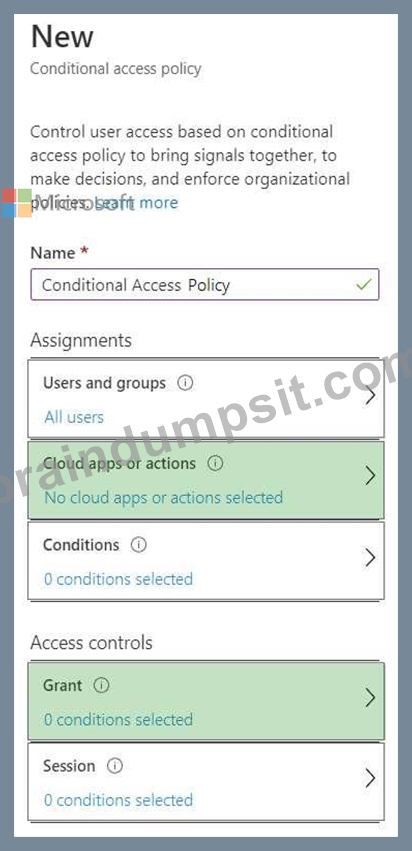
Explanation/Reference:
https://docs.microsoft.com/en-us/azure/active-directory/authentication/tutorial-enable-azure-mfa
NEW QUESTION 55
DRAG DROP
You need to ensure that you can implement user profile shares for the Boston office users. The solution must meet the user profile requirements.
Which four actions should you perform in sequence? To answer, move the appropriate actions from the list of actions to the answer area and arrange them in the correct order.
Select and Place:
Answer:
Explanation:
Explanation/Reference:
https://www.christiaanbrinkhoff.com/2020/03/01/learn-here-how-to-configure-azure-files-with-active-directory- ad-authentication-for-fslogix-profile-container-and-msix-app-attach/
NEW QUESTION 56
You have an Azure Virtual Desktop host pool named Pool1, an application named App1, and an Azure file share named Share1.
You need to ensure that you can publish App1 to Pool1 by using MSIX app attach.
Which four actions should you perform in sequence before you publish App1? To answer, move the appropriate actions from the list of actions to the answer area and arrange them in the correct order.
Answer:
Explanation:
1 - Generate a signing certificate.
2 - Create an MSIX package.
3 - Create an MSIX image.
4 - Upload the MSIX image to Shsre1.
Reference:
https://docs.microsoft.com/en-us/windows/msix/packaging-tool/create-app-package
https://docs.microsoft.com/en-us/azure/virtual-desktop/app-attach-image-prep
NEW QUESTION 57
Note: This question is part of a series of questions that present the same scenario. Each question in the series contains a unique solution that might meet the stated goals. Some question sets might have more than one correct solution, while others might not have a correct solution.
After you answer a question in this section, you will NOT be able to return to it. As a result, these questions will not appear in the review screen.
You have an Azure Virtual Desktop host pool that runs Windows 10 Enterprise multi-session.
User sessions are load-balanced between the session hosts. Idle session timeout is 30 minutes.
You plan to shut down a session host named Host1 to perform routine maintenance.
You need to prevent new user sessions to Host1 without disconnecting active user sessions.
Solution: From the host pool, you remove Host1 from the session host list.
Does this meet the goal?
- A. No
- B. Yes
Answer: A
Explanation:
Reference:
https://docs.microsoft.com/en-us/azure/virtual-desktop/drain-mode
NEW QUESTION 58
Note: This question is part of a series of questions that present the same scenario. Each question in the series contains a unique solution that might meet the stated goals. Some question sets might have more than one correct solution, while others might not have a correct solution.
After you answer a question in this section, you will NOT be able to return to it. As a result, these questions will not appear in the review screen.
You have the following:
A Microsoft 365 E5 tenant
An on-premises Active Directory domain
A hybrid Azure Active Directory (Azure AD) tenant
An Azure Active Directory Domain Services (Azure AD DS) managed domain
An Azure Virtual Desktop deployment
The Azure Virtual Desktop deployment contains personal desktops that are hybrid joined to the on-premises domain and enrolled in Microsoft Intune.
You need to configure the security settings for the Microsoft Edge browsers on the personal desktops.
Solution: You create and configure a Group Policy Object (GPO) in the on-premises domain.
Does this meet the goal?
- A. No
- B. Yes
Answer: B
Explanation:
Reference:
https://www.compete366.com/blog-posts/eight-tips-on-how-to-manage-azure-virtual-desktop-avd/
NEW QUESTION 59
You have a Windows Virtual Desktop deployment.
You publish a RemoteApp named AppVersion1.
You need AppVersion1 to appear in the Remote Desktop client as Sales Contact Application.
Which PowerShell cmdlet should you use?
- A. New-AzADApplication
- B. Register-AzWvdApplicationGroup
- C. Update-AzWvdApplicationGroup
- D. Update-AzWvdApplication
Answer: D
Explanation:
Reference:
https://docs.microsoft.com/en-us/azure/virtual-desktop/customize-feed-for-virtual-desktop-users
https://docs.microsoft.com/en-us/powershell/module/az.desktopvirtualization/update-azwvdapplication?view=azps-5.7.0
NEW QUESTION 60
You have a Windows Virtual Desktop host pool.
You need to install Microsoft Antimalware for Azure on the session hosts.
What should you do?
- A. Sign in to each session host and install a Windows feature.
- B. Add an extension to each session host.
- C. From a Group Policy Object (GPO), enable Windows 10 security features.
- D. Configure the RDP Properties of the host pool.
Answer: B
Explanation:
Explanation/Reference:
https://docs.microsoft.com/en-us/azure/security/fundamentals/antimalware
NEW QUESTION 61
You have a Windows Virtual Desktop host pool that runs Windows 10 Enterprise multi-session.
You need to configure automatic scaling of the host pool to meet the following requirements:
Distribute new user sessions across all running session hosts.
Automatically start a new session host when concurrent user sessions exceed 30 users per host.
What should you include in the solution?
- A. an Azure load balancer and the depth-first load balancing algorithm
- B. an Azure Automation account and the depth-first load balancing algorithm
- C. an Azure load balancer and the breadth-first load balancing algorithm
- D. an Azure Automation account and the breadth-first load balancing algorithm
Answer: B
Explanation:
Reference:
https://docs.microsoft.com/en-us/azure/virtual-desktop/host-pool-load-balancing
https://docs.microsoft.com/en-us/azure/virtual-desktop/configure-host-pool-load-balancing
NEW QUESTION 62
......
Pass Microsoft AZ-140 Exam Quickly With BraindumpsIT: https://www.braindumpsit.com/AZ-140_real-exam.html
AZ-140 Exam Questions (Updated 2022) 100% Real Question Answers: https://drive.google.com/open?id=15jbpz9qpuCNfLkYjdxPfvmEuHD_ppRY1