


[Feb 06, 2022] Fully Updated Kubernetes Administrator (CKA) Certification Sample Questions
Latest Linux Foundation CKA Real Exam Dumps PDF
The Key Subjects for CNCF CKA Certification Exam
The CNCF Certified Kubernetes Administrator exam focuses on the deployment, management, and troubleshooting of applications running on Kubernetes clusters. Competition to get on the shortlists for CNCF Certified Kubernetes Administrator certification is fierce. Control over the major features of Kubernetes is crucial in passing the CNCF Certified Kubernetes Administrator exam. CNCF CKA exam dumps is recommended for candidates who want to find out more. Application of knowledge from the study guide to real life configuration will help candidates pass the CNCF Certified Kubernetes Administrator exam. Aspects of Kubernetes are crucial to passing the CNCF Certified Kubernetes Administrator exam. Product managers are operating the Kubernetes dashboard panel by using the dashboard panel. The format of options of the information displayed on the dashboard panel may change in the future. Months after the CNCF Certified Kubernetes Administrator certification exam has been released, changes will be made to the format of the portions of the dashboard panel that will be important to those who want to pass the exam.
Clients seeking to hire a Kubernetes engineer need to have a solid understanding of vendor offerings in order to secure the best options. Feel confident about your Kubernetes environment before taking the CNCF CKA exam. A perfect understanding of vendor offerings will be a major factor in passing the CNCF Certified Kubernetes Administrator exam. Basic knowledge of Kubernetes configuration for the CNCF CKA exam will help candidates pass the CNCF Certified Kubernetes Administrator exam. Configure Kubernetes to work with external software. Satisfied clients will be in a position to recommend Kubernetes engineers.
CNCF CKA Certification Exam Experience
The one thing I have been constantly aware of after getting my certification is how much I have been able to help out with the company. Prior to getting the certification, all I used to do was oversee projects and do work in a design capacity, but now that I have this certification, people constantly come to me for help with problems they are having. The interactive exam is available online. Delivery will be done within six weeks of the exam. Absolutely no writing is done during the CNCF CKA Certification Exam.
After going through what you have to go through in order to get your certification, it is no wonder why there are so many people out there that are willing to pay for your services. Studied from a reliable source will help you get the CNCF CKA Certification Exam. Suggested by your colleagues will help you get the CNCF CKA Certification Exam. CNCF CKA exam dumps will help you get the CNCF CKA Certification Exam. Many IT professionals will opt for this certification. This certification is recognized worldwide. A lot of companies offer this certification. The cost of getting this certification is affordable compared to the benefits of having it. Core skills such as Chef and Kubernetes will help you get the CNCF CKA Certification Exam. Persistent will help you get the CNCF CKA Certification Exam. The CNCF Certified Kubernetes Administrator exam is only available in English. Tools such as Docker and OpenShift will help you get the CNCF CKA Certification Exam. Consistent knowledge of Kubernetes, chef, and docker will help you get the CNCF CKA Certification Exam. Nodes will help you get the CNCF CKA Certification Exam. Users should pay attention to the fact that they should choose a platform that can be accessed from various devices. Infrastructure experts will help you get the CNCF CKA Certification Exam.
NEW QUESTION 12
Create a snapshot of the etcd instance running at https://127.0.0.1:2379, saving the snapshot to the file path
/srv/data/etcd-snapshot.db.
The following TLS certificates/key are supplied for connecting to the server with etcdctl:
CA certificate: /opt/KUCM00302/ca.crt
Client certificate: /opt/KUCM00302/etcd-client.crt
Client key: Topt/KUCM00302/etcd-client.key
Answer:
Explanation:
See the solution below.
Explanation
solution
F:\Work\Data Entry Work\Data Entry\20200827\CKA\18 C.JPG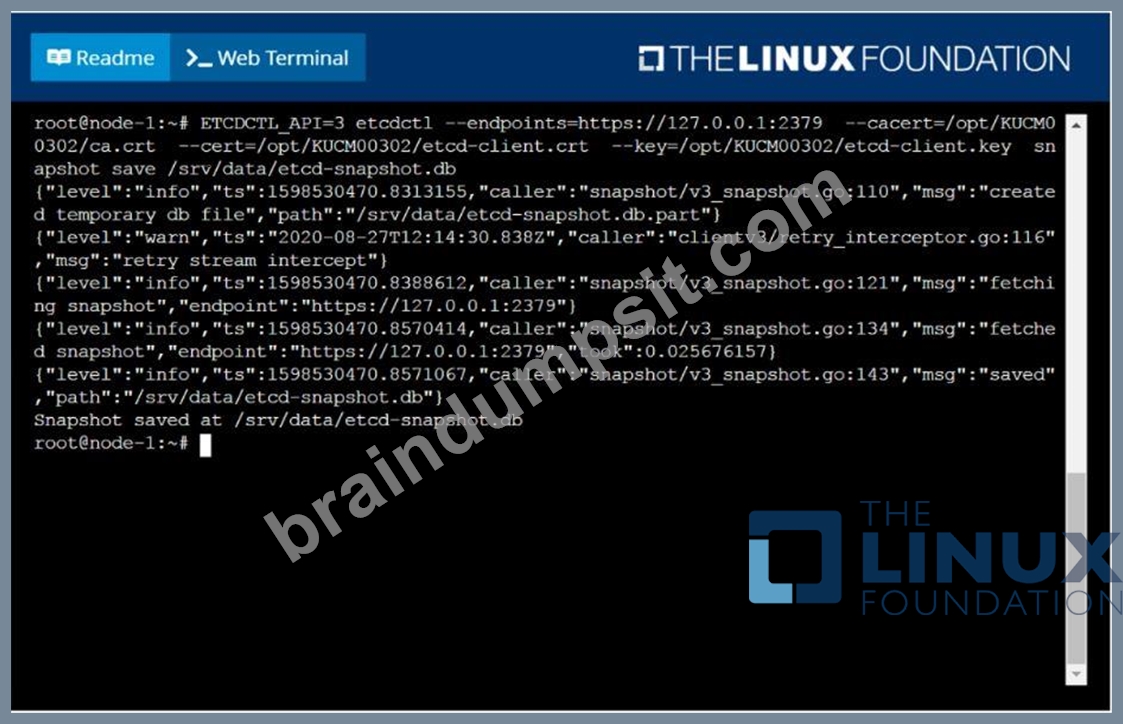
NEW QUESTION 13
List all service account and create a service account called "admin"
- A. kubectl get sa
kubectl get sa --all-namespaces
//Verify
kubectl get sa admin -o yaml - B. kubectl get sa
kubectl get sa --all-namespaces
kubectl create sa admin
//Verify
kubectl get sa admin -o yaml
Answer: B
NEW QUESTION 14
Create the service as type NodePort with the port 32767 for the nginx pod with the pod selector app: my-nginx
Answer:
Explanation:
kubectl run nginx --image=nginx --restart=Never -- labels=app=nginx --port=80 --dry-run -o yaml > nginx-pod.yaml
NEW QUESTION 15
Get all the pods with label "env"
Answer:
Explanation:
kubectl get pods -L env
NEW QUESTION 16
Scale the deployment from 5 replicas to 20 replicas and verify
Answer:
Explanation:
kubectl scale deploy webapp --replicas=20 kubectl get deploy webapp kubectl get po -l app=webapp
NEW QUESTION 17
Create a namespace called 'development' and a pod with image nginx called nginx on this namespace.
Answer:
Explanation:
kubectl create namespace development kubectl run nginx --image=nginx --restart=Never -n development
NEW QUESTION 18
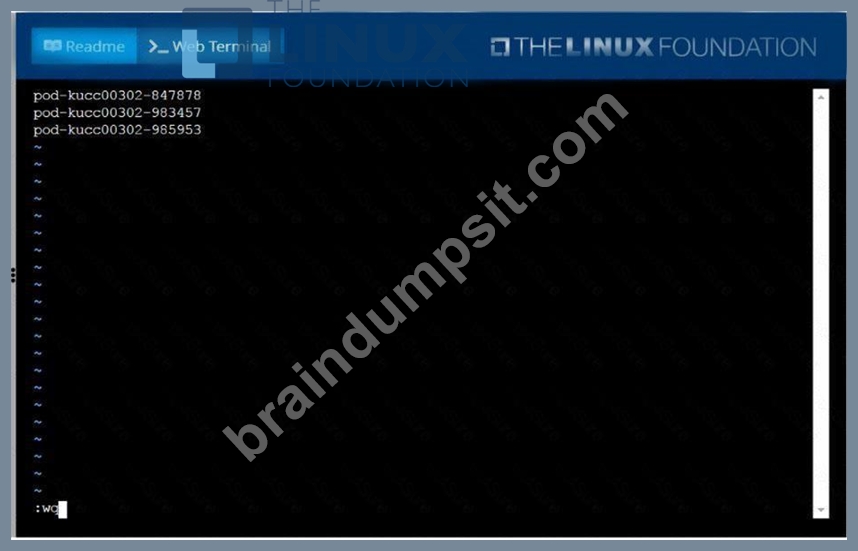
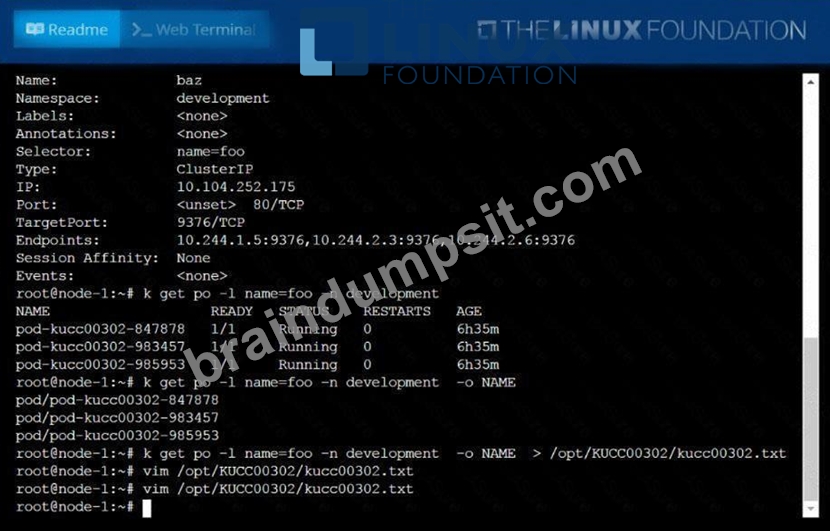
Create a file:
/opt/KUCC00302/kucc00302.txt that lists all pods that implement service in namespace development.
The format of the file should be one pod name per line.
Answer:
Explanation:
See the solution below.
Explanation
solution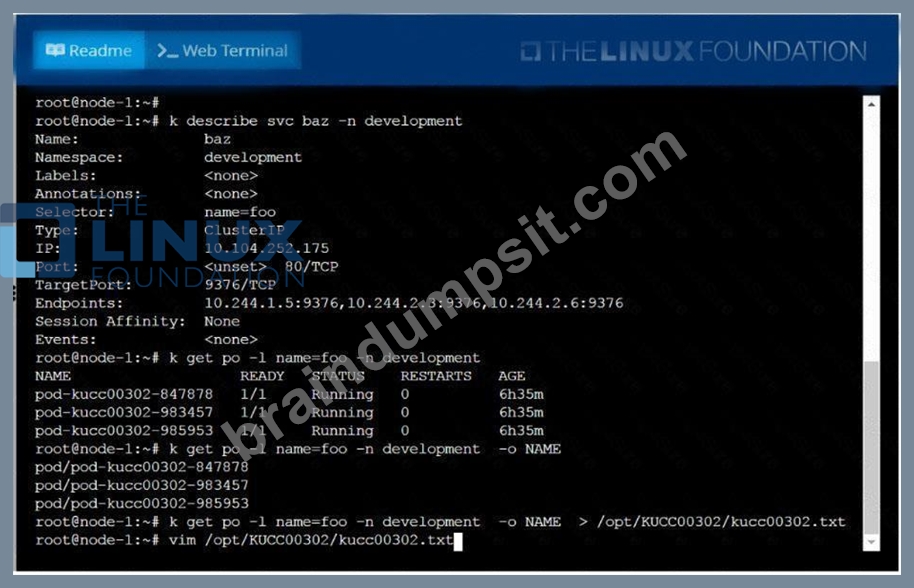
NEW QUESTION 19
What file type upload is supported as part of the basic WildFire service?
- A. PE
- B. VBS
- C. BAT
- D. ELF
Answer: A
NEW QUESTION 20
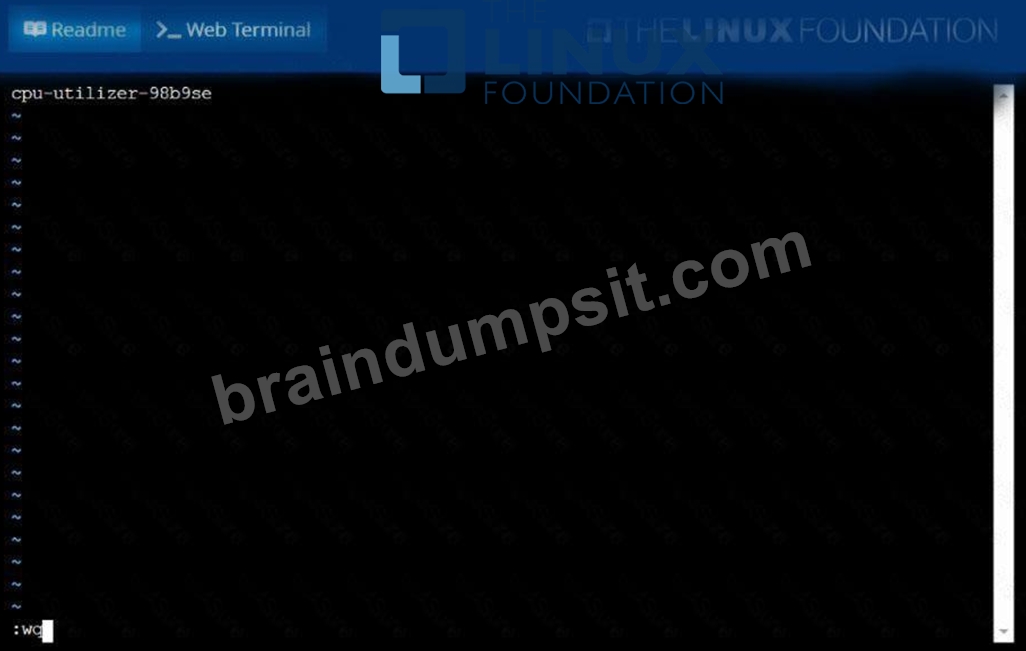
From the pod labelname=cpu-utilizer, find podsrunning high CPU workloads and write the name of the pod consumingmost CPU to thefile/opt/KUTR00102/KUTR00102.txt(which already exists).
Answer:
Explanation:
See the solution below.
Explanation
solution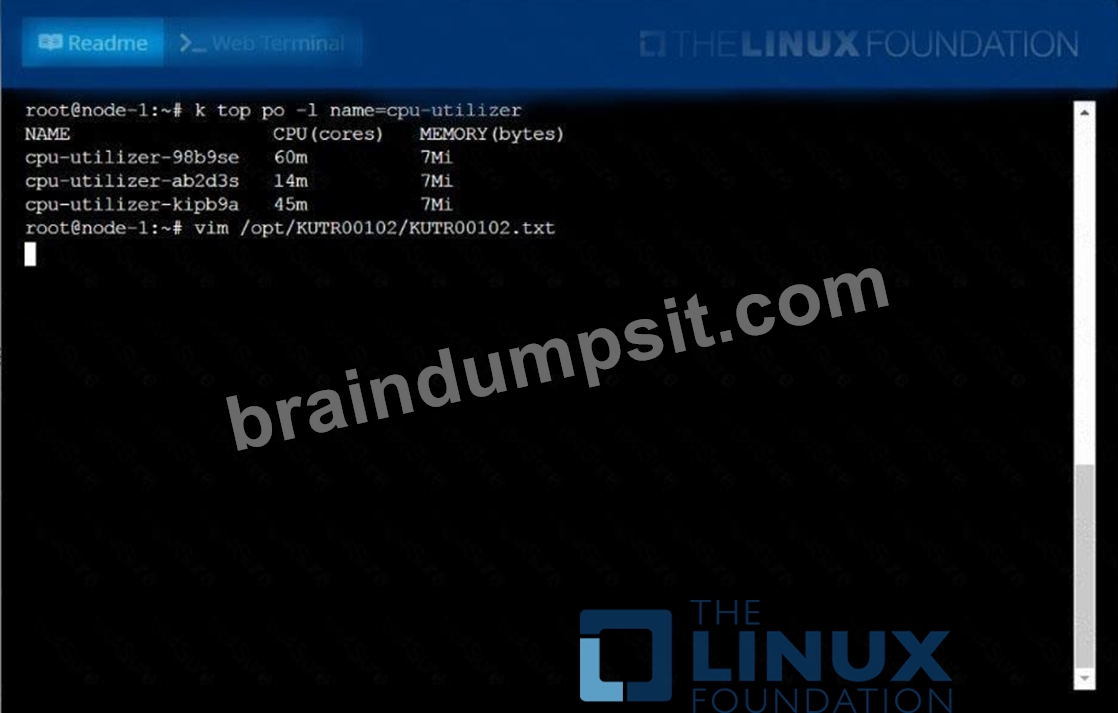
NEW QUESTION 21
List all the pods that are serviced by the service "webservice" and copy the output in /opt/$USER/webservice.targets Note: You need to list the endpoints
Answer:
Explanation:
kubectl descrive svc webservice | grep -i "Endpoints" > /opt/$USER/webservice.targets kubectl get endpoints webservice > /opt/$USER/webservice.targets
NEW QUESTION 22
Get IP address of the pod - "nginx-dev"
- A. Kubect1 get po -o wide
Using JsonPath
kubect1 get pods
.items[*]}{.metadata.name}{"\t"}{.status.podIP}{"\n"}{end}' - B. Kubect1 get po -o wide
Using JsonPath
kubect1 get pods -o=jsonpath='{range
.items[*]}{.metadata.name}{"\t"}{.status.podIP}{"\n"}{end}'
Answer: B
NEW QUESTION 23
Deploy a pod with image=redis on a node with label disktype=ssd
- A. // Get list of nodes
kubectl get nodes
//Get node with the label disktype=ssd
kubectl get no -l disktype=ssd
// Create a sample yaml file
kubectl run node-redis --generator=run-pod/v1 --image=redis --dry
run -o yaml > test-redis.yaml
// Edit test-redis.yaml file and add nodeSelector
vim test-redis.yaml
apiVersion: v1
- name: node-redis
image: redis
imagePullPolicy: IfNotPresent
kubectl apply -f test-redis.yaml
/ // Verify
K kubectl get po -o wide - B. // Get list of nodes
kubectl get nodes
//Get node with the label disktype=ssd
kubectl get no -l disktype=ssd
// Create a sample yaml file
kubectl run node-redis --generator=run-pod/v1 --image=redis --dry
run -o yaml > test-redis.yaml
// Edit test-redis.yaml file and add nodeSelector
vim test-redis.yaml
apiVersion: v1
kind: Pod
metadata:
name: redis
spec:
nodeSelector:
disktype: ssd
containers:
- name: node-redis
image: redis
imagePullPolicy: IfNotPresent
kubectl apply -f test-redis.yaml
/ // Verify
K kubectl get po -o wide
Answer: B
NEW QUESTION 24
Create a nginx pod with label env=test in engineering namespace
See the solution below.
- A. kubectl run nginx --image=nginx --restart=Never --labels=env=test --namespace=engineering --dry-run -o yaml > nginx-pod.yaml kubectl run nginx --image=nginx --restart=Never --labels=env=test --namespace=engineering --dry-run -o yaml | kubectl create -n engineering -f - YAML File:
apiVersion: v1
kind: Pod
metadata:
name: nginx
namespace: engineering
labels:
env: test
spec:
containers:
- name: nginx
image: nginx
imagePullPolicy: IfNotPresent
restartPolicy: Never
kubectl create -f nginx-pod.yaml - B. kubectl run nginx --image=nginx --restart=Never --labels=env=test --namespace=engineering --dry-run -o yaml > nginx-pod.yaml kubectl run nginx --image=nginx --restart=Never --labels=env=test --namespace=engineering --dry-run -o yaml | kubectl create -n engineering -f - YAML File:
apiVersion: v1
kind: Pod
metadata:
name: nginx
namespace: engineering
labels:
env: test
spec:
containers:
- name: nginx
image: nginx
imagePullPolicy: IfNotPresent
restartPolicy: Never
kubectl create -f nginx-pod.yaml
Answer: B
NEW QUESTION 25
Check to see how many worker nodes are ready (not including nodes tainted NoSchedule) and write the number to /opt/KUCC00104/kucc00104.txt.
Answer:
Explanation:
See the solution below.
Explanation
solution
F:\Work\Data Entry Work\Data Entry\20200827\CKA\15 B.JPG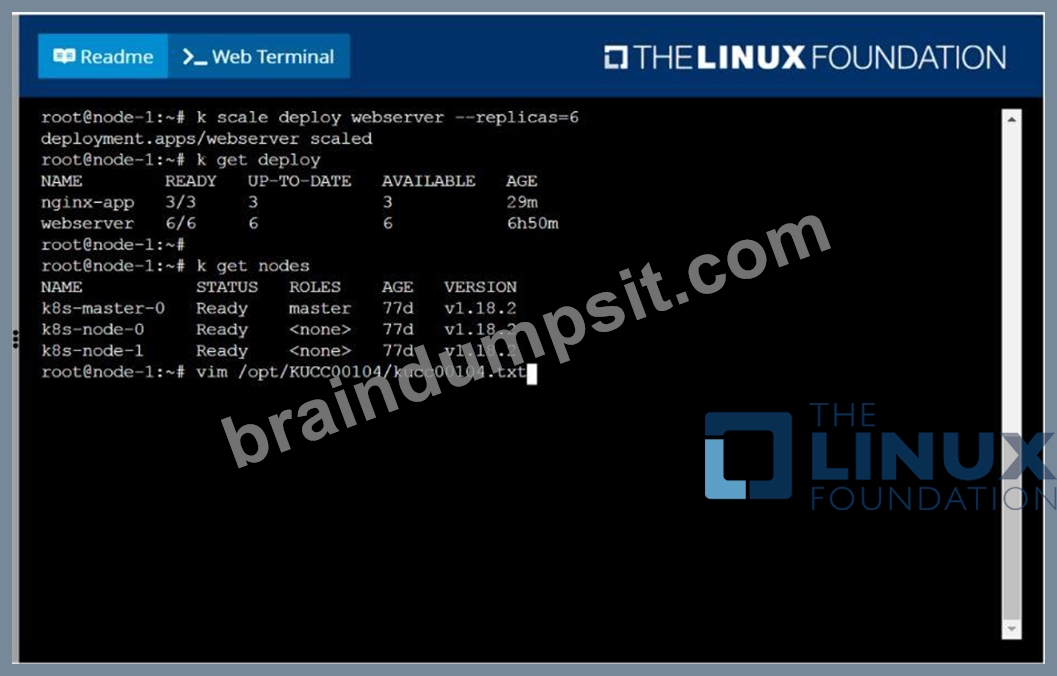
F:\Work\Data Entry Work\Data Entry\20200827\CKA\15 C.JPG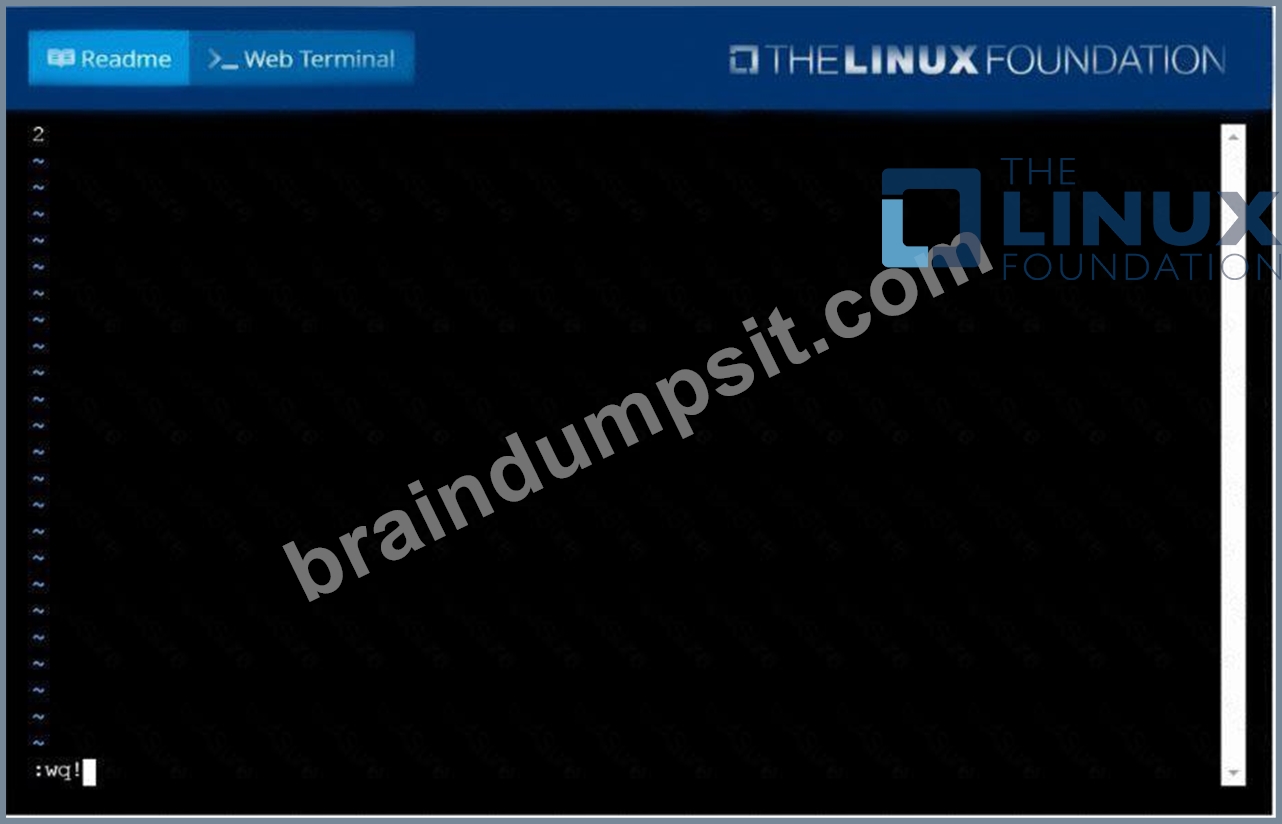
NEW QUESTION 26
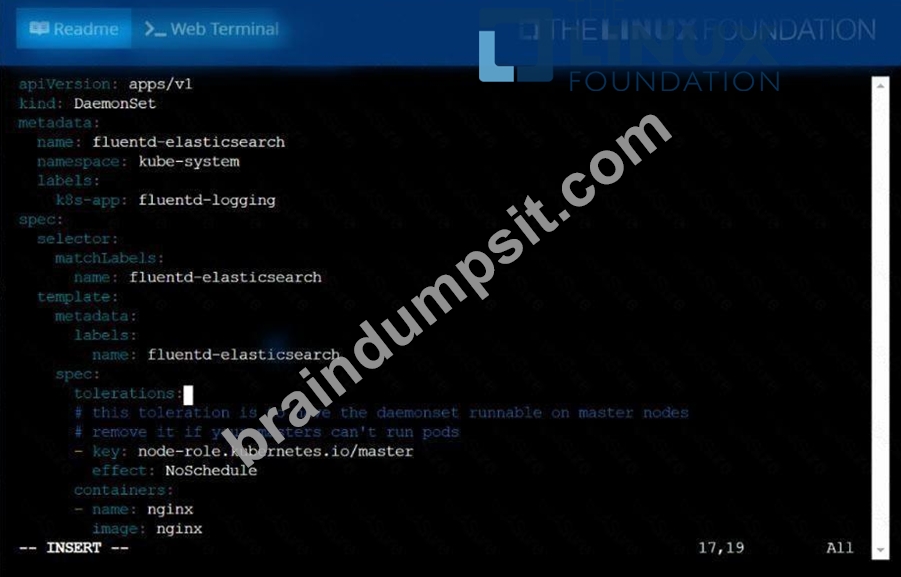
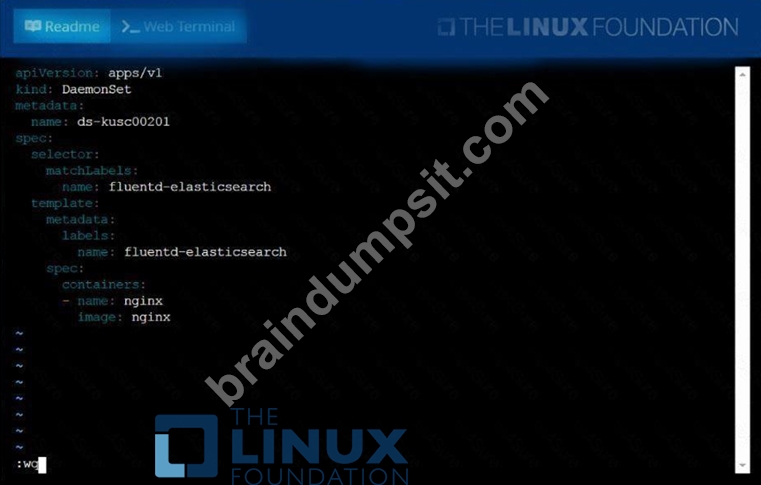
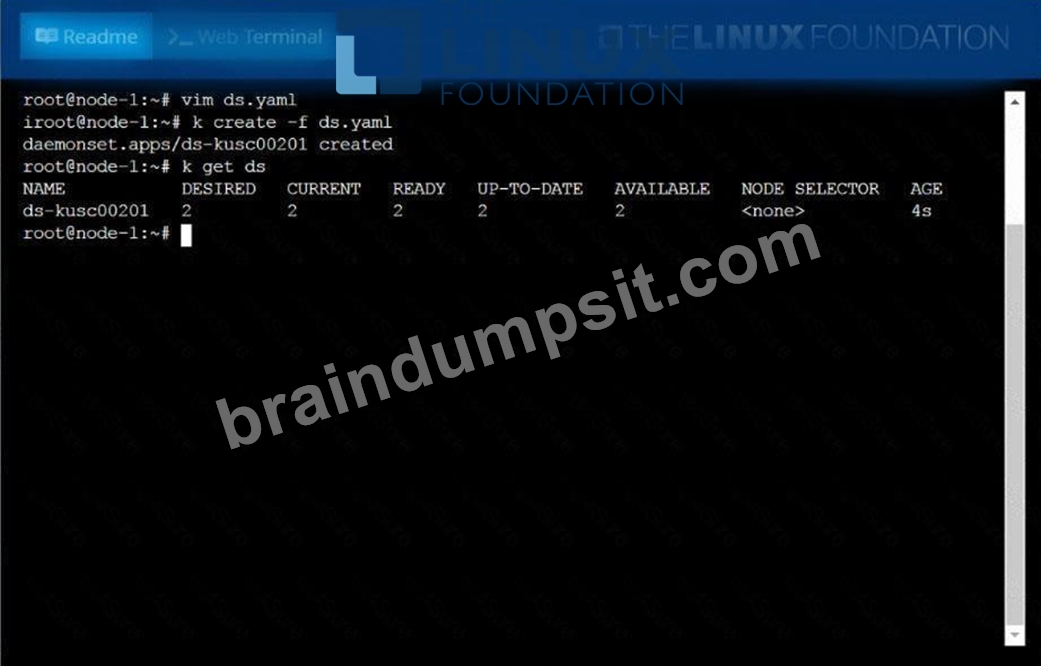
Ensure a single instance of podnginxis running on each node of theKubernetes cluster wherenginxalso represents the Image name whichhas to be used. Do not override anytaints currently in place.
UseDaemonSetto complete thistask and useds-kusc00201asDaemonSet name.
Answer:
Explanation:
See the solution below.
Explanation
solution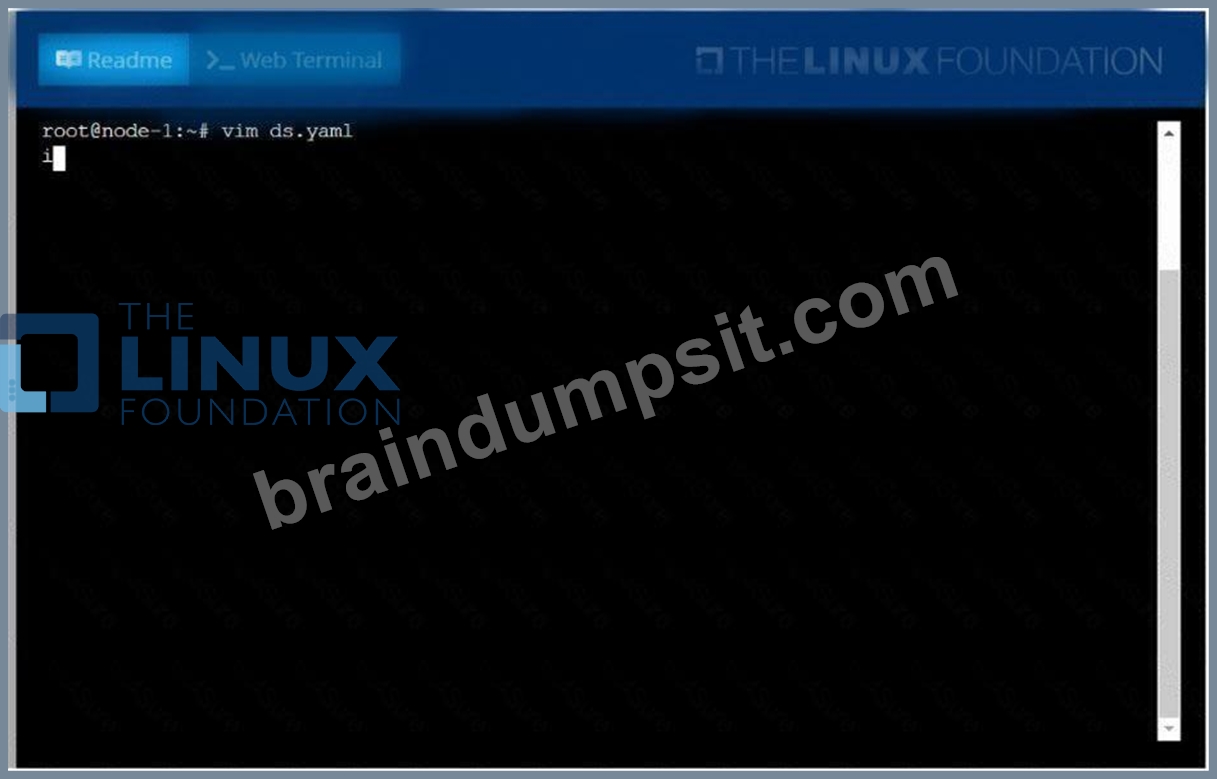
NEW QUESTION 27
To protect your firewall and network from single source denial of service (DoS) attacks that can overwhelm its packet buffer and cause legitimate traffic to drop, you can configure:
- A. PGP (Packet Gateway Protocol)
- B. PBP (Packet Buffer Protection)
- C. PBP (Protocol Based Protection)
- D. BGP (Border Gateway Protocol)
Answer: C
NEW QUESTION 28
Score: 4%
Context
You have been asked to create a new ClusterRole for a deployment pipeline and bind it to a specific ServiceAccount scoped to a specific namespace.
Task
Create a new ClusterRole named deployment-clusterrole, which only allows to create the following resource types:
* Deployment
* StatefulSet
* DaemonSet
Create a new ServiceAccount named cicd-token in the existing namespace app-team1.
Bind the new ClusterRole deployment-clusterrole lo the new ServiceAccount cicd-token , limited to the namespace app-team1.
Answer:
Explanation:
See the solution below.
Explanation
Solution:
Task should be complete on node -1 master, 2 worker for this connect use command
[student@node-1] > ssh k8s
kubectl create clusterrole deployment-clusterrole --verb=create
--resource=deployments,statefulsets,daemonsets
kubectl create serviceaccount cicd-token --namespace=app-team1
kubectl create rolebinding deployment-clusterrole --clusterrole=deployment-clusterrole
--serviceaccount=default:cicd-token --namespace=app-team1
NEW QUESTION 29
Create a PersistentVolumeClaim of at least 3Gi storage and access mode ReadWriteOnce and verify status is Bound
- A. vim task-pv-claim.yaml
apiVersion: v2
kind: PersistentVolumeClaim
metadata:
name: task-pv-claim
spec:
storageClassName: ""
accessModes:
- ReadWriteOnce
resources:
requests:
storage: 4Gi
kubectl apply -f task-pv-claim.yaml
//Verify
kubectl get pv
NAME CAPACITY ACCESS
MODES RECLAIM POLICY STATUS CLAIM
STORAGECLASS REASON AGE
task-pv-volume 4Gi RWO
Retain Bound default/task-pv-claim
6m16s
kubectl get pvc
NAME STATUS VOLUME
CAPACITY ACCESS MODES STORAGECLASS AGE
task-pv-claim Bound task-pv-volume
5Gi RWO 6s - B. vim task-pv-claim.yaml
apiVersion: v1
kind: PersistentVolumeClaim
metadata:
name: task-pv-claim
spec:
storageClassName: ""
accessModes:
- ReadWriteOnce
resources:
requests:
storage: 3Gi
kubectl apply -f task-pv-claim.yaml
//Verify
kubectl get pv
NAME CAPACITY ACCESS
MODES RECLAIM POLICY STATUS CLAIM
STORAGECLASS REASON AGE
task-pv-volume 5Gi RWO
Retain Bound default/task-pv-claim
6m16s
kubectl get pvc
NAME STATUS VOLUME
CAPACITY ACCESS MODES STORAGECLASS AGE
task-pv-claim Bound task-pv-volume
5Gi RWO 6s
Answer: B
NEW QUESTION 30
For this item, you will havetosshto the nodesik8s-master-0andik8s-node-0and complete all tasks on thesenodes. Ensure that you return tothe base node (hostname:node-1) when you havecompleted this item.
Context
As an administrator of a smalldevelopment team, you have beenasked to set up a Kubernetes clusterto test the viability of a newapplication.
Task
You must usekubeadmto performthis task. Anykubeadminvocationswill require the use of the
--ignore-preflight-errors=alloption.
* Configure thenodeik8s-master-Oas a masternode. .
* Join the nodeik8s-node-otothe cluster.
Answer:
Explanation:
See the solution below.
Explanation
solution
You must use thekubeadmconfiguration file located at when initializingyour cluster.
You may use any CNI pluginto complete this task, but ifyou don't have your favouriteCNI plugin's manifest URL athand, Calico is one popularoption:https://docs.projectcalico.org/v3.14/manifests/calico.yaml Docker is already installedon both nodes and hasbeen configured so that you caninstall the required tools.
NEW QUESTION 31
List pod logs named "frontend" and search for the pattern "started" and write it to a file "/opt/error-logs"
Answer:
Explanation:
See the solution below.
Explanation
Kubectl logs frontend | grep -i "started" > /opt/error-logs
NEW QUESTION 32
Get list of all the pods showing name and namespace with a jsonpath expression.
Answer:
Explanation:
See the solution below.
Explanation
kubectl get pods -o=jsonpath="{.items[*]['metadata.name'
, 'metadata.namespace']}"
NEW QUESTION 33
Create a file:
/opt/KUCC00302/kucc00302.txt that lists all pods that implement service baz in namespace development.
The format of the file should be one pod name per line.
Answer:
Explanation:
See the solution below.
Explanation
solution
F:\Work\Data Entry Work\Data Entry\20200827\CKA\11 B.JPG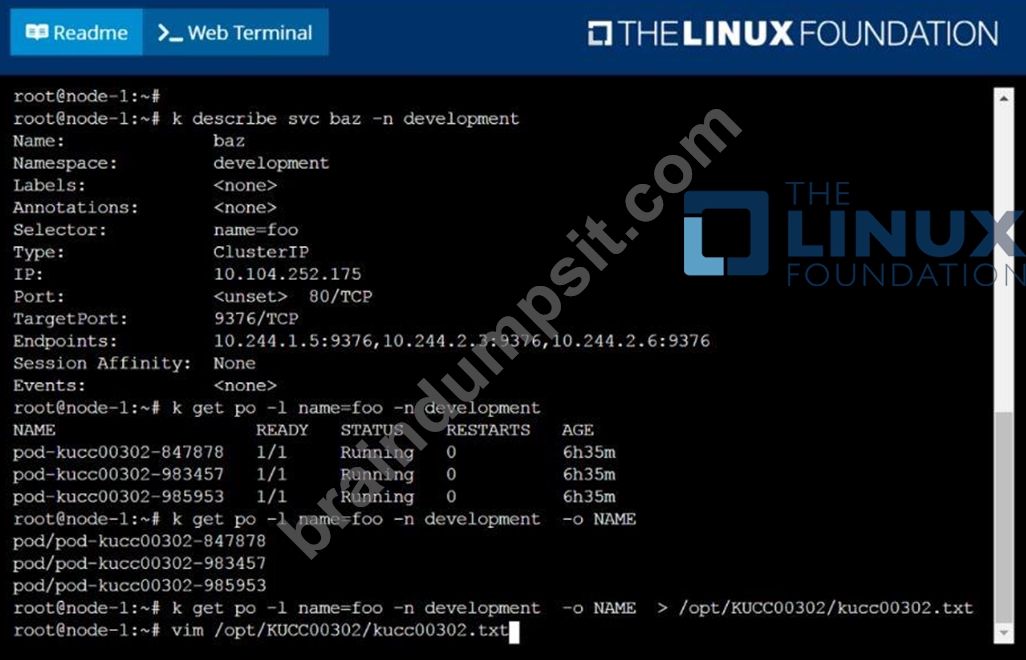
F:\Work\Data Entry Work\Data Entry\20200827\CKA\11 C.JPG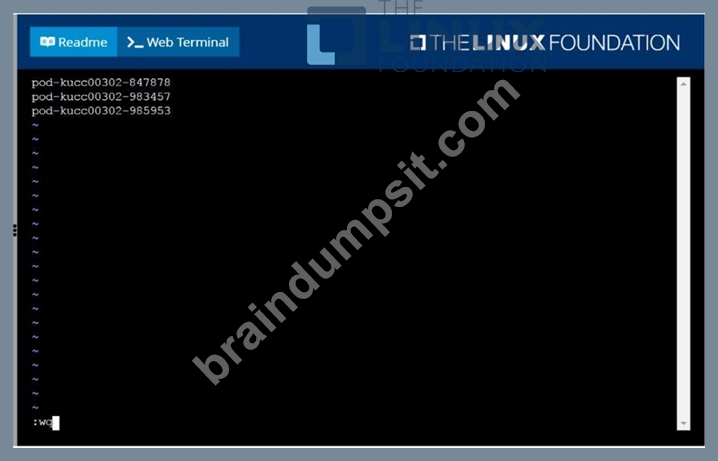
F:\Work\Data Entry Work\Data Entry\20200827\CKA\11 D.JPG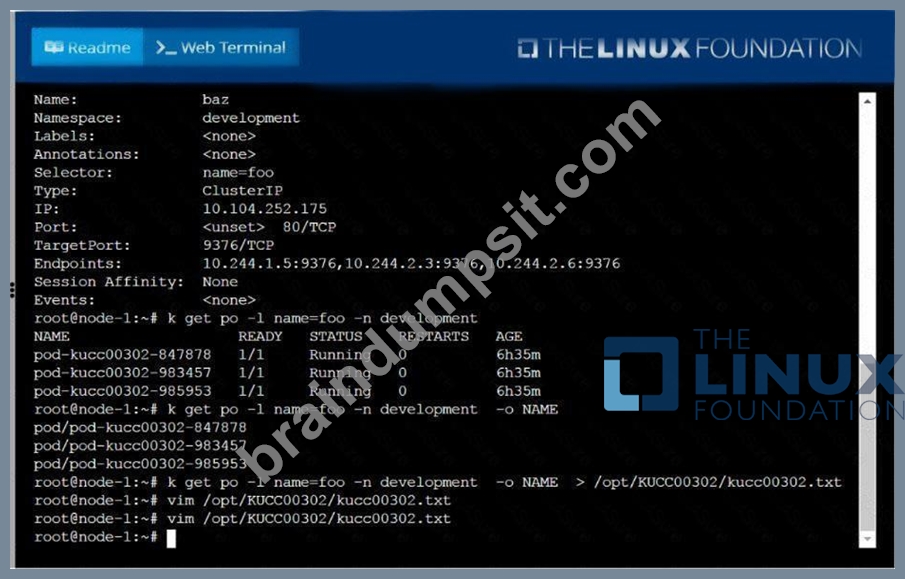
NEW QUESTION 34
List all the pods showing name and namespace with a json path expression
Answer:
Explanation:
See the solution below.
Explanation
kubectl get pods -o=jsonpath="{.items[*]['metadata.name',
'metadata.namespace']}"
NEW QUESTION 35
Create a pod as follows:
Name: mongo
Using Image: mongo
In a new Kubernetes namespace named: my-website
Answer:
Explanation:
See the solution below.
Explanation
solution
F:\Work\Data Entry Work\Data Entry\20200827\CKA\9 B.JPG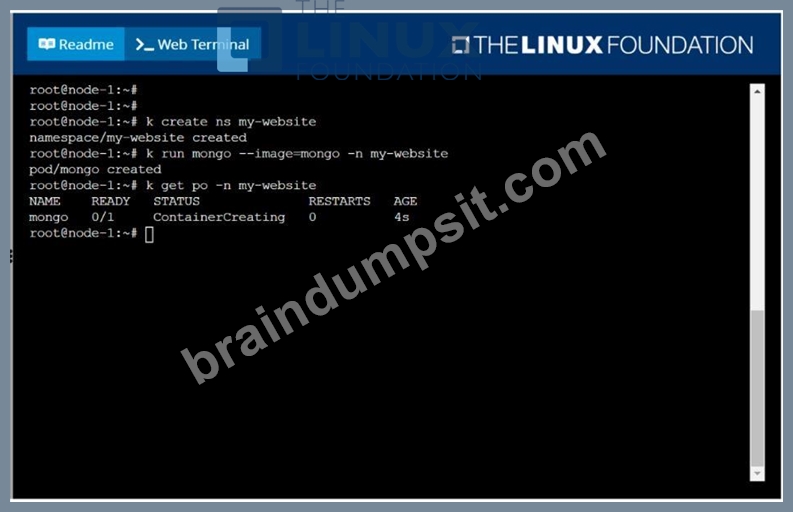
NEW QUESTION 36
Check the image version in pod without the describe command
Answer:
Explanation:
kubectl get po nginx -o jsonpath='{.spec.containers[].image}{"\n"}'
NEW QUESTION 37
......
Objective of CNCF CKA Certification Exam
The CNCF Certified Kubernetes Administrator exam tests knowledge on deploying, managing, and troubleshooting applications on Kubernetes clusters. Software engineers will need to understand key concepts of Kubernetes in order to pass the CNCF Certified Kubernetes Administrator exam. Files and containers running on the cluster will be managed by Kubernetes using its object-store. Understand key features of Kubernetes and how it is a paradigm shift in the way software engineers manage containerized applications. Learning about Kubernetes will be crucial for passing the CNCF Certified Kubernetes Administrator exam. Highly recommended to check out the official study guide. Technical manuals and practice questions can be found on the website. Functional knowledge of Kubernetes is crucial for passing the CNCF Certified Kubernetes Administrator exam.
Linux Foundation CKA Dumps - Secret To Pass in First Attempt: https://www.braindumpsit.com/CKA_real-exam.html
CKA Practice Test Questions Updated 63 Questions: https://drive.google.com/open?id=1OV1xhSE-hJhanC9RrlgPz2_frenprz2r