


[Jun 25, 2023] Professional-Cloud-Architect Dumps Full Questions - Exam Study Guide
Google Cloud Certified Free Certification Exam Material from BraindumpsIT with 262 Questions
The benefit of obtaining the Google Professional Cloud Architect Exam Certification
- Google Professional Cloud Architect will be confident and stand different from others as their skills are more trained than non-certified professionals.
- Google Professional Cloud Architect Certification is distinguished among competitors. Google Professional Cloud Architect certification can give them an edge at that time easily when candidates appear for employment interview, employers are very fascinated to note one thing that differentiates the individual from all other candidates.
- Google Professional Cloud Architect Certifications provide opportunities to get a job easily in which they are interested in instead of wasting years and ending without getting any experience.
- Google Professional Cloud Architect Exam provide proven knowledge to use the tools to complete the task efficiently and cost effectively than the other non-certified professionals lack in doing so.
NEW QUESTION # 87 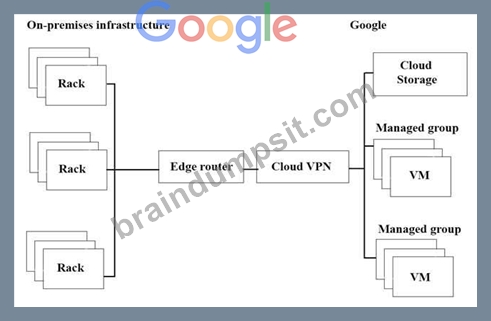
The migration of JencoMart's application to Google Cloud Platform (GCP) is progressing too slowly. The infrastructure is shown in the diagram. You want to maximize throughput.
What are three potential bottlenecks? (Choose three.)
- A. A single VPN tunnel, which limits throughput
- B. Complicated internet connectivity between the on-premises infrastructure and GCP
- C. A separate storage layer outside the VMs, which is not suited for this task
- D. Fewer virtual machines (VMs) in GCP than on-premises machines
- E. A copy command that is not suited to operate over long distances
- F. A tier of Google Cloud Storage that is not suited for this task
Answer: A,C,E
NEW QUESTION # 88
Your company is moving 75 TB of data into Google Cloud. You want to use Cloud Storage and follow Googlerecommended practices. What should you do?
- A. Move your data onto a Transfer Appliance. Use Cloud Dataprep to decrypt the data into Cloud Storage.
- B. Move your data onto a Transfer Appliance. Use a Transfer Appliance Rehydrator to decrypt the data into Cloud Storage.
- C. Install gsutil on each server that contains data. Use resumable transfers to upload the data into Cloud Storage.
- D. Install gsutil on each server containing data. Use streaming transfers to upload the data into Cloud Storage.
Answer: B
Explanation:
https://cloud.google.com/transfer-appliance/docs/2.0/faq
NEW QUESTION # 89
You are developing a globally scaled frontend for a legacy streaming backend data API. This API expects events in strict chronological order with no repeat data for proper processing.
Which products should you deploy to ensure guaranteed-once FIFO (first-in, first-out) delivery of data?
- A. Cloud Pub/Sub to Cloud DataFlow
- B. Cloud Pub/Sub to Cloud SQL
- C. Cloud Pub/Sub to Stackdriver
- D. Cloud Pub/Sub alone
Answer: B
Explanation:
Explanation/Reference:
Reference https://cloud.google.com/pubsub/docs/ordering
NEW QUESTION # 90
A recent audit that a new network was created in Your GCP project. In this network, a GCE instance has an SSH port open the world. You want to discover this network's origin. What should you do?
- A. Navigate to the Activity page in the Home section. Set category to Data Access and search for Create VM entry.
- B. In the logging section of the console, specify GCE Network as the logging section. Search for the Create Insert entry.
- C. Connect to the GCE instance using project SSH Keys. Identify previous logins in system logs, and match these with the project owners list.
- D. Search for Create VM entry in the Stackdriver alerting console.
Answer: B
Explanation:
Incorrect Answers:
A: To use the Stackdriver alerting console we must first set up alerting policies.
B: Data access logs only contain read-only operations.
Audit logs help you determine who did what, where, and when.
Cloud Audit Logging returns two types of logs:
NEW QUESTION # 91
You are helping the QA team to roll out a new load-testing tool to test the scalability of your primary cloud services that run on Google Compute Engine with Cloud Bigtable. Which three requirements should they include? Choose 3 answers
- A. Instrument the load-testing tool and the target services with detailed logging and metrics collection.
- B. Create a separate Google Cloud project to use for the load-testing environment.
- C. Ensure all third-party systems your services use are capable of handling high load.
- D. Instrument the production services to record every transaction for replay by the load- testing tool.
- E. Ensure that the load tests validate the performance of Cloud Bigtable.
- F. Schedule the load-testing tool to regularly run against the production environment.
Answer: A,C,E
NEW QUESTION # 92
You deploy your custom Java application to Google App Engine. It fails to deploy and gives you the following stack trace.
What should you do?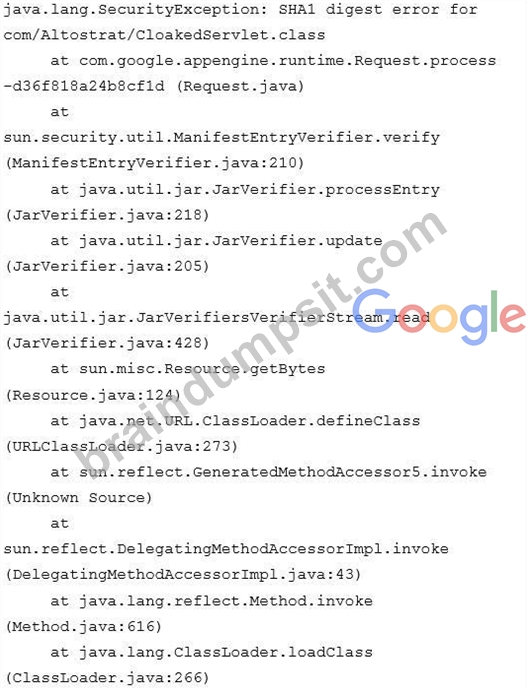
- A. Digitally sign all of your JAR files and redeploy your application
- B. Upload missing JAR files and redeploy your application.
- C. Recompile the CLoakedServlet class using and MD5 hash instead of SHA1
Answer: A
NEW QUESTION # 93
Your company's user-feedback portal comprises a standard LAMP stack replicated across two zones. It is deployed in the us-central1 region and uses autoscaled managed instance groups on all layers, except the database. Currently, only a small group of select customers have access to the portal. The portal meets a 99,99% availability SLA under these conditions. However next quarter, your company will be making the portal available to all users, including unauthenticated users. You need to develop a resiliency testing strategy to ensure the system maintains the SLA once they introduce additional user load.
What should you do?
- A. Create synthetic random user input, replay synthetic load until autoscale logic is triggered on at least one layer, and introduce "chaos" to the system by terminating random resources on both zones
- B. Expose the new system to a larger group of users, and increase group size each day until autoscale logic is triggered on all layers. At the same time, terminate random resources on both zones
- C. Capture existing users input, and replay captured user load until resource utilization crosses 80%.
Also, derive estimated number of users based on existing user's usage of the app, and deploy enough resources to handle 200% of expected load - D. Capture existing users input, and replay captured user load until autoscale is triggered on all layers. At the same time, terminate all resources in one of the zones
Answer: C
NEW QUESTION # 94
Case Study: 3 - JencoMart Case Study
Company Overview
JencoMart is a global retailer with over 10,000 stores in 16 countries. The stores carry a range of goods, such as groceries, tires, and jewelry. One of the company's core values is excellent customer service. In addition, they recently introduced an environmental policy to reduce their carbon output by 50% over the next 5 years.
Company Background
JencoMart started as a general store in 1931, and has grown into one of the world's leading brands known for great value and customer service. Over time, the company transitioned from only physical stores to a stores and online hybrid model, with 25% of sales online. Currently, JencoMart has little presence in Asia, but considers that market key for future growth.
Solution Concept
JencoMart wants to migrate several critical applications to the cloud but has not completed a technical review to determine their suitability for the cloud and the engineering required for migration. They currently host all of these applications on infrastructure that is at its end of life and is no longer supported.
Existing Technical Environment
JencoMart hosts all of its applications in 4 data centers: 3 in North American and 1 in Europe, most applications are dual-homed.
JencoMart understands the dependencies and resource usage metrics of their on-premises architecture.
Application Customer loyalty portal
LAMP (Linux, Apache, MySQL and PHP) application served from the two JencoMart-owned U.S.
data centers.
Database
* Oracle Database stores user profiles



* PostgreSQL database stores user credentials
-homed in US West


service level agreement (SLA)

Authenticates all users
Compute
* 30 machines in US West Coast, each machine has:


* 20 machines in US East Coast, each machine has:
-core CPU

Storage
* Access to shared 100 TB SAN in each location
* Tape backup every week
Business Requirements
* Optimize for capacity during peak periods and value during off-peak periods
* Guarantee service availably and support
* Reduce on-premises footprint and associated financial and environmental impact.
* Move to outsourcing model to avoid large upfront costs associated with infrastructure purchase
* Expand services into Asia.
Technical Requirements
* Assess key application for cloud suitability.
* Modify application for the cloud.
* Move applications to a new infrastructure.
* Leverage managed services wherever feasible
* Sunset 20% of capacity in existing data centers
* Decrease latency in Asia
CEO Statement
JencoMart will continue to develop personal relationships with our customers as more people access the web. The future of our retail business is in the global market and the connection between online and in-store experiences. As a large global company, we also have a responsibility to the environment through 'green' initiatives and polices.
CTO Statement
The challenges of operating data centers prevents focus on key technologies critical to our long- term success. Migrating our data services to a public cloud infrastructure will allow us to focus on big data and machine learning to improve our service customers.
CFO Statement
Since its founding JencoMart has invested heavily in our data services infrastructure. However, because of changing market trends, we need to outsource our infrastructure to ensure our long- term success. This model will allow us to respond to increasing customer demand during peak and reduce costs.
For this question, refer to the JencoMart case study.
JencoMart has decided to migrate user profile storage to Google Cloud Datastore and the application servers to Google Compute Engine (GCE). During the migration, the existing infrastructure will need access to Datastore to upload the data. What service account key- management strategy should you recommend?
- A. Deploy a custom authentication service on GCE/Google Container Engine (GKE) for the on- premises infrastructure and use GCP managed keys for the VMs.
- B. Provision service account keys for the on-premises infrastructure and for the GCE virtual machines (VMs).
- C. Authenticate the on-premises infrastructure with a user account and provision service account keys for the VMs.
- D. Provision service account keys for the on-premises infrastructure and use Google Cloud Platform (GCP) managed keys for the VMs
Answer: B
Explanation:
A) (correct answer) This addresses both of data migration and application server migration properly.
"Provision service account keys for the on-premises infrastructure": For code running on systems outside Google, you cannot use GCP-managed keys. You need to create Service account for it and provision User-managed keys. These keys are created, downloadable, and managed by users - This is solution for on-premises access to GCP datastore during migration
"use Google Cloud Platform (GCP) managed keys for the VMs" - this is solution for Application server migration since there is no external access to GCP is required during the migration.
Answer B is incorrect: First, the applications running on-premises to access GCP Datastore assume the identity of the service account to call Google APIs, so that the users aren't directly involved.
Secondly, for the application server migration to GCP VMs, you can use GCP managed keys for the VMs. It's simple and effective. There is no need to provision and manage keys (User- managed keys) by yourself for the VMs.
GCP-managed keys are used by Cloud Platform services such as App Engine and Compute Engine. These keys cannot be downloaded. Google will keep the keys and automatically rotate them on an approximately weekly basis.
C) is incorrect in the solution for on-premises access to GCP Datastore - This is possible options that might require more setup than worthwhile for the requirements.
D) is incorrect for reason of application server migration: you can use GCP managed keys for the VMs. It's simple and effective. There is no need to provision and manage keys (User-managed keys) by yourself for the application VMs
NEW QUESTION # 95
For this question, refer to the JencoMart case study.
The migration of JencoMart's application to Google Cloud Platform (GCP) is progressing too slowly. The infrastructure is shown in the diagram. You want to maximize throughput. What are three potential bottlenecks? (Choose 3 answers.)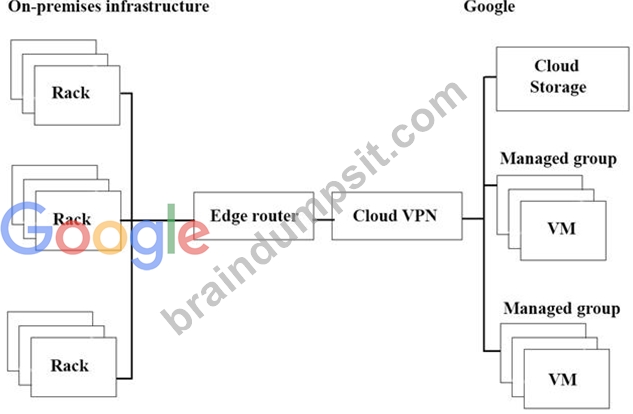
- A. A single VPN tunnel, which limits throughput
- B. Complicated internet connectivity between the on-premises infrastructure and GCP
- C. A separate storage layer outside the VMs, which is not suited for this task
- D. Fewer virtual machines (VMs) in GCP than on-premises machines
- E. A copy command that is not suited to operate over long distances
- F. A tier of Google Cloud Storage that is not suited for this task
Answer: A,C,E
NEW QUESTION # 96
Your company has decided to build a backup replica of their on-premises user authentication PostgreSQL database on Google Cloud Platform. The database is 4 TB, and large updates are frequent. Replication requires private address space communication. Which networking approach should you use?
- A. Google Cloud Dedicated Interconnect
- B. Google Cloud VPN connected to the data center network
- C. A NAT and TLS translation gateway installed on-premises
- D. A Google Compute Engine instance with a VPN server installed connected to the data center network
Answer: A
Explanation:
Google Cloud Dedicated Interconnect provides direct physical connections and RFC 1918 communication between your on-premises network and Google's network. Dedicated Interconnect enables you to transfer large amounts of data between networks, which can be more cost effective than purchasing additional bandwidth over the public Internet or using VPN tunnels.
Benefits:
Traffic between your on-premises network and your VPC network doesn't traverse the public
Internet. Traffic traverses a dedicated connection with fewer hops, meaning there are less points of failure where traffic might get dropped or disrupted.
Your VPC network's internal (RFC 1918) IP addresses are directly accessible from your on-
premises network. You don't need to use a NAT device or VPN tunnel to reach internal IP addresses. Currently, you can only reach internal IP addresses over a dedicated connection.
To reach Google external IP addresses, you must use a separate connection.
You can scale your connection to Google based on your needs. Connection capacity is
delivered over one or more 10 Gbps Ethernet connections, with a maximum of eight connections (80 Gbps total per interconnect).
The cost of egress traffic from your VPC network to your on-premises network is reduced. A
dedicated connection is generally the least expensive method if you have a high-volume of traffic to and from Google's network.
References: https://cloud.google.com/interconnect/docs/details/dedicated
NEW QUESTION # 97
You have an outage in your Compute Engine managed instance group: all instance keep restarting after 5 seconds. You have a health check configured, but autoscaling is disabled. Your colleague, who is a Linux expert, offered to look into the issue. You need to make sure that he can access the VMs. What should you do?
- A. Disable the health check for the instance group. Add his SSH key to the project-wide SSH keys
- B. Disable autoscaling for the instance group. Add his SSH key to the project-wide SSH Keys
- C. Grant your colleague the IAM role of project Viewer
- D. Perform a rolling restart on the instance group
Answer: A
NEW QUESTION # 98
You want to establish a Compute Engine application in a single VPC across two regions. The application must communicate over VPN to an on-premises network. How should you deploy the VPN?
- A. Use VPC Network Peering between the VPC and the on-premises network.
- B. Expose the VPC to the on-premises network using IAM and VPC Sharing.
- C. Create a global Cloud VPN Gateway with VPN tunnels from each region to the on-premises peer gateway.
- D. Deploy Cloud VPN Gateway in each region. Ensure that each region has at least one VPN tunnel to the on-premises peer gateway.
Answer: C
Explanation:
Reference:
https://cloud.google.com/vpn/docs/how-to/creating-static-vpns
NEW QUESTION # 99
You are designing a mobile chat application. You want to ensure people cannot spoof chat messages, by providing a message were sent by a specific user.
What should you do
- A. Encrypt the message client side using block-based encryption with a shared key.
- B. Use public key infrastructure (PKI) to encrypt the message client side using the originating user's private key.
- C. Use a trusted certificate authority to enable SSL connectivity between the client application and the server.
- D. Tag messages client side with the originating user identifier and the destination user.
Answer: C
Explanation:
Explanation
Encrypting each block and tagging each message at the client side is an overhead on the application. Best method which has been adopted since years is contacting the SSL provider and use the public certificate to encrypt the traffic between client and the server.
NEW QUESTION # 100
You are migrating your on-premises solution to Google Cloud in several phases. You will use Cloud VPN to maintain a connection between your on-premises systems and Google Cloud until the migration is completed.
You want to make sure all your on-premises systems remain reachable during this period. How should you organize your networking in Google Cloud?
- A. Use the same IP range on Google Cloud as you use on-premises
- B. Use an IP range on Google Cloud that does not overlap with the range you use on-premises
- C. Use an IP range on Google Cloud that does not overlap with the range you use on-premises for your primary IP range and use a secondary range with the same IP range as you use on-premises
- D. Use the same IP range on Google Cloud as you use on-premises for your primary IP range and use a secondary range that does not overlap with the range you use on-premises
Answer: C
NEW QUESTION # 101
Case Study: 3 - JencoMart Case Study
Company Overview
JencoMart is a global retailer with over 10,000 stores in 16 countries. The stores carry a range of goods, such as groceries, tires, and jewelry. One of the company's core values is excellent customer service. In addition, they recently introduced an environmental policy to reduce their carbon output by 50% over the next 5 years.
Company Background
JencoMart started as a general store in 1931, and has grown into one of the world's leading brands known for great value and customer service. Over time, the company transitioned from only physical stores to a stores and online hybrid model, with 25% of sales online. Currently, JencoMart has little presence in Asia, but considers that market key for future growth.
Solution Concept
JencoMart wants to migrate several critical applications to the cloud but has not completed a technical review to determine their suitability for the cloud and the engineering required for migration. They currently host all of these applications on infrastructure that is at its end of life and is no longer supported.
Existing Technical Environment
JencoMart hosts all of its applications in 4 data centers: 3 in North American and 1 in Europe, most applications are dual-homed.
JencoMart understands the dependencies and resource usage metrics of their on-premises architecture.
Application Customer loyalty portal
LAMP (Linux, Apache, MySQL and PHP) application served from the two JencoMart-owned U.S.
data centers.
Database
* Oracle Database stores user profiles
* PostgreSQL database stores user credentials
-homed in US West
Authenticates all users
Compute
* 30 machines in US West Coast, each machine has:
HDD (RAID 1)
* 20 machines in US East Coast, each machine has:
-core CPU
Storage
* Access to shared 100 TB SAN in each location
* Tape backup every week
Business Requirements
* Optimize for capacity during peak periods and value during off-peak periods
* Guarantee service availably and support
* Reduce on-premises footprint and associated financial and environmental impact.
* Move to outsourcing model to avoid large upfront costs associated with infrastructure purchase
* Expand services into Asia.
Technical Requirements
* Assess key application for cloud suitability.
* Modify application for the cloud.
* Move applications to a new infrastructure.
* Leverage managed services wherever feasible
* Sunset 20% of capacity in existing data centers
* Decrease latency in Asia
CEO Statement
JencoMart will continue to develop personal relationships with our customers as more people access the web. The future of our retail business is in the global market and the connection between online and in-store experiences. As a large global company, we also have a responsibility to the environment through 'green' initiatives and polices.
CTO Statement
The challenges of operating data centers prevents focus on key technologies critical to our long- term success. Migrating our data services to a public cloud infrastructure will allow us to focus on big data and machine learning to improve our service customers.
CFO Statement
Since its founding JencoMart has invested heavily in our data services infrastructure. However, because of changing market trends, we need to outsource our infrastructure to ensure our long- term success. This model will allow us to respond to increasing customer demand during peak and reduce costs.
For this question, refer to the JencoMart case study
A few days after JencoMart migrates the user credentials database to Google Cloud Platform and shuts down the old server, the new database server stops responding to SSH connections. It is still serving database requests to the application servers correctly. What three steps should you take to diagnose the problem? Choose 3 answers
- A. Delete the virtual machine (VM) and disks and create a new one.
- B. Check inbound firewall rules for the network the machine is connected to.
- C. Take a snapshot of the disk and connect to a new machine to investigate.
- D. Delete the instance, attach the disk to a new VM, and investigate.
- E. Print the Serial Console output for the instance for troubleshooting, activate the interactive console, and investigate.
- F. Connect the machine to another network with very simple firewall rules and investigate.
Answer: B,C,E
Explanation:
D: Handling "Unable to connect on port 22" error message
Possible causes include:
There is no firewall rule allowing SSH access on the port. SSH access on port 22 is enabled on
* all Compute Engine instances by default. If you have disabled access, SSH from the Browser will not work. If you run sshd on a port other than 22, you need to enable the access to that port with a custom firewall rule.
The firewall rule allowing SSH access is enabled, but is not configured to allow connections
* from GCP Console services. Source IP addresses for browser-based SSH sessions are dynamically allocated by GCP Console and can vary from session to session.
F: Handling "Could not connect, retrying..." error
You can verify that the daemon is running by navigating to the serial console output page and looking for output lines prefixed with the accounts-from-metadata: string. If you are using a standard image but you do not see these output prefixes in the serial console output, the daemon might be stopped. Reboot the instance to restart the daemon.
References:
https://cloud.google.com/compute/docs/ssh-in-browser
https://cloud.google.com/compute/docs/ssh-in-browser
NEW QUESTION # 102
You are using Cloud Shell and need to install a custom utility for use in a few weeks. Where can you store the file so it is in the default execution path and persists across sessions?
- A. /usr/local/bin
- B. ~/bin
- C. Cloud Storage
- D. /google/scripts
Answer: B
Explanation:
Explanation
NEW QUESTION # 103
......
Dumps Brief Outline Of The Professional-Cloud-Architect Exam: https://www.braindumpsit.com/Professional-Cloud-Architect_real-exam.html
Use Real Professional-Cloud-Architect - 100% Cover Real Exam Questions: https://drive.google.com/open?id=1ZgWkBAH2DqArWobXljNhNGYh4ncaG_2g