


Microsoft AZ-500 Cert Guide PDF 100% Cover Real Exam Questions
Pass AZ-500 Exam - Real Questions and Answers
The AZ-500 certification exam covers various topics such as managing identity and access, implementing platform protection, securing data and applications, and managing security operations. AZ-500 exam is ideal for security professionals, cloud architects, and IT professionals who have experience working with Azure and want to validate their skills in securing Azure services. By earning this certification, professionals can demonstrate their expertise in securing cloud services and data, which is highly valued by employers in today's digital landscape.
The candidates for Microsoft AZ-500 will be tested on four different domains. They should understand each component of the topics before attempting the exam. The highlights of these areas are as follows:
- Managing Security Operations: 25-30%
Here the test takers are required to develop their knowledge and skills in monitoring security with the use of Azure Monitor. This covers their expertise in creating and customizing alerts, monitoring security logs with Azure Monitor, and configuring diagnostic logging & log retention. The students also need to have competence in monitoring security with the use of Azure Security Center; configuring security policies; monitoring security with the use of Azure Sentinel.
- Securing Data & Applications: 20-25%
This topic of the Microsoft AZ-500 exam will measure the ability of the candidates to configure security for storage, which includes configuring access control and key management for storage accounts, configuring Azure AD authentication for Azure Storage and Azure AD Domain Services authentication for different Azure Files. It also evaluates the skills of the learners associated with configuring security for different databases and configuring and managing Key Vault.
- Managing Identity & Access: 30-35%
This subject area will measure one’s skills in managing Azure AD identities, including configuring and managing security for service principals, Azure AD directory groups, Azure AD users, password write-back, and authentication methods. It will also evaluate the competence in configuring secure access through the use of Azure Active Directory, managing application access, and managing access control.
- Implementing Platform Protection: 15-20%
This section requires that the examinees develop competence in applying advanced network security, which includes securing connectivity of virtual networks, configuring NSG and ASGs, Web Application Firewall, Azure Front Door Service, firewall on storage accounts, and implementing DDoS protection and Service Endpoints. It also measures their skills in configuring advanced security for computing.
Microsoft AZ-500 is a certification exam that focuses on testing the skills and knowledge of individuals in the field of Microsoft Azure security technologies. AZ-500 exam is designed for professionals who are interested in proving their skills and knowledge in securing Microsoft Azure workloads and data services. AZ-500 exam tests various aspects of Azure security, including identity and access management, platform protection, data and application protection, and infrastructure security. It assesses an individual's ability to implement security controls, manage identity and access policies, monitor security incidents, and respond to security threats.
NEW QUESTION # 67
You are testing an Azure Kubernetes Service (AKS) cluster. The cluster is configured as shown in the exhibit.
(Click the Exhibit tab.)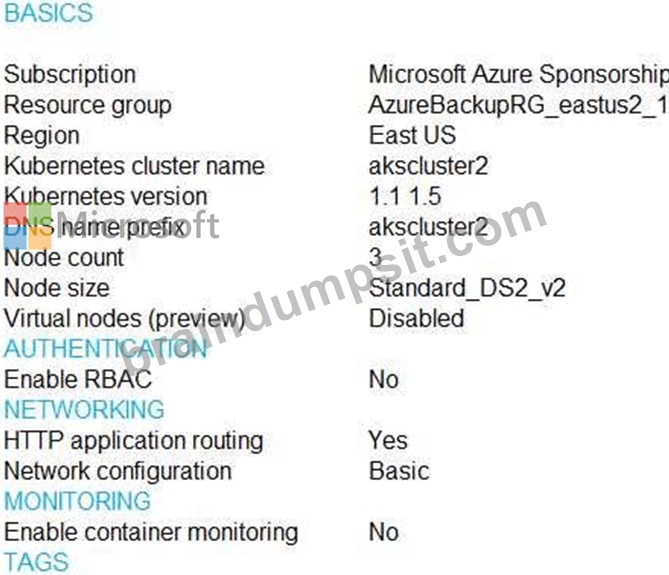
You plan to deploy the cluster to production. You disable HTTP application routing.
You need to implement application routing that will provide reverse proxy and TLS termination for AKS services
by using a single IP address.
What should you do?
- A. Create an AKS Ingress controller.
- B. Create an Azure Standard Load Balancer.
- C. Install the container network interface (CNI) plug-in.
- D. Create an Azure Basic Load Balancer.
Answer: A
Explanation:
An ingress controller is a piece of software that provides reverse proxy, configurable traffic routing, and TLS
termination for Kubernetes services.
References:
https://docs.microsoft.com/en-us/azure/aks/ingress-tls
NEW QUESTION # 68
Use the following login credentials as needed:
To enter your username, place your cursor in the Sign in box and click on the username below.
To enter your password, place your cursor in the Enter password box and click on the password below.
Azure Username: [email protected]
Azure Password: Ag1Bh9!#Bd
The following information is for technical support purposes only:
Lab Instance: 10598168
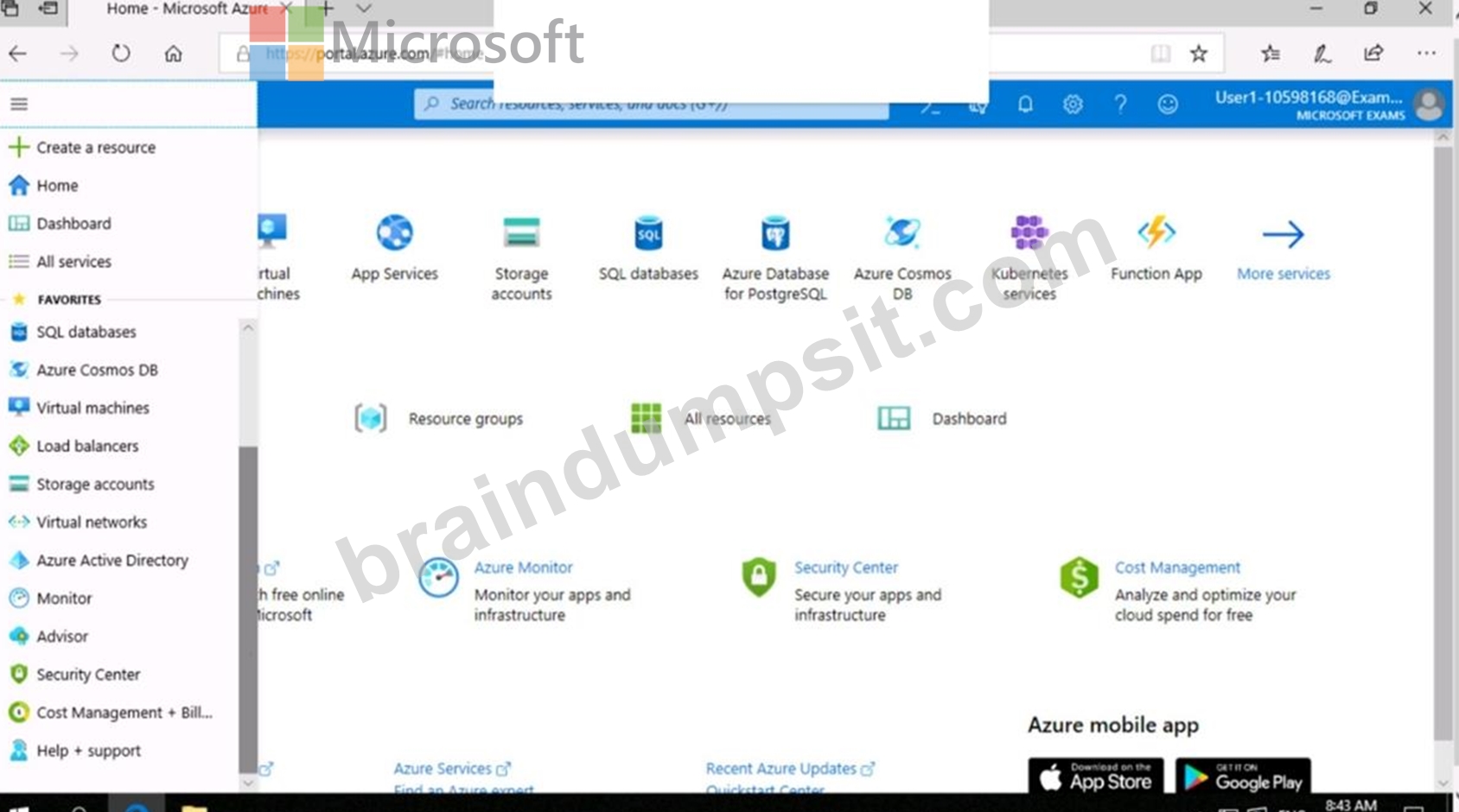
The developers at your company plan to create a web app named App10598168 and to publish the app to
https://www.contoso.com.
You need to perform the following tasks:
* Ensure that App10598168 is registered to Azure Active Directory (Azure AD).
* Generate a password for App10598168.
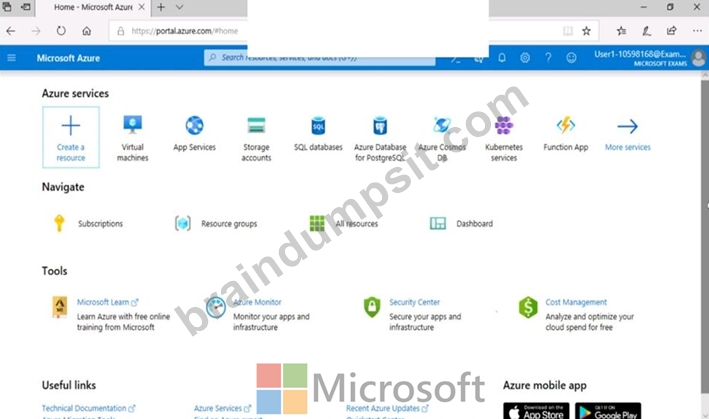
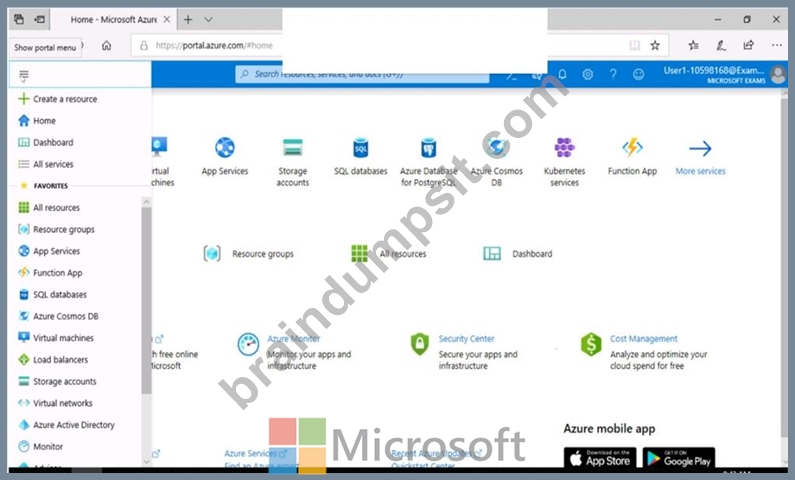
To complete this task, sign in to the Azure portal.
Answer:
Explanation:
See the explanation below.
Explanation
Step 1: Register the Application
1. Sign in to your Azure Account through the Azure portal.
2. Select Azure Active Directory.
3. Select App registrations.
4. Select New registration.
5. Name the application App10598168 . Select a supported account type, which determines who can use the application. Under Redirect URI, select Web for the type of application you want to create. Enter the URI:
https://www.contoso.com , where the access token is sent to.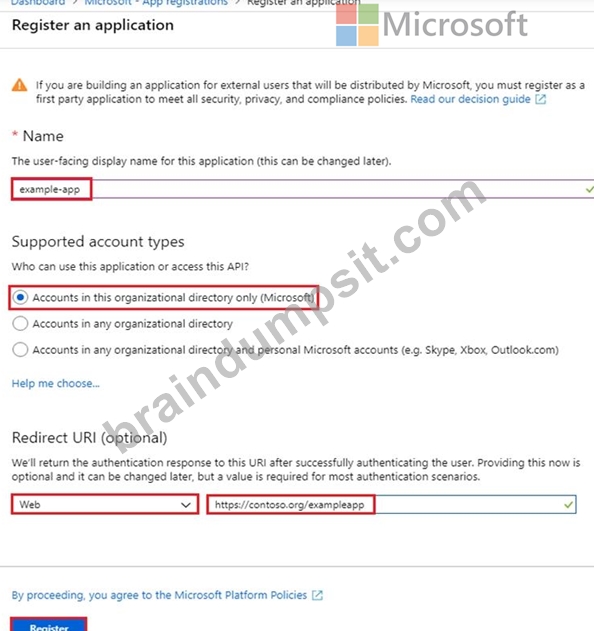
6. Click Register
Step 2: Create a new application secret
If you choose not to use a certificate, you can create a new application secret.
7 Select Certificates & secrets.
8. Select Client secrets -> New client secret.
9. Provide a description of the secret, and a duration. When done, select Add.
After saving the client secret, the value of the client secret is displayed. Copy this value because you aren't able to retrieve the key later. You provide the key value with the application ID to sign in as the application.
Store the key value where your application can retrieve it.
Reference:
https://docs.microsoft.com/en-us/azure/active-directory/develop/howto-create-service-principal-portal
NEW QUESTION # 69
You have a network security group (NSG) bound to an Azure subnet.
You run Get-AzureRmNetworkSecurityRuleConfig and receive the output shown in the following exhibit.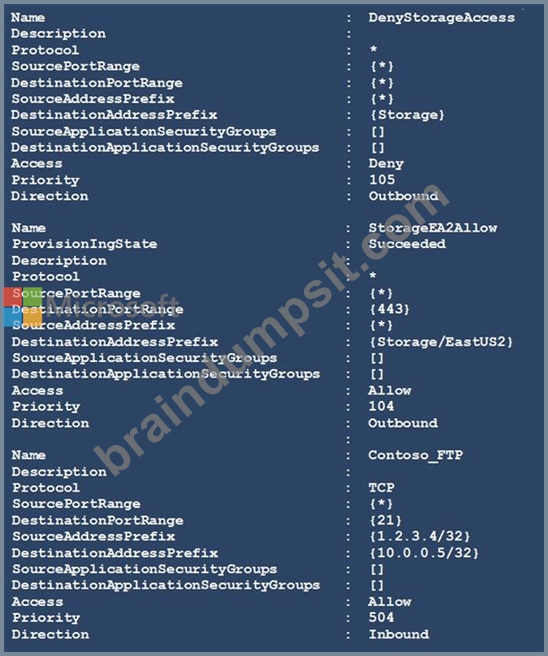
Use the drop-down menus to select the answer choice that completes each statement based on the information presented in the graphic.
NOTE: Each correct selection is worth one point.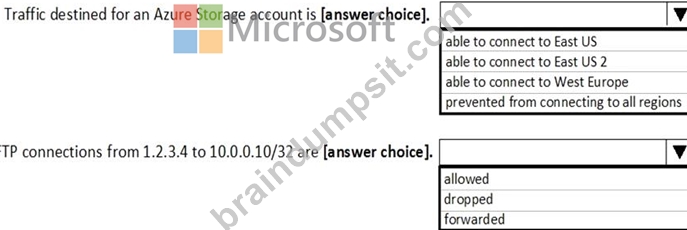
Answer:
Explanation: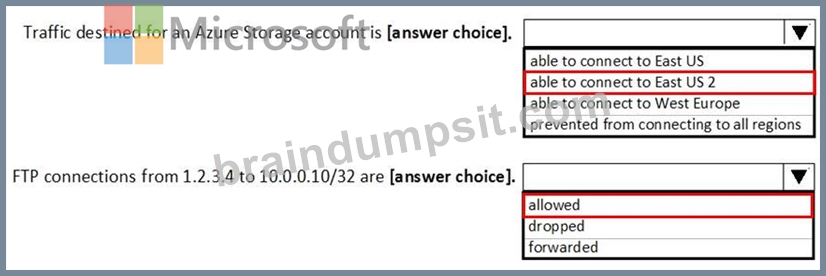
Explanation:
Box 1: able to connect to East US 2
The StorageEA2Allow has DestinationAddressPrefix {Storage/EastUS2}
Box 2: allowed
TCP Port 21 controls the FTP session. Contoso_FTP has SourceAddressPrefix {1.2.3.4/32} and DestinationAddressPrefix {10.0.0.5/32} Note:
The Get-AzureRmNetworkSecurityRuleConfig cmdlet gets a network security rule configuration for an Azure network security group.
Security rules in network security groups enable you to filter the type of network traffic that can flow in and out of virtual network subnets and network interfaces.
Reference:
https://docs.microsoft.com/en-us/azure/virtual-network/manage-network-security-group
NEW QUESTION # 70
You have two Azure virtual machines in the East US2 region as shown in the following table.
You deploy and configure an Azure Key vault.
You need to ensure that you can enable Azure Disk Encryption on VM1 and VM2.
What should you modify on each virtual machine? To answer, select the appropriate options in the answer area.
NOTE: Each correct selection is worth one point.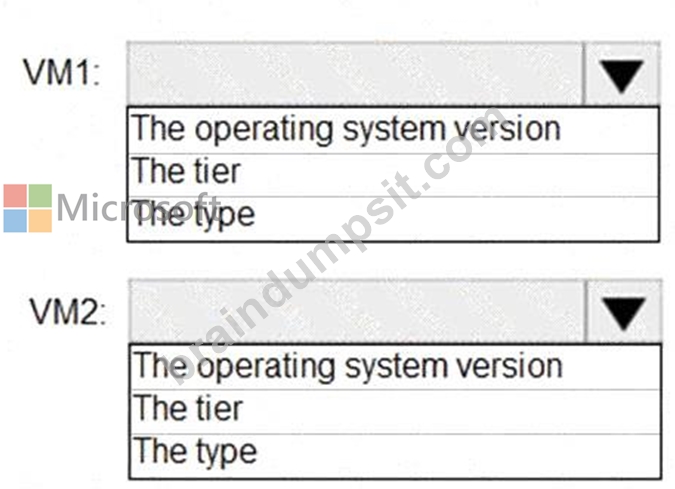
Answer:
Explanation: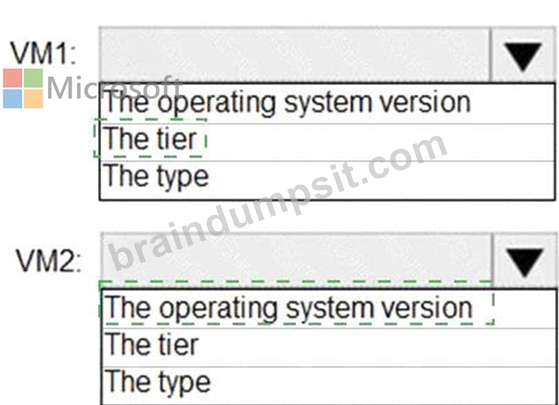
Explanation:
VM1: The Tier
The Tier needs to be upgraded to standard.
Disk Encryption for Windows and Linux IaaS VMs is in General Availability in all Azure public regions and Azure Government regions for Standard VMs and VMs with Azure Premium Storage.
VM2: the operating system
References:
https://docs.microsoft.com/en-us/azure/virtual-machines/windows/generation-2#generation-1-vs-generation-2- capabilities
NEW QUESTION # 71
You have an Azure subscription that contains an Azure key vault named Vault1.
On January 1, 2019, Vault1 stores the following secrets.
Which can each secret be used by an application? To answer, select the appropriate options in the answer area.
NOTE: Each correct selection is worth one point.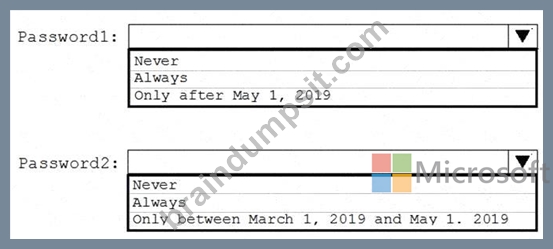
Answer:
Explanation: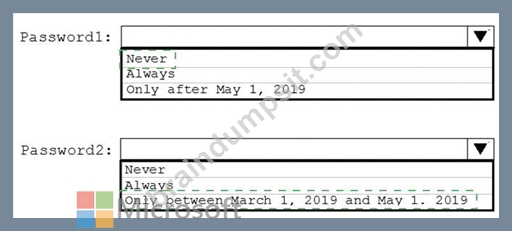
Explanation: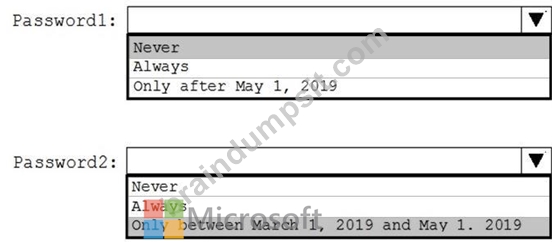
Box 1: Never
Password1 is disabled.
Box 2: Only between March 1, 2019 and May 1,
Password2:
Reference:
https://docs.microsoft.com/en-us/powershell/module/azurerm.keyvault/set-azurekeyvaultsecretattribute
NEW QUESTION # 72
You have two Azure virtual machines in the East US2 region as shown in the following table.
You deploy and configure an Azure Key vault.
You need to ensure that you can enable Azure Disk Encryption on VM1 and VM2.
What should you modify on each virtual machine? To answer, select the appropriate options in the answer area.
NOTE: Each correct selection is worth one point.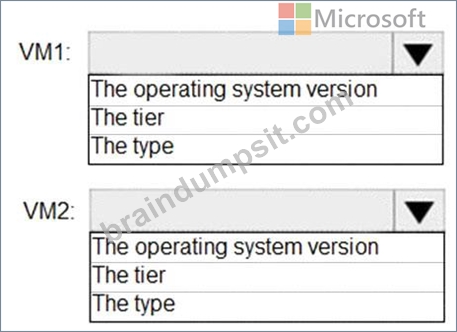
Answer:
Explanation: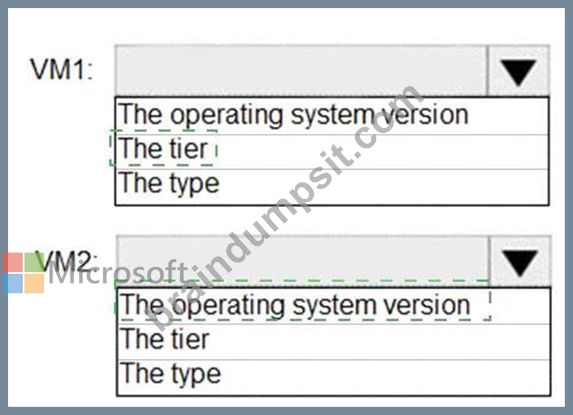
Explanation
VM1: The Tier
The Tier needs to be upgraded to standard.
Disk Encryption for Windows and Linux IaaS VMs is in General Availability in all Azure public regions and Azure Government regions for Standard VMs and VMs with Azure Premium Storage.
VM2: the operating system
References:
https://docs.microsoft.com/en-us/azure/virtual-machines/windows/generation-2#generation-1-vs-generation-2-ca
NEW QUESTION # 73
You have an Azure Active Directory (Azure AD) tenant named contoso.com that contains the users shown in the following table.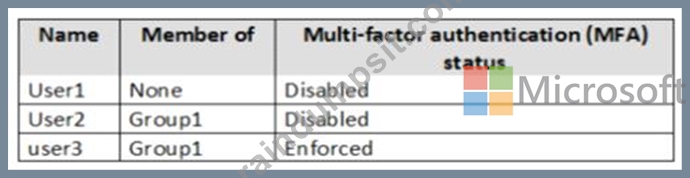
Azure AD Privileged Identity Management (PIM) is enabled for the tenant.
In PIM, the Password Administrator role has the following settings:
Maximum activation duration (hours): 2
Send email notifying admins of activation: Disable
Require incident/request ticket number during activation: Disable
Require Azure Multi-Factor Authentication for activation: Enable
Require approval to activate this role: Enable
Selected approver: Group1
You assign users the Password Administrator role as shown in the following table.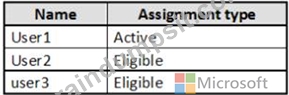
For each of the following statements, select Yes if the statement is true. Otherwise, select No.
NOTE: Each correct selection is worth one point.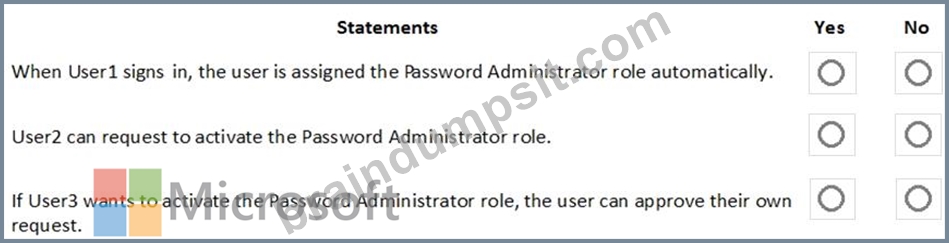
Answer:
Explanation: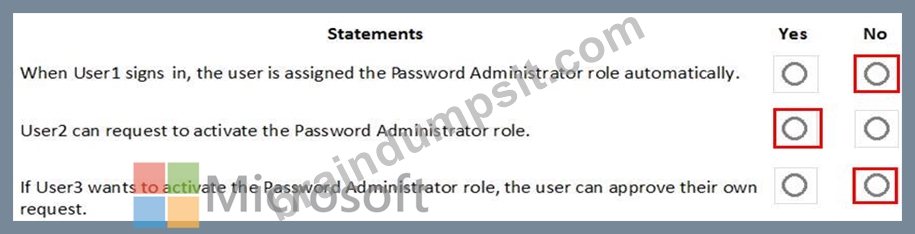
Reference:
https://docs.microsoft.com/bs-latn-ba/azure/active-directory/privileged-identity-management/pim-resource-roles-assign-roles
NEW QUESTION # 74
You have an Azure subscription that contains the following resources:
A virtual network named VNET1 that contains two subnets named Subnet1 and Subnet2.
A virtual machine named VM1 that has only a private IP address and connects to Subnet1.
You need to ensure that Remote Desktop connections can be established to VM1 from the internet.
Which three actions should you perform in sequence? To answer, move the appropriate actions from the list of actions to the answer area and arrange then in the correct order.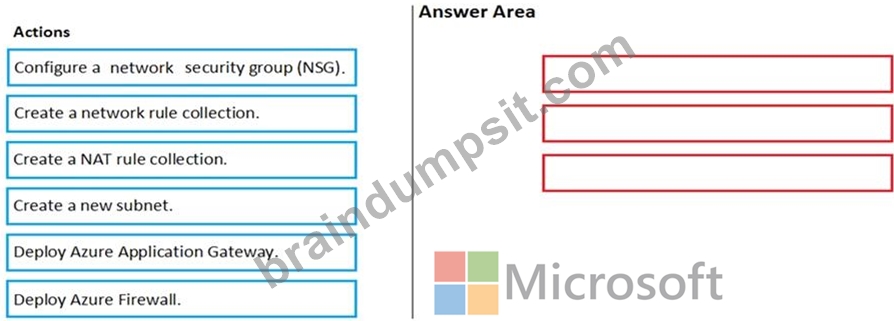
Answer:
Explanation: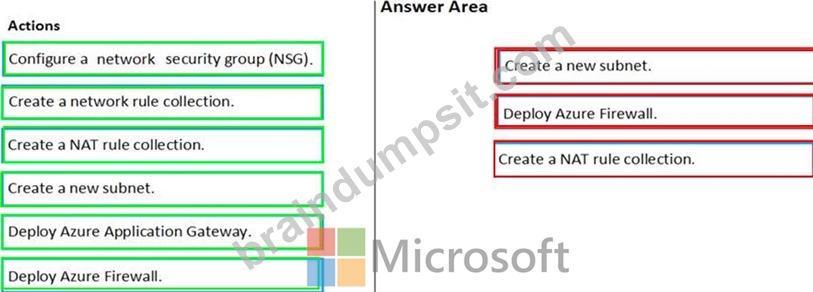
NEW QUESTION # 75
You have an Azure subscription named Sub1 that contains an Azure Log Analytics workspace named LAW1.
You have 500 Azure virtual machines that run Windows Server 2016 and are enrolled in LAW1.
You plan to add the System Update Assessment solution to LAW1.
You need to ensure that System Update Assessment-related logs are uploaded to LAW1 from 100 of the virtual machines only.
Which three actions should you perform in sequence? To answer, move the appropriate actions from the list of actions to the answer area and arrange them in the correct order.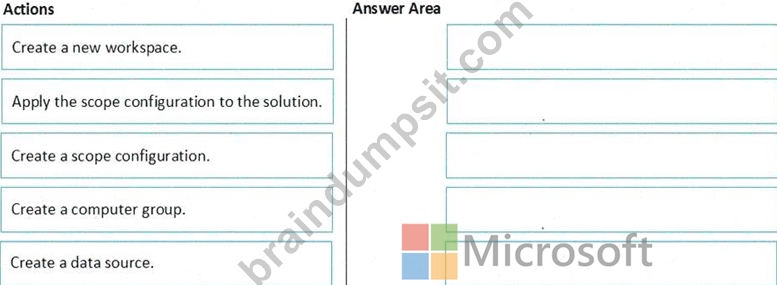
Answer:
Explanation: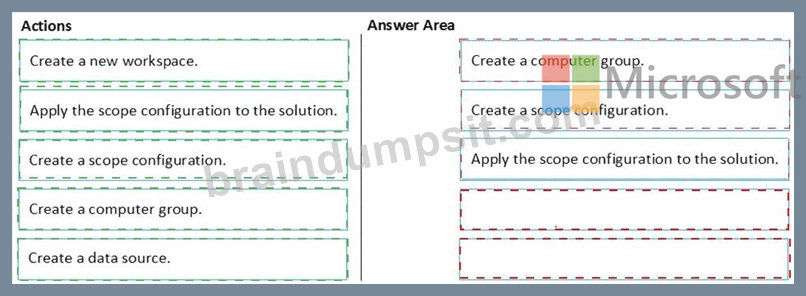
Explanation: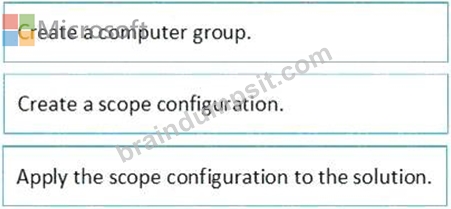
References:
https://docs.microsoft.com/en-us/azure/azure-monitor/insights/solution-targeting
NEW QUESTION # 76
You have an Azure subscription that contains an Azure Files share named share1 and a user named User1. Identity-based authentication is configured for share1.
User1 attempts to access share1 from a Windows 10 device by using SMB.
Which type of token will Azure Files use to authorize the request?
- A. Kerberos
- B. SAML
- C. JSON Web Token (JWT)
- D. OAuth 20
Answer: A
NEW QUESTION # 77
You have an Azure subscription that uses Microsoft Defender for Cloud.
Defender for Cloud has the security alerts shown in the following exhibit.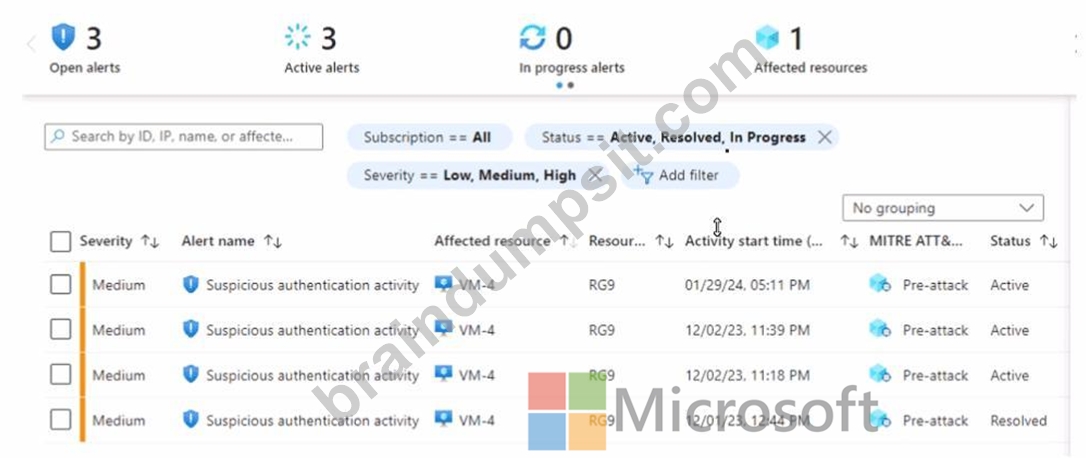
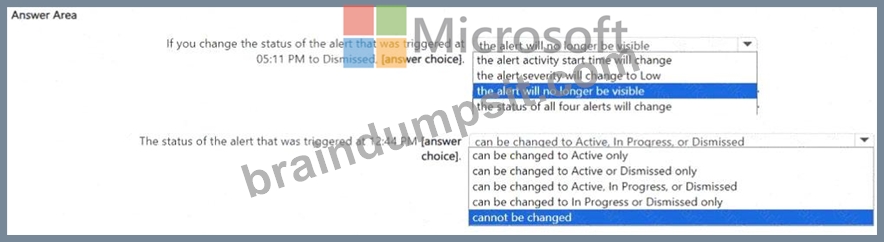
Answer:
Explanation: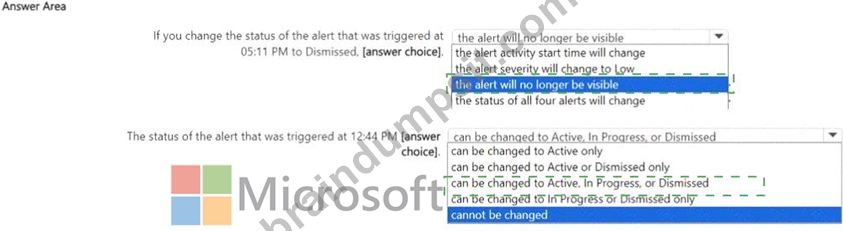
Explanation:
NEW QUESTION # 78
You have an Azure subscription that contains the virtual machines shown in the following table.
You create the Azure policies shown in the following table.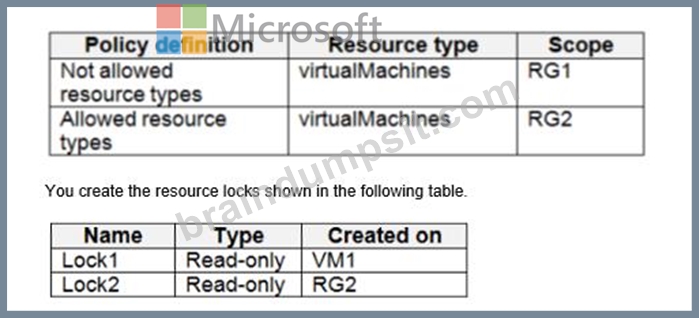
For each of the following statements, select Yes if the statement is true. Otherwise, select No.
NOTE: Each correct selection is worth one point.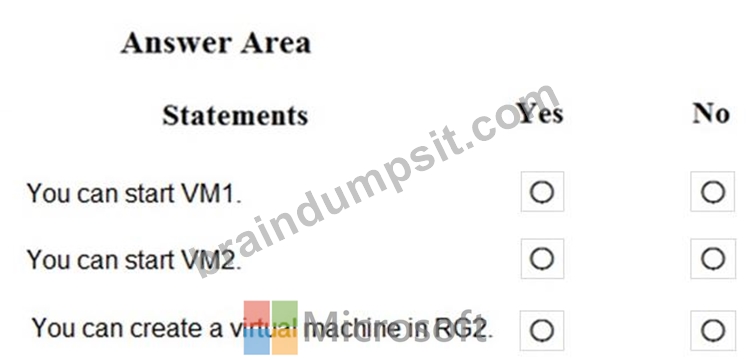
Answer:
Explanation: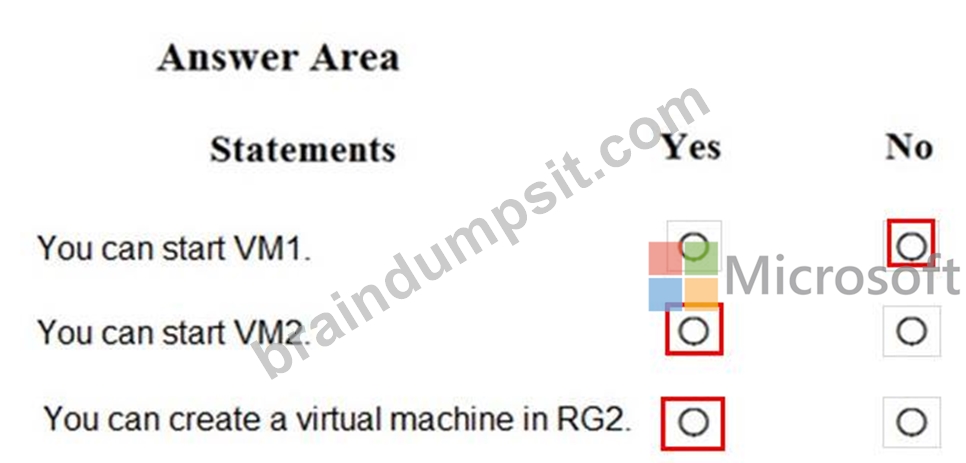
Reference:
https://docs.microsoft.com/en-us/azure/governance/blueprints/concepts/resource-locking
NEW QUESTION # 79
You have Azure Resource Manager templates that you use to deploy Azure virtual machines.
You need to disable unused Windows features automatically as instances of the virtual machines are
provisioned.
What should you use?
- A. device compliance policies in Microsoft Intune
- B. application security groups
- C. Azure Automation State Configuration
- D. Azure Advisor
Answer: C
Explanation:
Explanation/Reference:
Explanation:
You can use Azure Automation State Configuration to manage Azure VMs (both Classic and Resource
Manager), on-premises VMs, Linux machines, AWS VMs, and on-premises physical machines.
Note: Azure Automation State Configuration provides a DSC pull server similar to the Windows Feature
DSC-Service so that target nodes automatically receive configurations, conform to the desired state, and
report back on their compliance. The built-in pull server in Azure Automation eliminates the need to set up
and maintain your own pull server. Azure Automation can target virtual or physical Windows or Linux
machines, in the cloud or on-premises.
References:
https://docs.microsoft.com/en-us/azure/automation/automation-dsc-getting-started
NEW QUESTION # 80
You have an Azure subscription that contains the virtual networks shown in the following table.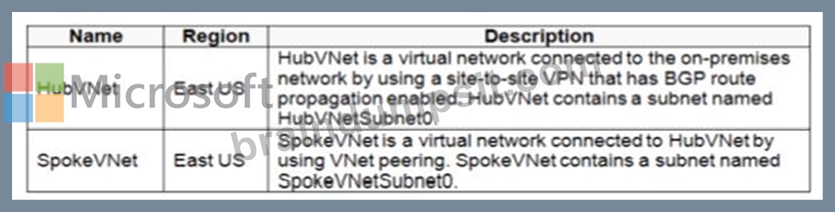
The Azure virtual machines on SpokeVNetSubnet0 can communicate with the computers on the on-premises network.
You plan to deploy an Azure firewall to HubVNet.
You create the following two routing tables:
RT1: Includes a user-defined route that points to the private IP address of the Azure firewall as a next hop address RT2: Disables BGP route propagation and defines the private IP address of the Azure firewall as the default gateway You need to ensure that traffic between SpokeVNetSubnet0 and the on-premises network flows through the Azure firewall.
To which subnet should you associate each route table? To answer, drag the appropriate subnets to the correct route tables. Each subnet may be used once, more than once, or not at all. You may need to drag the split bar between panes or scroll to view content.
NOTE: Each correct selection is worth one point.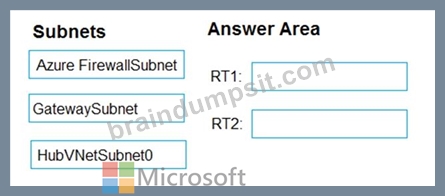
Answer:
Explanation: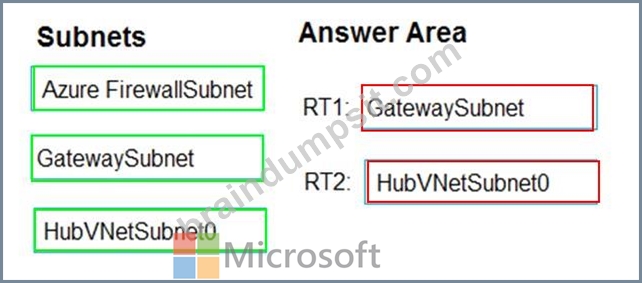
NEW QUESTION # 81
You have an Azure subscription that contains an Azure Active Directory (Azure AD) tenant and a user named User1.
The App registrations settings for the tenant are configured as shown in the following exhibit.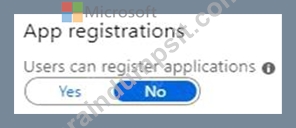
You plan to deploy an app named App1.
You need to ensure that User1 can register App1 in Azure AD. The solution must use the principle of least privilege.
Which role should you assign to User1?
- A. Managed Application Contributor for the subscription
- B. Application developer in Azure AD.
- C. Cloud application administrator in Azure AD
- D. App Configuration Data Owner for the subscription
Answer: B
Explanation:
Reference:
https://docs.microsoft.com/en-us/azure/active-directory/roles/delegate-by-task
NEW QUESTION # 82
You have an Azure subscription that has a managed identity named identity and is linked to an Azure Active Directory (Azure AD) tenant. The tenant contains the resources shown in the following table.
Which resources can be added to AUI and AU2? To answer, select the appropriate options in the answer area.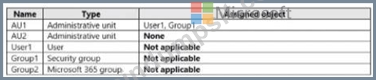
Which resources can be added to AU1 and AU2? To answer, select the appropriate options in the answer area.
NOTE: Each correct selection is worth one point.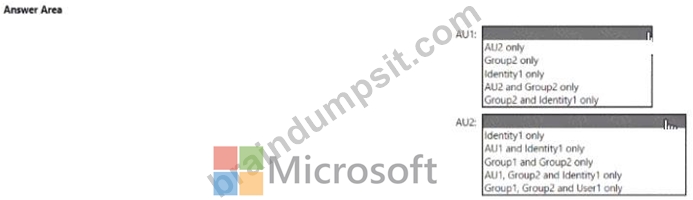
Answer:
Explanation: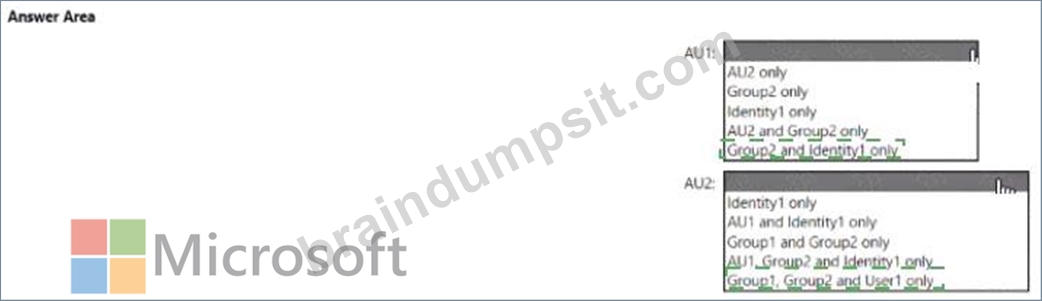
Explanation:
NEW QUESTION # 83
You are configuring network connectivity for two Azure virtual networks named VNET1 and VNET2.
You need to implement VPN gateways for the virtual networks to meet the following requirements:
* VNET1 must have six site-to-site connections that use BGP.
* VNET2 must have 12 site-to-site connections that use BGP.
* Costs must be minimized.
Which VPN gateway SKI) should you use for each virtual network? To answer, drag the appropriate SKUs to the correct networks. Each SKU may be used once, more than once, or not at all. You may need to drag the split bar between panes or scroll to view content.
NOTE: Each correct selection is worth one point
Answer:
Explanation:
Reference:
https://docs.microsoft.com/en-us/azure/vpn-gateway/vpn-gateway-about-vpngateways#gwsku
NEW QUESTION # 84
You have five Azure subscriptions linked to a single Azure Active Directory (Azure AD) tenant.
You create an Azure Policy initiative named SecurityPolicyInitiative1.
You identify which standard role assignments must be configured on all new resource groups.
You need to enforce SecurityPolicyInitiative1 and the role assignments when a new resource group is created.
Which three actions should you perform in sequence? To answer, move the appropriate actions from the list of actions to the answer area and arrange them in the correct order.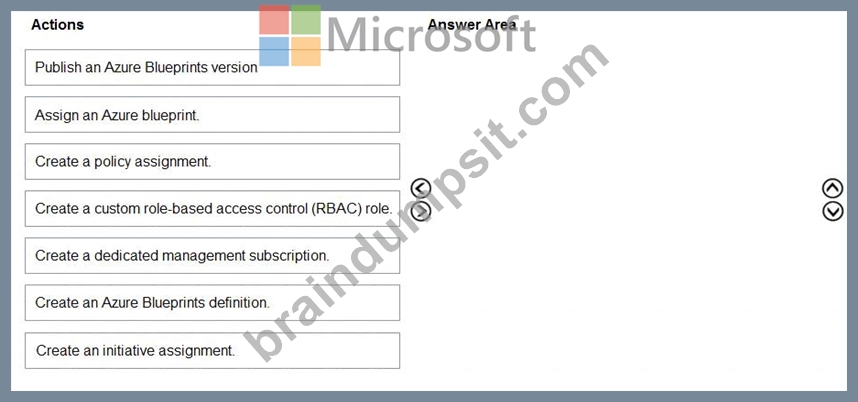
Answer:
Explanation: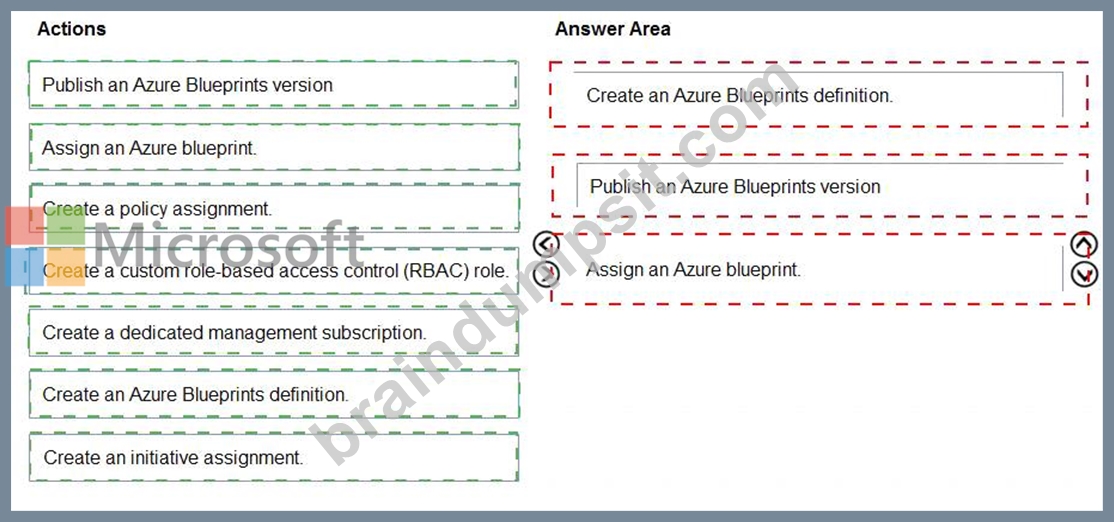
Explanation: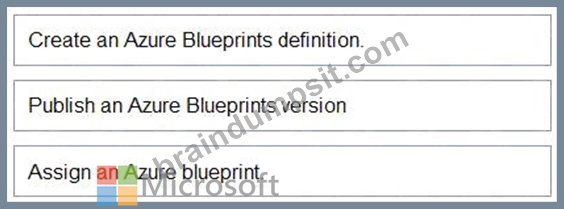
Reference:
https://docs.microsoft.com/en-us/azure/governance/blueprints/create-blueprint-portal
https://docs.microsoft.com/en-us/azure/azure-australia/azure-policy
NEW QUESTION # 85
You have an Azure subscription that contains three storage accounts, an Azure SQL managed instance named SQL and three Azure SQL databases. The storage accounts are configured as shown in the following table.
SQ11 has the following settings:
* Auditing: On
* Audit tog destination: storage1
The Azure SQL databases are configured as shown in the following table.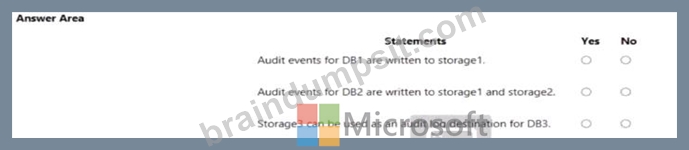
Answer:
Explanation: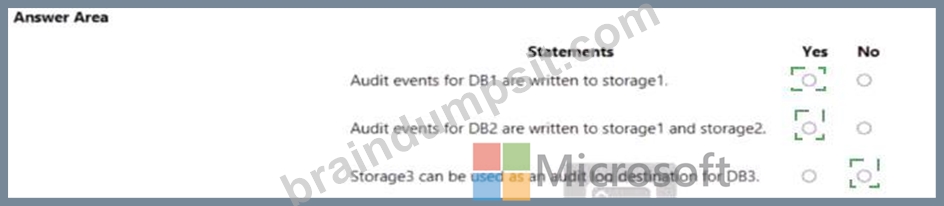
Explanation
Reference:
https://docs.microsoft.com/en-us/azure/azure-sql/managed-instance/auditing-configure
https://docs.microsoft.com/en-us/azure/azure-sql/database/auditing-overview
NEW QUESTION # 86
......
100% Free AZ-500 Daily Practice Exam With 517 Questions: https://www.braindumpsit.com/AZ-500_real-exam.html
Pass AZ-500 Review Guide, Reliable AZ-500 Test Engine: https://drive.google.com/open?id=1yaKNVva_I8xSUGkWyonZzBxwhBXHCIuM