


Provide Valid Databricks-Certified-Professional-Data-Engineer Dumps To Help You Prepare For Databricks Certified Professional Data Engineer Exam Exam Mar 25, 2026
Databricks Databricks-Certified-Professional-Data-Engineer Dumps Questions [2026] Pass for Databricks-Certified-Professional-Data-Engineer Exam
Databricks Certified Professional Data Engineer (Databricks-Certified-Professional-Data-Engineer) exam is designed for professionals who want to showcase their skills in building data pipelines and managing data workflows on Databricks. Databricks is a cloud-based data platform that provides powerful tools for data engineering, data science, and machine learning. Databricks Certified Professional Data Engineer Exam certification exam is intended to validate the candidates' ability to design, build, and maintain data processing systems using Databricks.
The Databricks Databricks-Certified-Professional-Data-Engineer exam consists of multiple-choice questions and hands-on exercises designed to test the candidate's knowledge and skills in working with Databricks. Candidates who pass the exam will be awarded the Databricks Certified Professional Data Engineer certification, which is recognized by employers worldwide as a validation of the candidate's expertise and proficiency in building and maintaining data pipelines using Databricks. Overall, the Databricks Certified Professional Data Engineer certification exam is a valuable credential for anyone looking to advance their career in big data engineering and analytics.
NEW QUESTION # 75
The data science team has created and logged a production model using MLflow. The following code correctly imports and applies the production model to output the predictions as a new DataFrame named preds with the schema "customer_id LONG, predictions DOUBLE, date DATE".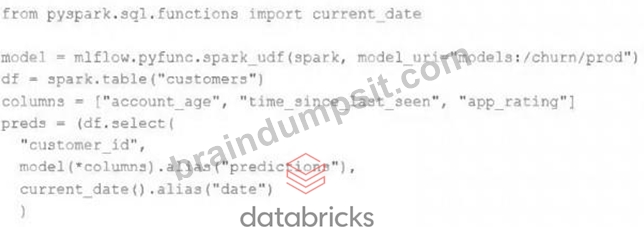
The data science team would like predictions saved to a Delta Lake table with the ability to compare all predictions across time. Churn predictions will be made at most once per day.
Which code block accomplishes this task while minimizing potential compute costs?
- A.

- B.

- C.
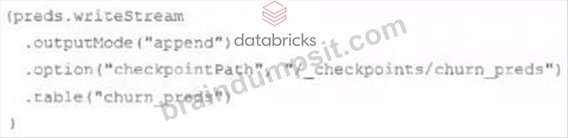
- D. preds.write.mode("append").saveAsTable("churn_preds")
- E. reds.write.format("delta").save("/preds/churn_preds")
Answer: D
NEW QUESTION # 76
You have written a notebook to generate a summary data set for reporting, Notebook was scheduled using the job cluster, but you realized it takes an average of 8 minutes to start the cluster, what feature can be used to start the cluster in a timely fashion?
- A. Use the Databricks cluster pools feature to reduce the startup time
- B. Setup an additional job to run ahead of the actual job so the cluster is running second job starts
- C. Pin the cluster in the cluster UI page so it is always available to the jobs
- D. Disable auto termination so the cluster is always running
- E. Use Databricks Premium edition instead of Databricks standard edition
Answer: A
Explanation:
Explanation
Cluster pools allow us to reserve VM's ahead of time, when a new job cluster is created VM are grabbed from the pool. Note: when the VM's are waiting to be used by the cluster only cost incurred is Azure. Databricks run time cost is only billed once VM is allocated to a cluster.
Here is a demo of how to setup and follow some best practices,
https://www.youtube.com/watch?v=FVtITxOabxg&ab_channel=DatabricksAcademy
NEW QUESTION # 77
A data engineer needs to provide access to a group named manufacturing-team. The team needs privileges to create tables in the quality schema.
Which set of SQL commands will grant a group named manufacturing-team to create tables in a schema named production with the parent catalog named manufacturing with the least privileges?
- A. GRANT CREATE TABLE ON SCHEMA manufacturing.quality TO manufacturing-team; GRANT CREATE SCHEMA ON SCHEMA manufacturing.quality TO manufacturing-team; GRANT USE CATALOG ON CATALOG manufacturing TO manufacturing-team;
- B. GRANT USE TABLE ON SCHEMA manufacturing.quality TO manufacturing-team; GRANT USE SCHEMA ON SCHEMA manufacturing.quality TO manufacturing-team; GRANT USE CATALOG ON CATALOG manufacturing TO manufacturing-team;
- C. GRANT CREATE TABLE ON SCHEMA manufacturing.quality TO manufacturing-team; GRANT USE SCHEMA ON SCHEMA manufacturing.quality TO manufacturing-team; GRANT USE CATALOG ON CATALOG manufacturing TO manufacturing-team;
- D. GRANT CREATE TABLE ON SCHEMA manufacturing.quality TO manufacturing-team; GRANT CREATE SCHEMA ON SCHEMA manufacturing.quality TO manufacturing-team; GRANT CREATE CATALOG ON CATALOG manufacturing TO manufacturing-team;
Answer: C
Explanation:
To create a table within a schema, a principal must have CREATE TABLE on the schema, USE SCHEMA on that schema, and USE CATALOG on the parent catalog. This combination ensures the group has just enough privileges to create objects in that schema without excessive permissions like CREATE SCHEMA or CREATE CATALOG.
Reference Source: Databricks Unity Catalog Privilege Model - "Privileges Required to Create a Table."
NEW QUESTION # 78
A junior data engineer on your team has implemented the following code block.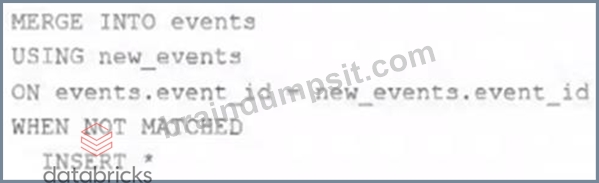
The viewnew_eventscontains a batch of records with the same schema as theeventsDelta table.
Theevent_idfield serves as a unique key for this table.
When this query is executed, what will happen with new records that have the sameevent_idas an existing record?
- A. They are merged.
- B. They are deleted.
- C. They are inserted.
- D. They are ignored.
- E. They are updated.
Answer: D
Explanation:
Explanation
This is the correct answer because it describes what will happen with new records that have the same event_id as an existing record when the query is executed. The query uses the INSERT INTO command to append new records from the view new_events to the table events. However, the INSERT INTO command does not check for duplicate values in the primary key column (event_id) and does not perform any update or delete operations on existing records. Therefore, if there are new records that have the same event_id as an existing record, they will be ignored and not inserted into the table events. Verified References: [Databricks Certified Data Engineer Professional], under "Delta Lake" section; Databricks Documentation, under "Append data using INSERT INTO" section.
NEW QUESTION # 79
An upstream system is emitting change data capture (CDC) logs that are being written to a cloud object storage directory. Each record in the log indicates the change type (insert, update, or delete) and the values for each field after the change. The source table has a primary key identified by the fieldpk_id.
For auditing purposes, the data governance team wishes to maintain a full record of all values that have ever been valid in the source system. For analytical purposes, only the most recent value for each record needs to be recorded. The Databricks job to ingest these records occurs once per hour, but each individual record may have changed multiple times over the course of an hour.
Which solution meets these requirements?
- A. Use merge into to insert, update, or delete the most recent entry for each pk_id into a bronze table, then propagate all changes throughout the system.
- B. Create a separate history table for each pk_id resolve the current state of the table by running a union all filtering the history tables for the most recent state.
- C. Ingest all log information into a bronze table; use merge into to insert, update, or delete the most recent entry for each pk_id into a silver table to recreate the current table state.
- D. Iterate through an ordered set of changes to the table, applying each in turn; rely on Delta Lake's versioning ability to create an audit log.
- E. Use Delta Lake's change data feed to automatically process CDC data from an external system, propagating all changes to all dependent tables in the Lakehouse.
Answer: C
Explanation:
This is the correct answer because it meets the requirements of maintaining a full record of all values that have ever been valid in the source system and recreating the current table state with only the most recent value for each record. The code ingests all log information into a bronzetable, which preserves the raw CDC data as it is. Then, it uses merge into to perform an upsert operation on a silver table, which means it will insert new records or update or delete existing records based on the change type and the pk_id columns. This way, the silver table will always reflect the current state of the source table, while the bronze table will keep the history of all changes. Verified References: [Databricks Certified Data Engineer Professional], under
"Delta Lake" section; Databricks Documentation, under "Upsert into a table using merge" section.
NEW QUESTION # 80
A data engineer wants to automate job monitoring and recovery in Databricks using the Jobs API. They need to list all jobs, identify a failed job, and rerun it.
Which sequence of API actions should the data engineer perform?
- A. Use the jobs/list endpoint to list jobs, then use the jobs/create endpoint to create a new job, and run the new job using jobs/run-now.
- B. Use the jobs/get endpoint to retrieve job details, then use jobs/update to rerun failed jobs.
- C. Use the jobs/list endpoint to list jobs, check job run statuses with jobs/runs/list, and rerun a failed job using jobs/run-now.
- D. Use the jobs/cancel endpoint to remove failed jobs, then recreate them with jobs/create and run the new ones.
Answer: C
Explanation:
Comprehensive and Detailed Explanation From Exact Extract of Databricks Data Engineer Documents:
The Databricks Jobs REST API provides several endpoints for automation. The correct monitoring and rerun flow uses three specific calls:
GET /api/2.1/jobs/list - Lists all available jobs within the workspace.
GET /api/2.1/jobs/runs/list - Returns all runs for a specific job, including their current state (e.g., TERMINATED: FAILED).
POST /api/2.1/jobs/run-now - Immediately triggers a rerun of the specified job.
This sequence aligns with Databricks' prescribed automation model for job observability and recovery. Using jobs/update modifies metadata but does not rerun jobs, and jobs/create is only used for creating new jobs, not rerunning failed ones. Cancelling and recreating jobs introduces unnecessary duplication. Therefore, option A is the correct automated recovery workflow.
NEW QUESTION # 81
The marketing team is looking to share data in an aggregate table with the sales organization, but the field names used by the teams do not match, and a number of marketing specific fields have not been approval for the sales org.
Which of the following solutions addresses the situation while emphasizing simplicity?
- A. Create a new table with the required schema and use Delta Lake's DEEP CLONE functionality to sync up changes committed to one table to the corresponding table.
- B. Create a view on the marketing table selecting only these fields approved for the sales team alias the names of any fields that should be standardized to the sales naming conventions.
- C. Add a parallel table write to the current production pipeline, updating a new sales table that varies as required from marketing table.
- D. Use a CTAS statement to create a derivative table from the marketing table configure a production jon to propagation changes.
Answer: B
Explanation:
Creating a view is a straightforward solution that can address the need for field name standardization and selective field sharing between departments. A view allows for presenting a transformed version of the underlying data without duplicating it. In this scenario, the view would only include the approved fields for the sales team and rename any fields as per their naming conventions.
References:
* Databricks documentation on using SQL views in Delta Lake: https://docs.databricks.com/delta/quick- start.html#sql-views
NEW QUESTION # 82
Which statement describes integration testing?
- A. Validates behavior of individual elements of your application
- B. Validates an application use case
- C. Requires an automated testing framework
- D. Validates interactions between subsystems of your application
- E. Requires manual intervention
Answer: D
Explanation:
This is the correct answer because it describes integration testing. Integration testing is a type of testing that validates interactions between subsystems of your application, such as modules, components, or services.
Integration testing ensures that the subsystems work together as expected and produce the correct outputs or results. Integration testing can be done at different levels of granularity, such as component integration testing, system integration testing, or end-to-end testing. Integration testing can help detect errors or bugs that may not be found by unit testing, which only validates behavior of individual elements of your application. Verified References: [Databricks Certified Data Engineer Professional], under "Testing" section; Databricks Documentation, under "Integration testing" section.
NEW QUESTION # 83
A data engineer wants to horizontally combine two tables as a part of a query. They want to use a shared
column as a key column, and they only want the query result to contain rows whose value in the key column is
present in both tables.
Which of the following SQL commands can they use to accomplish this task?
- A. OUTER JOIN
- B. LEFT JOIN
- C. UNION
- D. MERGE
- E. INNER JOIN
Answer: E
NEW QUESTION # 84
A data engineering team needs to implement a tagging system for their tables as part of an automated ETL process, and needs to apply tags programmatically to tables in Unity Catalog.
Which SQL command adds tags to a table programmatically?
- A. SET TAGS FOR table_name AS ('key1' = 'value1', 'key2' = 'value2');
- B. ALTER TABLE table_name SET TAGS ('key1' = 'value1', 'key2' = 'value2');
- C. COMMENT ON TABLE table_name TAGS ('key1' = 'value1', 'key2' = 'value2');
- D. APPLY TAGS ON table_name VALUES ('key1' = 'value1', 'key2' = 'value2');
Answer: B
Explanation:
Comprehensive and Detailed Explanation from Databricks Documentation:
Unity Catalog in Databricks provides the ability to attach tags (key-value metadata pairs) to securable objects such as catalogs, schemas, tables, volumes, and functions. Tags are critical for governance, compliance, and automation, as they allow organizations to track metadata like sensitivity, ownership, business purpose, and retention policies directly at the object level.
According to the official Databricks SQL reference for Unity Catalog, the correct way to programmatically add tags to a table is by using the ALTER TABLE ... SET TAGS command. The syntax is:
ALTER TABLE table_name SET TAGS ('tag_name' = 'tag_value', ...);
This command can be used within ETL workflows or jobs to automatically apply metadata during or after ingestion, ensuring that governance and compliance rules are embedded in the pipeline itself.
Option A is correct because it uses the supported syntax for applying tags.
Option B (APPLY TAGS) is not valid SQL in Unity Catalog and is not recognized by Databricks.
Option C confuses COMMENT with TAGS. While COMMENT can add descriptive text to a table, it does not handle tags.
Option D (SET TAGS FOR) is not a valid SQL construct in Databricks for applying tags.
Thus, Option A is the only valid and documented way to programmatically set tags on a table in Unity Catalog.
NEW QUESTION # 85
The data engineering team maintains the following code:
Assuming that this code produces logically correct results and the data in the source tables has been de-duplicated and validated, which statement describes what will occur when this code is executed?
- A. A batch job will update the enriched_itemized_orders_by_account table, replacing only those rows that have different values than the current version of the table, using accountID as the primary key.
- B. An incremental job will detect if new rows have been written to any of the source tables; if new rows are detected, all results will be recalculated and used to overwrite the enriched_itemized_orders_by_account table.
- C. No computation will occur until enriched_itemized_orders_by_account is queried; upon query materialization, results will be calculated using the current valid version of data in each of the three tables referenced in the join logic.
- D. The enriched_itemized_orders_by_account table will be overwritten using the current valid version of data in each of the three tables referenced in the join logic.
- E. An incremental job will leverage information in the state store to identify unjoined rows in the source tables and write these rows to the enriched_iteinized_orders_by_account table.
Answer: D
Explanation:
This is the correct answer because it describes what will occur when this code is executed. The code uses three Delta Lake tables as input sources: accounts, orders, and order_items. These tables are joined together using SQL queries to create a view called new_enriched_itemized_orders_by_account, which contains information about each order item and its associated account details. Then, the code uses write.format("delta").mode("overwrite") to overwrite a target table called enriched_itemized_orders_by_account using the data from the view. This means that every time this code is executed, it will replace all existing data in the target table with new data based on the current valid version of data in each of the three input tables. Verified References: [Databricks Certified Data Engineer Professional], under "Delta Lake" section; Databricks Documentation, under "Write to Delta tables" section.
NEW QUESTION # 86
A task orchestrator has been configured to run two hourly tasks. First, an outside system writes Parquet data to a directory mounted at /mnt/raw_orders/. After this data is written, a Databricks job containing the following code is executed:
(spark.readStream
.format("parquet")
.load("/mnt/raw_orders/")
.withWatermark("time", "2 hours")
.dropDuplicates(["customer_id", "order_id"])
.writeStream
.trigger(once=True)
.table("orders")
)
Assume that the fields customer_id and order_id serve as a composite key to uniquely identify each order, and that the time field indicates when the record was queued in the source system. If the upstream system is known to occasionally enqueue duplicate entries for a single order hours apart, which statement is correct?
- A. All records will be held in the state store for 2 hours before being deduplicated and committed to the orders table.
- B. Duplicate records enqueued more than 2 hours apart may be retained and the orders table may contain duplicate records with the same customer_id and order_id.
- C. The orders table will contain only the most recent 2 hours of records and no duplicates will be present.
- D. The orders table will not contain duplicates, but records arriving more than 2 hours late will be ignored and missing from the table.
Answer: D
Explanation:
Comprehensive and Detailed Explanation From Exact Extract:
Exact extract: "dropDuplicates with watermark performs stateful deduplication on the keys within the watermark delay." Exact extract: "Records older than the event-time watermark are considered late and may be dropped." Exact extract: "trigger(once) processes all available data once and then stops." The watermark of 2 hours bounds the deduplication state. Duplicate orders within the 2-hour window are removed; duplicates arriving later than 2 hours behind the corresponding first event are considered late and are ignored, so they won't appear, but any orders that themselves arrive later than the watermark will be dropped and thus be missing.
Reference:
NEW QUESTION # 87
Given the following error traceback:
AnalysisException: cannot resolve 'heartrateheartrateheartrate' given input columns:
[spark_catalog.database.table.device_id, spark_catalog.database.table.heartrate, spark_catalog.database.table.mrn, spark_catalog.database.table.time] The code snippet was:
display(df.select(3*"heartrate"))
Which statement describes the error being raised?
- A. There is a type error because a column object cannot be multiplied.
- B. There is no column in the table named heartrateheartrateheartrate.
- C. There is a syntax error because the heartrate column is not correctly identified as a column.
- D. There is a type error because a DataFrame object cannot be multiplied.
Answer: B
Explanation:
Comprehensive and Detailed Explanation From Exact Extract:
* Exact extract: "select() expects column names or Column expressions."
* Exact extract: "When using strings directly, Spark SQL interprets them as literal column names."
* Exact extract: "Python string operations, such as "colname"*3, return repeated strings, not column expressions." The expression 3*"heartrate" is Python string multiplication, which evaluates to "heartrateheartrateheartrate".
The select() method interprets this as a literal column name. Since there is no column with that name in the DataFrame schema, Spark raises AnalysisException saying it cannot resolve that column. To correctly multiply a column by a scalar, one must use the column expression form:
from pyspark.sql.functions import col
df.select((col("heartrate") * 3).alias("heartrate_x3"))
This ensures Spark evaluates the arithmetic operation on the column instead of misinterpreting the string.
References: PySpark DataFrame select; PySpark Column expressions with col().
NEW QUESTION # 88
A Data engineer wants to run unit's tests using common Python testing frameworks on python functions defined across several Databricks notebooks currently used in production.
How can the data engineer run unit tests against function that work with data in production?
- A. Define units test and functions within the same notebook
- B. Define and unit test functions using Files in Repos
- C. Run unit tests against non-production data that closely mirrors production
- D. Define and import unit test functions from a separate Databricks notebook
Answer: C
Explanation:
The best practice for running unit tests on functions that interact with data is to use a dataset that closely mirrors the production data. This approach allows data engineers to validate the logic of their functions without the risk of affecting the actual production data. It's important to have a representative sample of production data to catch edge cases and ensure the functions will work correctly when used in a production environment.
Reference:
Databricks Documentation on Testing: Testing and Validation of Data and Notebooks
NEW QUESTION # 89
The business intelligence team has a dashboard configured to track various summary metrics for retail stories.
This includes total sales for the previous day alongside totals and averages for a variety of time periods. The fields required to populate this dashboard have the following schema:
For Demand forecasting, the Lakehouse contains a validated table of all itemized sales updated incrementally in near real-time. This table named products_per_order, includes the following fields:
Because reporting on long-term sales trends is less volatile, analysts using the new dashboard only require data to be refreshed once daily. Because the dashboard will be queried interactively by many users throughout a normal business day, it should return results quickly and reduce total compute associated with each materialization.
Which solution meets the expectations of the end users while controlling and limiting possible costs?
- A. Use Structure Streaming to configure a live dashboard against the products_per_order table within a Databricks notebook.
- B. Define a view against the products_per_order table and define the dashboard against this view.
- C. Use the Delta Cache to persists the products_per_order table in memory to quickly the dashboard with each query.
- D. Populate the dashboard by configuring a nightly batch job to save the required to quickly update the dashboard with each query.
Answer: D
Explanation:
Given the requirement for daily refresh of data and the need to ensure quick response times for interactive queries while controlling costs, a nightly batch job to pre-compute and save the required summary metrics is the most suitable approach.
* By pre-aggregating data during off-peak hours, the dashboard can serve queries quickly without requiring on-the-fly computation, which can be resource-intensive and slow, especially with many users.
* This approach also limits the cost by avoiding continuous computation throughout the day and instead leverages a batch process that efficiently computes and stores the necessary data.
* The other options (A, C, D) either do not address the cost and performance requirements effectively or are not suitable for the use case of less frequent data refresh and high interactivity.
References:
* Databricks Documentation on Batch Processing: Databricks Batch Processing
* Data Lakehouse Patterns: Data Lakehouse Best Practices
NEW QUESTION # 90
In order to facilitate near real-time workloads, a data engineer is creating a helper function to leverage the schema detection and evolution functionality of Databricks Auto Loader. The desired function will automatically detect the schema of the source directly, incrementally process JSON files as they arrive in a source directory, and automatically evolve the schema of the table when new fields are detected.
The function is displayed below with a blank: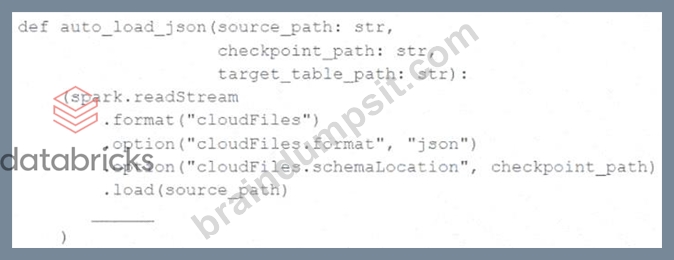
Which response correctly fills in the blank to meet the specified requirements?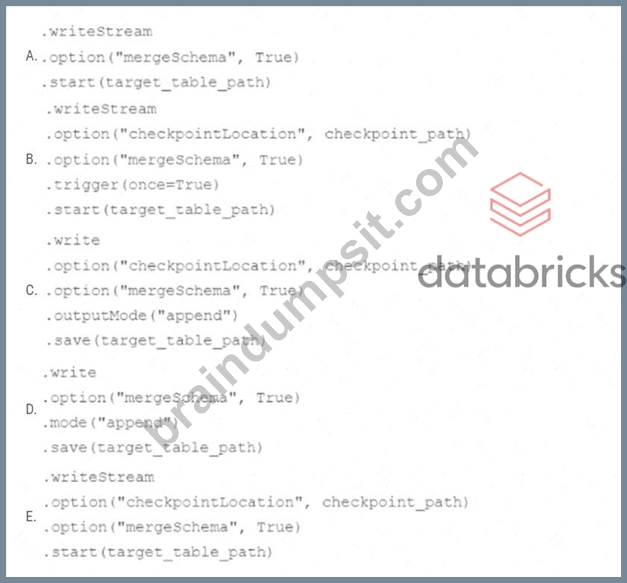
- A. Option B
- B. Option E
- C. Option C
- D. Option A
- E. Option D
Answer: A
Explanation:
Option B correctly fills in the blank to meet the specified requirements. Option B uses the "cloudFiles.
schemaLocation" option, which is required for the schema detection and evolution functionality of Databricks Auto Loader. Additionally, option B uses the "mergeSchema" option, which is required for the schema evolution functionality of Databricks Auto Loader. Finally, option B uses the "writeStream" method, which is required for the incremental processing of JSON files as they arrive in a source directory. The other options are incorrect because they either omit the required options, use the wrong method, or use the wrong format. References:
* Configure schema inference and evolution in Auto Loader: https://docs.databricks.com/en/ingestion
/auto-loader/schema.html
* Write streaming data: https://docs.databricks.com/spark/latest/structured-streaming/writing-streaming- data.html
NEW QUESTION # 91
Which of the statements is correct when choosing between lakehouse and Datawarehouse?
- A. Traditional Data warehouses have special indexes which are optimized for Machine learning
- B. SQL support is only available for Traditional Datawarehouse's, Lakehouses support Python and Scala
- C. Lakehouse replaces the current dependency on data lakes and data warehouses uses an open standard storage format and supports low latency BI workloads.
- D. Traditional Data warehouses are the preferred choice if we need to support ACID, Lakehouse does not support ACID.
- E. Traditional Data warehouses can serve low query latency with high reliability for BI workloads
Answer: C
Explanation:
Explanation
The lakehouse replaces the current dependency on data lakes and data warehouses for modern data companies that desire:
* Open, direct access to data stored in standard data formats.
* Indexing protocols optimized for machine learning and data science.
* Low query latency and high reliability for BI and advanced analytics.
NEW QUESTION # 92
......
Databricks Certified Professional Data Engineer exam is a valuable certification for professionals who want to showcase their expertise in big data processing using Databricks. Databricks Certified Professional Data Engineer Exam certification demonstrates that the candidate has the necessary skills and knowledge to design and implement scalable data pipelines using Databricks. Databricks Certified Professional Data Engineer Exam certification also provides a competitive advantage to professionals in the job market and opens up new career opportunities in the field of big data engineering.
Achieve Success in Actual Databricks-Certified-Professional-Data-Engineer Exam Databricks-Certified-Professional-Data-Engineer Exam Dumps: https://www.braindumpsit.com/Databricks-Certified-Professional-Data-Engineer_real-exam.html