


AZ-800 Actual Questions - Instant Download Tests Free Updated Today!
Get instant access of 100% real Microsoft AZ-800 exam questions with verified answers
NEW QUESTION # 76
You have an Azure virtual machine named VM1 that has a private IP address only.
You configure the Windows Admin Center extension on VM1.
You have an on-premises computer that runs Windows 11. You use the computer for server management.
You need to ensure that you can use Windows Admin Center from the Azure portal to manage VM1.
What should you configure?
- A. a VPN connection to the virtual network that contains VM1.
- B. an Azure Bastion host on the virtual network that contains VM1.
- C. a private endpoint on the virtual network that contains VM1.
- D. a network security group 1NSG) rule that allows inbound traffic on port 443.
Answer: A
Explanation:
Reference:
https://docs.microsoft.com/en-us/windows-server/manage/windows-admin-center/azure/manage-vm
NEW QUESTION # 77
You plan to deploy an Azure virtual machine that will run Windows Server.
You need to ensure that an Azure Active Directory (Azure AD) user [email protected] can connect 10 the virtual machine by using the Azure Serial Console.
What should you do? To answer, select the appropriate options in the answer area.
NOTE: Each correct selection is worth one point.
Answer:
Explanation:
Reference:
https://docs.microsoft.com/en-us/troubleshoot/azure/virtual-machines/serial-console-overview
NEW QUESTION # 78
You need to implement an availability solution for DHCP that meets the networking requirements.
Which two actions should you perform? Each correct answer presents part of the solution.
NOTE: Each correct selection is worth one point.
- A. DHCP2. configure a scope that contains 25 percent of the IP addresses from Scope 1 .
- B. On the router in each office, configure a DHCP relay.
- C. On DHCP1. create a scope that contains 25 percent of the IP addresses from Scope2.
- D. On each DHCP scope, configure DHCP failover.
- E. On each DHCP server, install the Failover Clustering feature and add the DHCP cluster role.
Answer: D,E
Explanation:
Reference:
https://docs.microsoft.com/en-us/previous-versions/windows/it-pro/windows-server-2012-r2-and-2012/hh831385(v=ws.11)
NEW QUESTION # 79
Your network contains two Active Directory forests and a domain trust as shown in the following exhibit.
The domain trust has the following configurations:
* Name: adatum.com
* Type: External
* Direction: One-way. outgoing
* Outgoing trust authentication level: Domain-wide authentication
The forests contain the network shares shown in the following table.
For each of the following statements, select Yes if the statement is true. Otherwise, select No. NOTE: Each correct selection is worth one point.
Answer:
Explanation:
Explanation
NEW QUESTION # 80
You have two servers that have the Hyper-V server role installed. The servers are joined to a failover cluster both servers can connect to the same disk on an iSCSi storage device. You plan to use the iSCSI storage to store highly available Hyper-V virtual machines that will support live migration functionality. You need to configure a storage resource in the failover cluster to store the virtual machines.
What should you configure?
- A. attributed File System (DFS) Replication
- B. a mirrored volume
- C. Cluster Shared volumes (CSV)
- D. a storage pool
Answer: C
NEW QUESTION # 81
Your network contains an Active Directory Domain Services (AD DS) domain named adatum.com The domain contains a server named Server1 and the users shown In the following table.
Server1 contains a folder named D:\Folder1. The advanced security settings for Folder 1 are configured as shown in the Permissions exhibit. (Click the Permissions lab.)
Folder1 is shared by using the following configurations


Answer:
Explanation:
NEW QUESTION # 82
Case Study 2 - Contoso, Ltd
Overview
Contoso, Ltd. is a company that has a main office in Seattle and two branch offices in Los Angeles and Montreal.
Existing Environment
AD DS Environment
The network contains an on premises Active Directory Domain Services (AD DS) forest named contoso.com. The forest contains two domains named contoso.com and canada.contoso.com.
The forest contains the domain controllers shown in the following table.
All the domain controllers are global catalog servers.
Server infrastructure
The network contains the servers shown in the following table.
A server named Server4 runs Windows Server and is in a workgroup. Windows Firewall on Server4 uses the private profile.
Server2 hosts three virtual machines named VM1, VM2, and VM3.
VM3 is a file server that stores data in the volumes shown in the following table.
Group Policies
The contoso.com domain has the Group Policies Objects (GPOs) shown in the following table.
Existing Identities
The forest contains the users shown in the following table.
The forest contains the groups shown in the following table.
Current Problems
When an administrator signs in to the console of VM2 by using Virtual Machine Connection, and then disconnects from the session without signing out, another administrator can connect to the console session as the currently signed in user.
Requirements
Technical Requirements
Contoso identifies the following technical requirements:
Change the replication schedule for all site links to 30 minutes.
Promote Server1 to a domain controller in canada.contoso.com.
Install and authorize Server3 as a DHCP server.
Ensure that User1 can manage the membership of all the groups in Contoso\OU3.
Ensure that you can manage Server4 from Server1 by using PowerShell remoting.
Ensure that you can run virtual machines on VM1.
Force users to provide credentials when they connect to VM2.
On VM3, ensure that Data Deduplication on all volumes is possible.
Question
Hotspot Question
You need to meet the technical requirements for VM1.
Which cmdlet should you run first? To answer, select the appropriate options in the answer area.
NOTE: Each correct selection is worth one point.
Answer:
Explanation:
Explanation:
https://docs.microsoft.com/en-us/virtualization/hyper-v-on-windows/user-guide/nested- virtualization
NEW QUESTION # 83
Note: This question is part of a series of questions that present the same scenario. Each question in the series contains a unique solution that might meet the stated goals. Some question sets might have more than one correct solution, while others might not have a correct solution.
After you answer a question in this section, you will NOT be able to return to it. As a result, these questions will not appear in the review screen.
You are planning the deployment of DNS to a new network.
You have three internal DNS servers as shown in the following table.
The contoso.local zone contains zone delegations for east.conloso.local and west.contoso.local. All the DNS servers use root hints.
You need to ensure that all the DNS servers can resolve the names of all the internal namespaces and internet hosts.
Solution: On Server2 and Server3, you configure a conditional forwarder for contoso.local.
Does this meet the goal?
- A. Yes
- B. No
Answer: B
Explanation:
Explanation
https://docs.microsoft.com/en-us/previous-versions/windows/it-pro/windows-server-2008-r2-and-2008/cc794735
NEW QUESTION # 84
You have an Azure virtual machine named VM1 that runs Windows Server.
You need to configure the management of VM1 to meet the following requirements:
Require administrators to request access to VM1 before establishing a Remote Desktop connection.
Limit access to VM1 from specific source IP addresses.
Limit access to VM1 to a specific management port.
What should you configure?
- A. Azure Front Door
- B. a network security group (NSG)
- C. Microsoft Defender for Cloud
- D. Azure Active Directory (Azure AD) Privileged Identity Management (PIM)
Answer: C
Explanation:
https://docs.microsoft.com/en-us/azure/defender-fo
NEW QUESTION # 85
Your network contains a single-domain Active Directory Domain Services (AD DS) forest named conto.com. The forest contains the servers shown in the following exhibit table.
You plan to install a line-of-business (LOB) application on Server1. The application will install a custom windows services.
A new corporate security policy states that all custom Windows services must run under the context of a group managed service account (gMSA). You deploy a root key.
You need to create, configure, and install the gMSA that will be used by the new application.
Which two actions should you perform? Each correct answer presents part of the solution.
NOTE: Each correct selection is worth one point.
- A. On DC1, run the New-ADServiceAccount cmdlet.
- B. On Server1, run the install-ADServiceAccount cmdlet.
- C. On Server1, run the Get-ADServiceAccount cmdlet.
- D. On DC1, run the Set_ADComputer cmdlet.
- E. ON DC1, run the Install-ADServiceAccount cmdlet.
Answer: A,B
NEW QUESTION # 86
Your network contains an Active Directory Domain Services (AD DS) domain named adatum.com. The domain contains a server named Server1 and the users shown in the following table.
Server1 contains a folder named D:\Folder1. The advanced security settings for Folder1 are configured as shown in the Permissions exhibit. (Click the Permissions tab.)
Folder1 is shared by using the following configurations:
The share permissions for Share1 are shown in the following table.
For each of the following statements, select Yes if the statement is true. Otherwise, select No.
NOTE: Each correct selection is worth one point.
Answer:
Explanation:
NEW QUESTION # 87
Your on-premises network contains a server named Server1 and uses an IP address space of 192.168.10.0/24.
You have an Azure virtual network that contains a subnet named Subnet1. Subnet1 uses an IP address space of
192.168.10.0/24.
You need to migrate Server1 to Subnet1. You must use Azure Extended Network to maintain the existing IP address of Server1.
What is the minimum number of virtual machines that you should deploy? To answer, select the appropriate options in the answer area.
NOTE: Each correct selection is worth one point
Answer:
Explanation:
Explanation
D:\mudassar\Untitled.jpg
NEW QUESTION # 88
Case Study 1 - Fabrikam, Inc
Overview
Fabrikam, Inc is a manufacturing company that has a main office in New York and a branch office in Seattle.
Existing Environment
On-premises Servers
The on-premises network contains servers that run Windows Server as shown in the following table.
DC1 hosts all the operation master roles.
WEB1 and WEB2 run an Internet Information Services (IIS) web app named Webapp1.
On-premises Network
The New York and Seattle offices are connected by using redundant WAN links.
The client computers in each office get IP addresses from their local DHCP server.
DHCP1 contains a scope named Scope1 that has addresses for the New York office, DHCP2 contains a scope named Scope2 that has addresses for the Seattle office.
Identity Infrastructure
The network contains a single on-premises Active Directory Domain Services (AD DS) domain named corp.falbrikam.com. Currently, all the service accounts use individual domain user accounts.
All domain controllers have the DNS Server role installed and host a copy of the Active Directory integrated DNS zone of corp.fabrikam.com.
The corp.fabrikam.com AD DS domain syncs with an Azure Active Directory (Azure AD) tenant.
Group Policy Objects (GPOs)
The corp.fabrikam.com domain contains the organizational units (OUs) and custom Group Policy Objects (GPOs) shown in the following table.
Requirements
Planned Changes
Fabrikam identifies the following planned changes:
Create a single Azure subscription named Sub1 that will contain a single Azure virtual network named Vnet1.
Replace the WAN links between the Seattle and New York offices by using Azure Virtual WAN and FxpressRoute. Both on premises offices will be connected to Vnet1 by using ExpressRoute.
Create three Azure file shares named newyorkhiles, seattlefiles, and companyfiles.
Create a domain controller named dc3.corp.fabrikam.com in Vnet1.
Deploy an Azure Virtual Desktop host pool to Vnet1. The Azure Virtual Desktop session hosts will be hybrid Azure AD-joined.
License all servers for Microsoft Defender for servers.
Use Azure Policy to enforce configuration management policies on the servers in Azure and on- premises.
Networking Requirements
Fabrikam identifies the following networking requirements:
Implement Virtual WAN and ensure that all the network traffic between the sites uses Virtual WAN. All communications must occur over ExpressRoute.
If a DHCP server fails, ensure that the client computers can continue to receive their dynamic IP address and renew their existing lease.
Ensure that the resources in Vnet1 can resolve the names of the on-premises servers in the corp.fabrikam.com domain.
Security Requirements
Fabrikam identifies the following security requirements:
Apply GPO4 to the Azure Virtual Desktop session hosts. Ensure that Azure Virtual Desktop user sessions lock after being idle for 10 minutes. Users must be able to control the lockout time manually from their client computer.
Ensure that server administrators request approval before they can establish a Remote Desktop connection to an Azure virtual machine. If the request is approved, the connection must be established within two hours.
Prevent user passwords from containing all or part of words that are based on the company name, such as Fab, f@br1kAm or fabr!|.
Ensure that all instances of Webapp1 use the same service account. The password of the service account must change automatically every 30 days.
Prevent domain controllers from directly contacting hosts on the internet.
File Sharing Requirements
You need to configure the synchronization of Azure files to meet the following requirements:
Ensure that seattlefiles syncs to FS2.
Ensure that newyorkfiles syncs to FS1.
Ensure that companyfiles syncs to both FS1 and FS2.
Question
Hotspot Question
You need to configure Azure File Sync to meet the file sharing requirements.
What should you do? To answer, select the appropriate options in the answer area. NOTE Each correct selection is worth one point.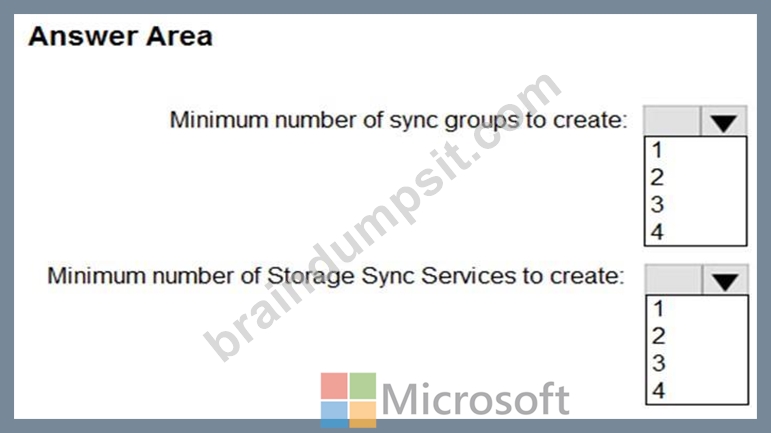
Answer:
Explanation:
Explanation:
https://docs.microsoft.com/en-us/azure/storage/file-sync/file-sync-planning
NEW QUESTION # 89
You plan to deploy an Azure virtual machine that will run Windows Server.
You need to ensure that an Azure Active Directory (Azure AD) user [email protected] can connect 10 the virtual machine by using the Azure Serial Console.
What should you do? To answer, select the appropriate options in the answer area.
NOTE: Each correct selection is worth one point.
Answer:
Explanation:
Explanation
Reference:
https://docs.microsoft.com/en-us/troubleshoot/azure/virtual-machines/serial-console-overview
NEW QUESTION # 90
Hotspot Question
You plan to deploy an Azure virtual machine that will run Windows Server. The virtual machine will host an Active Directory Domain Services (AD DS) domain controller and a drive named F: on a new virtual disk.
You need to configure storage for the virtual machine. The solution must meet the following requirements:
- Maximize resiliency for AD DS.
- Prevent accidental data loss.
How should you configure the storage? To answer, select the appropriate options in the answer area.
NOTE: Each correct selection is worth one point.
Answer:
Explanation:
Explanation:
Box 1: F
Create a separate virtual data disk for storing the database, logs, and sysvol folder for Active Directory. Do not store these items on the same disk as the operating system.
Box 2: None
By default, data disks that are attached to a VM use write-through caching. However, this form of caching can conflict with the requirements of AD DS. For this reason, set the Host Cache Preference setting on the data disk to None.
Reference:
https://docs.microsoft.com/en-us/azure/architecture/reference-architectures/identity/adds-extend- domain
NEW QUESTION # 91
Your network contains an on -premises Active Directory Domain Services (AD DS) domain named contoso.com The domain contains the objects shown in the following table.
You plan to sync contoso.com with an Azure Active Directory (Azure AD) tenant by using Azure AD Connect You need to ensure that all the objects can be used in Conditional Access policies What should you do?
- A. Change the scope o' Group1 and Group2 to Global
- B. Clear the Configure device writeback option.
- C. Change the scope of Group2 to Universal
- D. Select the Configure Hybrid Azure AD join option.
Answer: D
Explanation:
Hybrid Azure AD join needs to be configured to enable Computer1 to be used in Conditional Access Policies. Synchronized users, universal groups and domain local groups can be used in Conditional Access Policies.
NEW QUESTION # 92
Your network contains an Active Directory Domain Services (AD DS) domain named contoso.com. The domain contains the VPN servers shown in the following table.
You have a server named NPS1 that has Network Policy Server (NPS) installed. NPS1 has the following RADIUS clients:
VPN1, VPN2, and VPN3 use NPS1 for RADIUS authentication. All the users in contoso.com are allowed to establish VPN connections. For each of the following statements, select Yes If the statement is true. Otherwise, select No. NOTE: Each correct selection is worth one point.
Answer:
Explanation:
NEW QUESTION # 93
Your network contains an Active Directory Domain Services (AD DS) forest. The forest contains three Active Directory sites named Site1, Site2, and Site3. Each site contains two domain controllers. The sites are connected by using DEFAULTIPSITELINK.
You open a new branch office that contains only client computers.
You need to ensure that the client computers in the new office are primarily authenticated by the domain controllers in Site1.
Solution: You configure the Try Next Closest Site Group Policy Object (GPO) setting in a GPO that is linked to Site1.
Does this meet the goal?
- A. Yes
- B. No
Answer: B
NEW QUESTION # 94
......
The AZ-800 exam covers a wide range of topics, including Azure Arc-enabled servers, Azure Stack HCI, Azure Stack Hub, Azure hybrid networking, Azure hybrid identity, and Azure security. AZ-800 exam also assesses a candidate's ability to implement and manage hybrid server environments, configure and manage storage solutions, and implement disaster recovery and high availability solutions. To pass the exam, candidates must have a deep understanding of Microsoft technologies and be able to apply them to real-world scenarios.
Download Latest & Valid Questions For Microsoft AZ-800 exam: https://www.braindumpsit.com/AZ-800_real-exam.html
Exam Dumps for the Preparation of Latest AZ-800 Exam Questions: https://drive.google.com/open?id=1DCYyUpD-nrC2ZeKTbDUJzu5LIqVnuKlS