


Updated Apr-2024 DP-203 Free Exam Files Downloaded Instantly
Practice Exams and Training Solutions for Certifications
The DP-203 exam covers a wide range of topics related to data engineering on Azure, including data storage solutions, data processing, data integration, data security, and data monitoring and optimization. Candidates need to demonstrate their understanding of various Azure services and tools for data processing, such as Azure Data Factory, Azure Databricks, Azure HDInsight, and Azure Synapse Analytics.
NEW QUESTION # 154
You have an Azure Stream Analytics job that receives clickstream data from an Azure event hub.
You need to define a query in the Stream Analytics job. The query must meet the following requirements:
* Count the number of clicks within each 10-second window based on the country of a visitor.
* Ensure that each click is NOT counted more than once.
How should you define the Query?
SELECT Country, Avg(*) AS Average
- A. FROM ClickStream TIMESTAMP BY CreatedAt
GROUP BY Country, SessionWindow(second, 5, 10) - B. FROM ClickStream TIMESTAMP BY CreatedAt
GROUP BY Country, SlidingWindow(second, 10)
SELECT Country, Count(*) AS Count - C. FROM ClickStream TIMESTAMP BY CreatedAt
GROUP BY Country, TumblingWindow(second, 10)
SELECT Country, Avg(*) AS Average - D. FROM ClickStream TIMESTAMP BY CreatedAt
GROUP BY Country, HoppingWindow(second, 10, 2)
SELECT Country, Count(*) AS Count
Answer: C
Explanation:
Tumbling window functions are used to segment a data stream into distinct time segments and perform a function against them, such as the example below. The key differentiators of a Tumbling window are that they repeat, do not overlap, and an event cannot belong to more than one tumbling window.
Example:
Incorrect Answers:
A: Sliding windows, unlike Tumbling or Hopping windows, output events only for points in time when the content of the window actually changes. In other words, when an event enters or exits the window. Every window has at least one event, like in the case of Hopping windows, events can belong to more than one sliding window.
C: Hopping window functions hop forward in time by a fixed period. It may be easy to think of them as Tumbling windows that can overlap, so events can belong to more than one Hopping window result set. To make a Hopping window the same as a Tumbling window, specify the hop size to be the same as the window size.
D: Session windows group events that arrive at similar times, filtering out periods of time where there is no data.
Reference:
https://docs.microsoft.com/en-us/azure/stream-analytics/stream-analytics-window-functions
NEW QUESTION # 155
You have an Azure Data Lake Storage Gen2 account that contains a JSON file for customers. The file contains two attributes named FirstName and LastName.
You need to copy the data from the JSON file to an Azure Synapse Analytics table by using Azure Databricks. A new column must be created that concatenates the FirstName and LastName values.
You create the following components:
A destination table in Azure Synapse
An Azure Blob storage container
A service principal
Which five actions should you perform in sequence next in is Databricks notebook? To answer, move the appropriate actions from the list of actions to the answer area and arrange them in the correct order.
Answer:
Explanation:
Reference:
https://docs.microsoft.com/en-us/azure/azure-databricks/databricks-extract-load-sql-data-warehouse
NEW QUESTION # 156
You have an Azure Synapse workspace named MyWorkspace that contains an Apache Spark database named mytestdb.
You run the following command in an Azure Synapse Analytics Spark pool in MyWorkspace.
CREATE TABLE mytestdb.myParquetTable(
EmployeeID int,
EmployeeName string,
EmployeeStartDate date)
USING Parquet
You then use Spark to insert a row into mytestdb.myParquetTable. The row contains the following data.
One minute later, you execute the following query from a serverless SQL pool in MyWorkspace.
SELECT EmployeeID
FROM mytestdb.dbo.myParquetTable
WHERE name = 'Alice';
What will be returned by the query?
- A. a null value
- B. an error
- C. 0
Answer: B
Explanation:
Explanation
Once a database has been created by a Spark job, you can create tables in it with Spark that use Parquet as the storage format. Table names will be converted to lower case and need to be queried using the lower case name.
These tables will immediately become available for querying by any of the Azure Synapse workspace Spark pools. They can also be used from any of the Spark jobs subject to permissions.
Note: For external tables, since they are synchronized to serverless SQL pool asynchronously, there will be a delay until they appear.
Reference:
https://docs.microsoft.com/en-us/azure/synapse-analytics/metadata/table
NEW QUESTION # 157
The following code segment is used to create an Azure Databricks cluster.
For each of the following statements, select Yes if the statement is true. Otherwise, select No.
NOTE: Each correct selection is worth one point.
Answer:
Explanation:
Reference:
https://adatis.co.uk/databricks-cluster-sizing/
https://docs.microsoft.com/en-us/azure/databricks/jobs
https://docs.databricks.com/administration-guide/capacity-planning/cmbp.html
https://docs.databricks.com/delta/index.html
NEW QUESTION # 158
You have an Azure Synapse Analytics dedicated SQL pool that contains the users shown in the following table.
User1 executes a query on the database, and the query returns the results shown in the following exhibit.
User1 is the only user who has access to the unmasked data.
Use the drop-down menus to select the answer choice that completes each statement based on the information presented in the graphic.
NOTE: Each correct selection is worth one point.
Answer:
Explanation:
Reference:
https://docs.microsoft.com/en-us/azure/azure-sql/database/dynamic-data-masking-overview
NEW QUESTION # 159
You are designing a real-time dashboard solution that will visualize streaming data from remote sensors that connect to the internet. The streaming data must be aggregated to show the average value of each 10-second interval. The data will be discarded after being displayed in the dashboard.
The solution will use Azure Stream Analytics and must meet the following requirements:
Minimize latency from an Azure Event hub to the dashboard.
Minimize the required storage.
Minimize development effort.
What should you include in the solution? To answer, select the appropriate options in the answer area.
NOTE: Each correct selection is worth one point
Answer:
Explanation:
Reference:
https://docs.microsoft.com/en-us/azure/stream-analytics/stream-analytics-power-bi-dashboard
NEW QUESTION # 160
You are designing an Azure Stream Analytics solution that receives instant messaging data from an Azure Event Hub.
You need to ensure that the output from the Stream Analytics job counts the number of messages per time zone every 15 seconds.
How should you complete the Stream Analytics query? To answer, select the appropriate options in the answer area.
NOTE: Each correct selection is worth one point.
Answer:
Explanation:
Explanation
Table Description automatically generated
Box 1: timestamp by
Box 2: TUMBLINGWINDOW
Tumbling window functions are used to segment a data stream into distinct time segments and perform a function against them, such as the example below. The key differentiators of a Tumbling window are that they repeat, do not overlap, and an event cannot belong to more than one tumbling window.
Timeline Description automatically generated
Reference:
https://docs.microsoft.com/en-us/azure/stream-analytics/stream-analytics-window-functions
NEW QUESTION # 161
You have an Azure Storage account that generates 200.000 new files daily. The file names have a format of (YYY)/(MM)/(DD)/|HH])/(CustornerID).csv.
You need to design an Azure Data Factory solution that will toad new data from the storage account to an Azure Data lake once hourly. The solution must minimize load times and costs.
How should you configure the solution? To answer, select the appropriate options in the answer area.
NOTE: Each correct selection is worth one point.
Answer:
Explanation:
See the answer below in explanation.
Explanation
answer as below
NEW QUESTION # 162
What should you do to improve high availability of the real-time data processing solution?
- A. Set Data Lake Storage to use geo-redundant storage (GRS).
- B. Deploy identical Azure Stream Analytics jobs to paired regions in Azure.
- C. Deploy an Azure Stream Analytics job and use an Azure Automation runbook to check the status of the job and to start the job if it stops.
- D. Deploy a High Concurrency Databricks cluster.
Answer: B
Explanation:
Explanation
Guarantee Stream Analytics job reliability during service updates
Part of being a fully managed service is the capability to introduce new service functionality and improvements at a rapid pace. As a result, Stream Analytics can have a service update deploy on a weekly (or more frequent) basis. No matter how much testing is done there is still a risk that an existing, running job may break due to the introduction of a bug. If you are running mission critical jobs, these risks need to be avoided. You can reduce this risk by following Azure's paired region model.
Scenario: The application development team will create an Azure event hub to receive real-time sales data, including store number, date, time, product ID, customer loyalty number, price, and discount amount, from the point of sale (POS) system and output the data to data storage in Azure Reference:
https://docs.microsoft.com/en-us/azure/stream-analytics/stream-analytics-job-reliability
NEW QUESTION # 163
You are designing a folder structure for the files m an Azure Data Lake Storage Gen2 account. The account has one container that contains three years of data.
You need to recommend a folder structure that meets the following requirements:
* Supports partition elimination for queries by Azure Synapse Analytics serverless SQL pooh
* Supports fast data retrieval for data from the current month
* Simplifies data security management by department
Which folder structure should you recommend?
- A. \Depdftment\DataSource\YYY\MM\DataFile_YYYYMMDD.parquet
- B. \DD\MM\YYYY\Department\DataSource\DataFile_DDMMYY.parquet
- C. \YYY\MM\DD\Department\DataSource\DataFile_YYYMMMDD.parquet
- D. \DataSource\Department\YYYYMM\DataFile_YYYYMMDD.parquet
Answer: A
Explanation:
Department top level in the hierarchy to simplify security management.
Month (MM) at the leaf/bottom level to support fast data retrieval for data from the current month.
NEW QUESTION # 164
You have the following Azure Stream Analytics query.
For each of the following statements, select Yes if the statement is true. Otherwise, select No.
NOTE: Each correct selection is worth one point.
Answer:
Explanation:
Explanation
Box 1: Yes
You can now use a new extension of Azure Stream Analytics SQL to specify the number of partitions of a stream when reshuffling the data.
The outcome is a stream that has the same partition scheme. Please see below for an example:
WITH step1 AS (SELECT * FROM [input1] PARTITION BY DeviceID INTO 10),
step2 AS (SELECT * FROM [input2] PARTITION BY DeviceID INTO 10)
SELECT * INTO [output] FROM step1 PARTITION BY DeviceID UNION step2 PARTITION BY DeviceID Note: The new extension of Azure Stream Analytics SQL includes a keyword INTO that allows you to specify the number of partitions for a stream when performing reshuffling using a PARTITION BY statement.
Box 2: Yes
When joining two streams of data explicitly repartitioned, these streams must have the same partition key and partition count.
Box 3: Yes
10 partitions x six SUs = 60 SUs is fine.
Note: Remember, Streaming Unit (SU) count, which is the unit of scale for Azure Stream Analytics, must be adjusted so the number of physical resources available to the job can fit the partitioned flow. In general, six SUs is a good number to assign to each partition. In case there are insufficient resources assigned to the job, the system will only apply the repartition if it benefits the job.
Reference:
https://azure.microsoft.com/en-in/blog/maximize-throughput-with-repartitioning-in-azure-stream-analytics/
NEW QUESTION # 165
You need to implement an Azure Synapse Analytics database object for storing the sales transactions data. The solution must meet the sales transaction dataset requirements.
What solution must meet the sales transaction dataset requirements.
What should you do? To answer, select the appropriate options in the answer area.
NOTE: Each correct selection is worth one point.
Answer:
Explanation:
Explanation
Graphical user interface, text, application, table Description automatically generated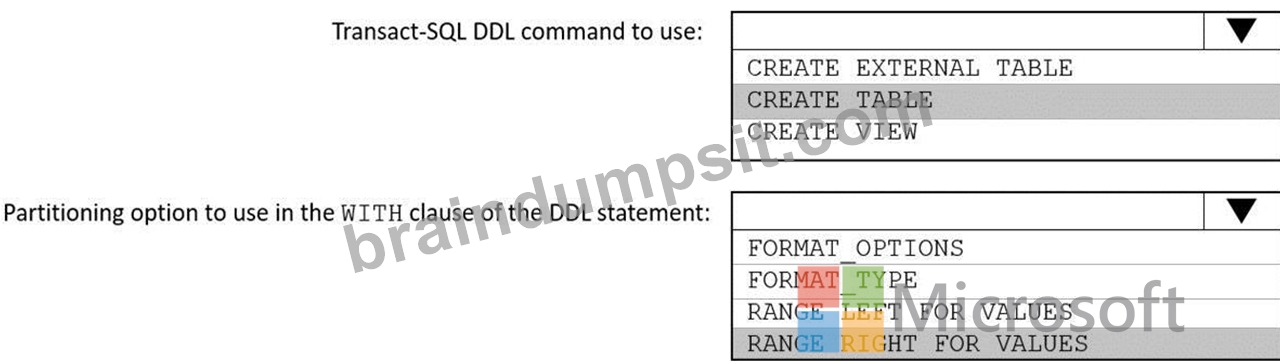
Box 1: Create table
Scenario: Load the sales transaction dataset to Azure Synapse Analytics Box 2: RANGE RIGHT FOR VALUES Scenario: Partition data that contains sales transaction records. Partitions must be designed to provide efficient loads by month. Boundary values must belong to the partition on the right.
RANGE RIGHT: Specifies the boundary value belongs to the partition on the right (higher values).
FOR VALUES ( boundary_value [,...n] ): Specifies the boundary values for the partition.
Scenario: Load the sales transaction dataset to Azure Synapse Analytics.
Contoso identifies the following requirements for the sales transaction dataset:
* Partition data that contains sales transaction records. Partitions must be designed to provide efficient loads by month. Boundary values must belong to the partition on the right.
* Ensure that queries joining and filtering sales transaction records based on product ID complete as quickly as possible.
* Implement a surrogate key to account for changes to the retail store addresses.
* Ensure that data storage costs and performance are predictable.
* Minimize how long it takes to remove old records.
Reference:
https://docs.microsoft.com/en-us/sql/t-sql/statements/create-table-azure-sql-data-warehouse
NEW QUESTION # 166
You need to implement an Azure Databricks cluster that automatically connects to Azure Data lake Storage Gen2 by using Azure Active Directory (Azure AD) integration. How should you configure the new clutter? To answer, select the appropriate options in the answers area. NOTE: Each correct selection is worth one point.
Answer:
Explanation:
Explanation
https://docs.azuredatabricks.net/spark/latest/data-sources/azure/adls-passthrough.html
NEW QUESTION # 167
You have an Azure Synapse Analytics dedicated SQL pool.
You run PDW_SHOWSPACEUSED(dbo,FactInternetSales'); and get the results shown in the following table.
Which statement accurately describes the dbo,FactInternetSales table?
- A. The table is skewed.
- B. The table contains less than 1,000 rows.
- C. All distributions contain data.
- D. The table uses round-robin distribution.
Answer: C
Explanation:
Explanation
Data skew means the data is not distributed evenly across the distributions.
Reference:
https://docs.microsoft.com/en-us/azure/synapse-analytics/sql-data-warehouse/sql-data-warehouse-tables-distribu
NEW QUESTION # 168
You need to create a partitioned table in an Azure Synapse Analytics dedicated SQL pool.
How should you complete the Transact-SQL statement? To answer, drag the appropriate values to the correct targets. Each value may be used once, more than once, or not at all. You may need to drag the split bar between panes or scroll to view content.
NOTE: Each correct selection is worth one point.
Answer:
Explanation:
Reference:
https://docs.microsoft.com/en-us/sql/t-sql/statements/create-table-azure-sql-data-warehouse?
NEW QUESTION # 169
You plan to monitor an Azure data factory by using the Monitor & Manage app.
You need to identify the status and duration of activities that reference a table in a source database.
Which three actions should you perform in sequence? To answer, move the actions from the list of actions to the answer are and arrange them in the correct order.
Answer:
Explanation:
Explanation
Step 1: From the Data Factory authoring UI, generate a user property for Source on all activities.
Step 2: From the Data Factory monitoring app, add the Source user property to Activity Runs table.
You can promote any pipeline activity property as a user property so that it becomes an entity that you can monitor. For example, you can promote the Source and Destination properties of the copy activity in your pipeline as user properties. You can also select Auto Generate to generate the Source and Destination user properties for a copy activity.
Step 3: From the Data Factory authoring UI, publish the pipelines
Publish output data to data stores such as Azure SQL Data Warehouse for business intelligence (BI) applications to consume.
References:
https://docs.microsoft.com/en-us/azure/data-factory/monitor-visually
NEW QUESTION # 170
You have an Azure Synapse Analytics serverless SQL pool, an Azure Synapse Analytics dedicated SQL pool, an Apache Spark pool, and an Azure Data Lake Storage Gen2 account.
You need to create a table in a lake database. The table must be available to both the serverless SQL pool and the Spark pool.
Where should you create the table, and Which file format should you use for data in the table? TO answer, select the appropriate options in the answer area.
NOTE: Each correct selection is worth one point.
Answer:
Explanation:
Explanation
The dedicated SQL pool
Apache Parquet
NEW QUESTION # 171
You have an Azure Databricks resource.
You need to log actions that relate to changes in compute for the Databricks resource.
Which Databricks services should you log?
- A. clusters
- B. DBFS
- C. SSH
E lobs - D. workspace
Answer: D
Explanation:
Explanation
Cloud Provider Infrastructure Logs.Databricks logging allows security and admin teams to demonstrate conformance to data governance standards within or from a Databricks workspace. Customers, especially in the regulated industries, also need records on activities like:- User access control to cloud data storage- Cloud Identity and Access Management roles- User access to cloud network and compute Azure Databricks offers three distinct workloads on several VM Instances tailored for your data analytics workflow-the Jobs Compute and Jobs Light Compute workloads make it easy for data engineers to build and execute jobs, and the All-Purpose Compute workload makes it easy for data scientists to explore, visualize, manipulate, and share data and insights interactively.
NEW QUESTION # 172
You use Azure Data Factory to prepare data to be queried by Azure Synapse Analytics serverless SQL pools.
Files are initially ingested into an Azure Data Lake Storage Gen2 account as 10 small JSON files. Each file contains the same data attributes and data from a subsidiary of your company.
You need to move the files to a different folder and transform the data to meet the following requirements:
Provide the fastest possible query times.
Automatically infer the schema from the underlying files.
How should you configure the Data Factory copy activity? To answer, select the appropriate options in the answer area.
NOTE: Each correct selection is worth one point.
Answer:
Explanation:
Reference:
https://docs.microsoft.com/en-us/azure/storage/blobs/data-lake-storage-introduction
https://docs.microsoft.com/en-us/azure/data-factory/format-parquet
NEW QUESTION # 173
You have an Azure subscription.
You need to deploy an Azure Data Lake Storage Gen2 Premium account. The solution must meet the following requirements:
* Blobs that are older than 365 days must be deleted.
* Administrator efforts must be minimized.
* Costs must be minimized
What should you use? To answer, select the appropriate options in the answer are a. NOTE Each correct selection is worth one point.
Answer:
Explanation:
NEW QUESTION # 174
You are creating dimensions for a data warehouse in an Azure Synapse Analytics dedicated SQL pool.
You create a table by using the Transact-SQL statement shown in the following exhibit.
Use the drop-down menus to select the answer choice that completes each statement based on the information presented in the graphic.
NOTE: Each correct selection is worth one point.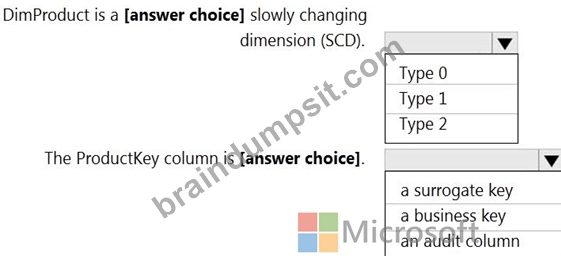
Answer:
Explanation:
Reference:
https://docs.microsoft.com/en-us/learn/modules/populate-slowly-changing-dimensions-azure-synapse-analytics-pipelines/3-choose-between-dimension-types
NEW QUESTION # 175
You have an Azure Data Lake Storage Gen2 account that contains two folders named Folder and Folder2.
You use Azure Data Factory to copy multiple files from Folder1 to Folder2.
You receive the following error.
What should you do to resolve the error.
- A. Add an explicit mapping.
- B. Change the Copy activity setting to Binary Copy
- C. Lower the degree of copy parallelism
- D. Enable fault tolerance to skip incompatible rows.
Answer: D
NEW QUESTION # 176
You have an Azure subscription that contains the following resources:
An Azure Active Directory (Azure AD) tenant that contains a security group named Group1 An Azure Synapse Analytics SQL pool named Pool1 You need to control the access of Group1 to specific columns and rows in a table in Pool1.
Which Transact-SQL commands should you use? To answer, select the appropriate options in the answer area.
Answer:
Explanation:
Reference:
https://docs.microsoft.com/en-us/azure/synapse-analytics/sql-data-warehouse/column-level-security
NEW QUESTION # 177
You have an Azure subscription that contains an Azure Data Lake Storage account named myaccount1. The myaccount1 account contains two containers named container1 and contained. The subscription is linked to an Azure Active Directory (Azure AD) tenant that contains a security group named Group1.
You need to grant Group1 read access to contamer1. The solution must use the principle of least privilege.
Which role should you assign to Group1?
- A. Storage Table Data Reader for container1
- B. Storage Blob Data Reader for myaccount1
- C. Storage Blob Data Reader for container1
- D. Storage Table Data Reader for myaccount1
Answer: C
Explanation:
Topic 2, Contoso Case StudyTransactional Date
Contoso has three years of customer, transactional, operation, sourcing, and supplier data comprised of 10 billion records stored across multiple on-premises Microsoft SQL Server servers. The SQL server instances contain data from various operational systems. The data is loaded into the instances by using SQL server integration Services (SSIS) packages.
You estimate that combining all product sales transactions into a company-wide sales transactions dataset will result in a single table that contains 5 billion rows, with one row per transaction.
Most queries targeting the sales transactions data will be used to identify which products were sold in retail stores and which products were sold online during different time period. Sales transaction data that is older than three years will be removed monthly.
You plan to create a retail store table that will contain the address of each retail store. The table will be approximately 2 MB. Queries for retail store sales will include the retail store addresses.
You plan to create a promotional table that will contain a promotion ID. The promotion ID will be associated to a specific product. The product will be identified by a product ID. The table will be approximately 5 GB.
Streaming Twitter Data
The ecommerce department at Contoso develops and Azure logic app that captures trending Twitter feeds referencing the company's products and pushes the products to Azure Event Hubs.
Planned Changes
Contoso plans to implement the following changes:
* Load the sales transaction dataset to Azure Synapse Analytics.
* Integrate on-premises data stores with Azure Synapse Analytics by using SSIS packages.
* Use Azure Synapse Analytics to analyze Twitter feeds to assess customer sentiments about products.
Sales Transaction Dataset Requirements
Contoso identifies the following requirements for the sales transaction dataset:
* Partition data that contains sales transaction records. Partitions must be designed to provide efficient loads by month. Boundary values must belong: to the partition on the right.
* Ensure that queries joining and filtering sales transaction records based on product ID complete as quickly as possible.
* Implement a surrogate key to account for changes to the retail store addresses.
* Ensure that data storage costs and performance are predictable.
* Minimize how long it takes to remove old records.
Customer Sentiment Analytics Requirement
Contoso identifies the following requirements for customer sentiment analytics:
* Allow Contoso users to use PolyBase in an A/ure Synapse Analytics dedicated SQL pool to query the content of the data records that host the Twitter feeds. Data must be protected by using row-level security (RLS). The users must be authenticated by using their own A/ureAD credentials.
* Maximize the throughput of ingesting Twitter feeds from Event Hubs to Azure Storage without purchasing additional throughput or capacity units.
* Store Twitter feeds in Azure Storage by using Event Hubs Capture. The feeds will be converted into Parquet files.
* Ensure that the data store supports Azure AD-based access control down to the object level.
* Minimize administrative effort to maintain the Twitter feed data records.
* Purge Twitter feed data records;itftaitJ are older than two years.
Data Integration Requirements
Contoso identifies the following requirements for data integration:
Use an Azure service that leverages the existing SSIS packages to ingest on-premises data into datasets stored in a dedicated SQL pool of Azure Synaps Analytics and transform the data.
Identify a process to ensure that changes to the ingestion and transformation activities can be version controlled and developed independently by multiple data engineers.
NEW QUESTION # 178
You are implementing an Azure Stream Analytics solution to process event data from devices.
The devices output events when there is a fault and emit a repeat of the event every five seconds until the fault is resolved. The devices output a heartbeat event every five seconds after a previous event if there are no faults present.
A sample of the events is shown in the following table.
You need to calculate the uptime between the faults.
How should you complete the Stream Analytics SQL query? To answer, select the appropriate options in the answer are a.
NOTE: Each correct selection is worth one point.
Answer:
Explanation:
Reference:
https://docs.microsoft.com/en-us/stream-analytics-query/session-window-azure-stream-analytics
https://docs.microsoft.com/en-us/stream-analytics-query/tumbling-window-azure-stream-analytics
NEW QUESTION # 179
......
Q&As with Explanations Verified & Correct Answers: https://www.braindumpsit.com/DP-203_real-exam.html
Dumps Free Test Engine Player Verified Answers: https://drive.google.com/open?id=1I5jpeb2XOcY125r3x5z9daDNMgcnDnPn