


Updated Jan 16, 2024 Test Engine to Practice Test for CCBA Valid and Updated Dumps
Exam Questions for CCBA Updated Versions With Test Engine
The CCBA exam covers various topics such as business analysis planning and monitoring, elicitation and collaboration, requirements life cycle management, strategy analysis, and requirements analysis and design definition. CCBA exam comprises of 130 multiple-choice questions, and candidates have three hours to complete it. CCBA exam is available in a computer-based format and can be taken at various exam centers worldwide. Passing the CCBA exam requires a minimum score of 70%, which is considered a challenging pass rate.
NEW QUESTION # 243
A key stakeholder has requested an extensive range of performance measures for a replacement workflow system. A business analyst (BA) has decided to work closely with the stakeholder to validate the performance measures requested. The BA will be ensuring that the performance measures:
- A. align to industry benchmarks gathered for similar solution implementations.
- B. align with other measures within the broader context of the solution.
- C. are written in the correct format. using the agreed standards and terminology.
- D. are ether qualitative or quantitative measurements, but not both.
Answer: A
NEW QUESTION # 244
The RGQ Organization utilizes a change log. What is a change log?
- A. It is a document that records all change requests for the project.
- B. It is a document that tracks the changes that have been received, including their implementation to the project solution.
- C. It is a document that tracks all characteristics and status of changes that have been received.
- D. It is a document that tracks all unauthorized changes to the project solution.
Answer: C
Explanation:
A change log tracks all characteristics of a proposed change request and it status.
Answer A is incorrect. The change log tracks change requests and its status.
Answer B is incorrect. This description is close to being accurate, but the change log records the status of the change request too.
Answer C is incorrect. This statement is false because a request for change can be made, but it does not necessarily mean that the change will be implemented into the project.
NEW QUESTION # 245
A business analyst (BA) creates the following diagram as part of current state analysis activities.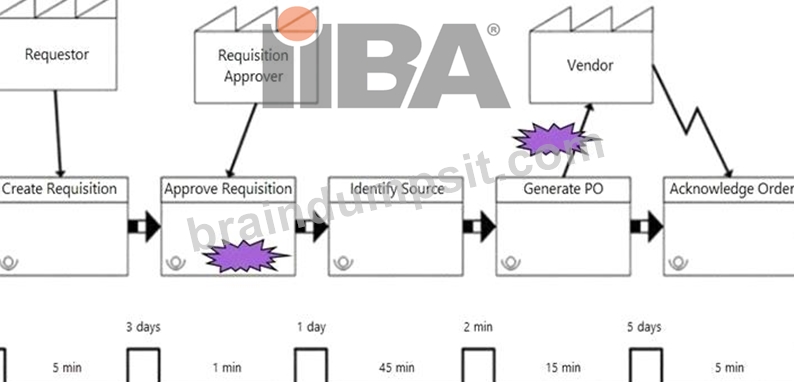
What does a diagram of this type help users to understand?
- A. Decision-making
- B. Process improvement
- C. Business capability
- D. Regulatory compliance
Answer: B
Explanation:
The diagram that the BA created is a flowchart diagram of a procurement process. A flowchart diagram is a graphical representation of a process that shows the steps, decisions, inputs, outputs, and roles involved. A diagram of this type can help users to understand process improvement by identifying the current state of the process, highlighting the pain points, bottlenecks, delays, or inefficiencies, and suggesting ways to optimize or streamline the process. References: Flowchart Diagram, Process Improvement
NEW QUESTION # 246
In order to plan the business analysis approach, the business analyst must understand the organizational process needs and what other thing?
- A. Objectives that apply to the initiative
- B. Stakeholders' threats and perceived threats
- C. Purpose of the proposed solution
- D. Consideration of risk and reward
Answer: A
Explanation:
Explanation
The business analyst must understand how the organization operates and the objectives of business analysis duties. Without a clear understanding of what the expected outcomes are to be of the business analysis duties, the business analyst cannot adequately plan for the business analysis duties.
Answer B is incorrect. It's important for the business analyst to identify and categorize stakeholders, but this isn't the best answer for this QUESTION.
Answer D is incorrect. The purpose of the proposed solution is valid only if the initiative is to solve a problem. Business analysis can also occur to detail an opportunity, not just to create solutions to identified problems.
Answer C is incorrect. This isn't the best answer for this QUESTION.
NEW QUESTION # 247
In preparation for your business analysis examinations, you should be familiar with the tasks to complete requirements management and communication activities. How many tasks are there in the knowledge area of requirements management and communication?
- A. 0
- B. 1
- C. 2
- D. 3
Answer: A
NEW QUESTION # 248
A business analyst (BA) is examining the relationships between elicited requirements on a project. What quality criteria must be satisfied when the BA is defining requirements relationships?
- A. Source
- B. Priority
- C. Necessary
- D. Complexity
Answer: C
NEW QUESTION # 249
The business analyst (BA) assigned to support a legacy system has developed a customer survey to assess its usability. Before distributing the survey, what should the BA do?
- A. Observe customer interaction with the system
- B. Update the project plan to include the survey
- C. Review the risk register with the project sponsor
- D. Validate the survey with the project sponsor
Answer: D
NEW QUESTION # 250
As a business analyst, you should work to identify opportunities to improve the operations of your organization. Which one of the following improvement opportunities aims to improve the experience of the customer?
- A. Improve the purchasing process.
- B. Automate or simplify the work people perform.
- C. Increase consistency of behavior.
- D. Eliminate redundancy.
Answer: C
Explanation:
When customers experience the same process, such as checkout in different ways, it's frustrating. This improvement opportunity aims to create consistency in all behaviors to improve the customer experience.
Answer B is incorrect. Automating or simplifying the work people perform helps streamline costs and improve quality by doing the work in the same way each time the work is performed.
Answer A is incorrect. Eliminating redundancy considers that stakeholders may have common needs that can be met with a single solution, reducing the cost of implementation.
Answer D is incorrect. While this choice is tempting, it's not an actual improvement opportunity for the business analyst to consider.
NEW QUESTION # 251
Marcy is working with stakeholders to understand the stakeholders' needs as part of the business requirements.
The stakeholders are describing their needs for new computers for their designers. The stakeholders have specifications, monitors, and software selected for the business requirements. What are the stakeholders actually defining in this scenario?
- A. Perceived problems
- B. Solutions
- C. Longevity
- D. Perceived needs
Answer: B
Explanation:
In this scenario, the stakeholders are actually defining their selected solution and not the needs that should lead to the best solution. When defining the requirements, it's best that stakeholders define the problem to understand their needs, not a solution.
Answer C is incorrect. The stakeholders' needs aren't discussed, but their solution is.
Answer B is incorrect. This scenario isn't an example of problems or issues, but of the stakeholders' defined solution.
Answer D is incorrect. Longevity isn't a valid answer for this scenario.
NEW QUESTION # 252
Bonny is the business analyst for her organization and she's making a determination from which vendor the solution should be purchased. She has identified several categories to measure each vendor's overall performance and solution. cost, schedule, experience, certification, references, and years in business. For each category, she has identified scores the vendor may earn; for example, cost is worth 25 points, schedule is worth up to 20 points, and years in business is worth up to ten points. The vendor who gets the most points in the assessment will win the contract. What is Bonny using in this scenario?
- A. Weighted scoring model
- B. Scoring model
- C. Screening system
- D. Vendor profile assessment scale
Answer: A
Explanation:
Explanation
This is an example of a weighted scoring model; as some categories are more valued than others, they carry more weight in the decision.
Answer D is incorrect. A screening system is a method to "screen out" a vendor from selection. Answer A is incorrect. A scoring model is almost correct, but this usually has a uniform score for each category, rather than weighted values for each category.
Answer B is incorrect. This isn't a valid term for this QUESTION so this choice is not correct.
NEW QUESTION # 253
Which of the following documents graphically depicts the project team members and displays their interrelationship for a specific project?
- A. Project charter
- B. Project team directory
- C. Project organization chart
- D. Project scope statement
Answer: C
Explanation:
Explanation
Project organization chart is a document that graphically portrays the team members of the project and their interrelationships for a specific project. An organization chart is a diagram that shows the hierarchical structure of an organization. Usually a chart starts with a higher or superior level and branches downward to subordinate levels.
Answer D is incorrect. The project charter is the document that formally authorizes a project. The project charter provides the project manager with the authority to apply organizational resources to project activities.
Answer A is incorrect. It is a documented list of project team members, their project roles, and communication information.
Answer C is incorrect. Project scope statement is the narrative description of the project scope. It includes major deliverables, project assumptions, project constraints, and a description of work. It helps developing a common understanding of project scope among the stakeholders. It is a documented description of the project to answer Questions such as What is being produced? How is it being produced? What is included? etc.
NEW QUESTION # 254
According to 'A Guide to the Business Analysis Body of Knowledge', when should the business analyst and an organization actually start requirements allocation?
- A. After the project charter
- B. After approval of the requirements
- C. As soon as the solution approach is determined
- D. As soon as a budget has been created
Answer: C
NEW QUESTION # 255
As a business analyst in your organization, you must understand the difference between operative rules and structural rules. What is the difference between structural rules and operative rules?
- A. Structural rules are rules that the organization chooses to enforce as a matter of policy. Operative rules are intended to help determine when something is or is not true, or when things fall into a specific category.
- B. Operative rules are rules that describe the organizational process assets of the organization. Structural rules are policies that restrict the authority of each line of business.
- C. Operative rules are rules that define how an organization operates. Structural rules define the boundaries of the structure, business units, and departments within the organization.
- D. Operative rules are rules that the organization chooses to enforce as a matter of policy. Structural rules are intended to help determine when something is or is not true, or when things fall into a specific category.
Answer: D
NEW QUESTION # 256
You are the business analyst for your organization and you're preparing to elicit requirements from the stakeholders. You've gathered several inputs to help with the elicitation process. Which input(s) will be used to ensure that you understand the type of information that should be elicited from the stakeholders?
- A. Business need
- B. Risk assessment
- C. Stakeholder list
- D. Roles and responsibility
Answer: A
Explanation:
Explanation
The business need and the solution scope are the two inputs which help the business analyst understand what should be elicited from the stakeholders.
Answer A is incorrect. Stakeholder list, roles, and responsibilities help the business analyst understand from
whom the requirements should be elicited.
Answer D is incorrect. Stakeholder list, roles, and responsibilities help the business analyst understand from
whom the requirements should be elicited.
Answer B is incorrect. Risk assessment is a review of the risks in the project and isn't an input to elicitation
business analyst tasks.
NEW QUESTION # 257
You have identified a task in your task list that cannot be completed until the inspector for the project signs off on the initial deliverables. The inspector's signoff on the initial deliverables is called what?
- A. Dependency
- B. Milestone
- C. Assumption
- D. Constraint
Answer: A
NEW QUESTION # 258
When do change requests generally increase in a project?
- A. Towards the beginning of the project.
- B. During the project scope management processes.
- C. Towards the end of the project.
- D. During the project's launch.
Answer: C
Explanation:
Explanation
Changes generally increase towards the end of the project. This can be due to a loosely defined scope, lack of requirements, and other reasons.
Answer B is incorrect. The scope management process happens throughout the project until the scope is
completed.
Answer C is incorrect. Changes are easier to incorporate at the launch of the project but generally do not
happen until later in the project.
Answer A is incorrect. Scope changes generally happen towards the end of the project.
NEW QUESTION # 259
What's the difference between a desired outcome and a solution? Choose the best answer.
- A. The solution is the ideal fulfillment of the business goals; the desired outcome is the financial gain created by the implementation of the solution.
- B. The desired outcome is what the solution will remove.
- C. The desired outcome is how the organization will operate in the future; the solution is the method to reach the desired outcome.
- D. They are synonymous.
Answer: C
Explanation:
Explanation
Of all the choices, only this answer properly identifies the desired outcome as how the organization will operate once the solution has been implemented.
Answer B is incorrect. Business goals and desired outcomes are not the same. Answer D is incorrect. The solution doesn't remove the desired outcome.
Answer C is incorrect. The solution is not always a financial gain so this choice is not valid.
NEW QUESTION # 260
Beth is the business analyst for her organization and she's creating a data dictionary for her organization. All of the following information should be included in the data dictionary for an endeavor Beth is leading except for which one?
- A. Description
- B. Aliases
- C. Code of account identifier
- D. Name
Answer: C
NEW QUESTION # 261
You are the business analyst for a new project. Part of this project is for the project team to manually install new workstations through the company's campus. Based on your research you have determined that the project team can install 25 new workstations per hour. Since there is a fixed amount of time that these workstations need to be installed you are considering adding additional labor for the implementation. You are also considering to adjust the prioritization of the project requirements based on the amount of workstations the project team can install per hour. What does the 25 workstations per hour represent in this scenario?
- A. Timeboxing
- B. Report project
- C. Parametric estimate
- D. Planning
Answer: A
NEW QUESTION # 262
You are the business analyst for your organization. You are currently writing the business goals and objectives as part of the elements for the define business process. Which one of the following statements best describes the business goals and objectives element?
- A. They describe all of the positive benefits in ratio to the risk and costs of the project.
- B. They describe all of the required work the project will need to complete in order to reach its objectives.
- C. They describe the ends that the organization is seeking to achieve.
- D. They describe the processes the solution will need to improve for the project to be successful.
Answer: C
Explanation:
Explanation/Reference:
Business goals and objectives clearly define the ends that the organization is seeking to achieve.
C is incorrect. This is not a valid definition of the business goals and objectives.
A is incorrect. This is a definition of the project scope.
D is incorrect. This is not a valid definition of the business goals and objectives.
NEW QUESTION # 263
A business analyst (BA) elicits requirements from end users for a new application, and then completes a set of use cases and use case scenarios. What should the BA do next?
- A. Identify all the roles and responsibilities
- B. Review the use case scenarios
- C. Create acceptance and evaluation
- D. Conduct a requirements workshop
Answer: B
Explanation:
The BA should review the use case scenarios after eliciting requirements from end users for a new application, and then completing a set of use cases and use case scenarios. Reviewing the use case scenarios means verifying and validating that they are accurate, complete, clear, consistent, and aligned with the stakeholder needs and expectations. Reviewing the use case scenarios can help to ensure the quality and correctness of the requirements.
The other options are incorrect because:
Option A is incorrect because identifying all the roles and responsibilities is not an action that the BA takes after eliciting requirements from end users for a new application, and then completing a set of use cases and use case scenarios. Identifying all the roles and responsibilities means defining and documenting the functions or duties that stakeholders perform within an organization or a project.
Identifying all the roles and responsibilities can help to engage and collaborate with the relevant stakeholders.
Option C is incorrect because conducting a requirements workshop is not an action that the BA takes after eliciting requirements from end users for a new application, and then completing a set of use cases and use case scenarios. Conducting a requirements workshop means facilitating a structured session with stakeholders to elicit, analyze, communicate, or validate requirements. Conducting a requirements workshop can help to gather information from multiple stakeholders in an interactive way.
Option D is incorrect because creating acceptance criteria is not an action that the BA takes after eliciting requirements from end users for a new application, and then completing a set of use cases and use case scenarios. Creating acceptance criteria means defining and documenting the conditions or standards that must be met by a solution to be accepted by stakeholders. Creating acceptance criteria can help to evaluate the performance and value of the solution.
References:
BABOK Guide v3, section 10.46: Use Cases
CCBA Exam Questions, question 22
NEW QUESTION # 264
You are the business analyst for your organization and you're working with your team to define the business problem. As part of this analysis, you've identified the adverse impacts of the problem, the benefits from a potential solution, and how quickly the problem could be solved. What other element should you consider?
- A. Vendors input and paid solutions
- B. Underlying source of the problem
- C. Competition and their approach
- D. Dataflow of the problem
Answer: B
NEW QUESTION # 265
Which one of the following is not an event-based elicitation technique?
- A. Interface analysis
- B. Workshop
- C. Focus group
- D. Interview
Answer: A
Explanation:
Explanation
Interface analysis is not an event-based elicitation technique. It is an elicitation technique that identifies interfaces between solutions and how the interfaces will interact.
Answer D is incorrect. A workshop is an event-based elicitation technique. Answer A is incorrect. A focus group is an event-based elicitation technique. Answer C is incorrect. An interview is an event-based elicitation technique.
NEW QUESTION # 266
As a business analyst, it's important to understand the relationships among requirements. All of the following are valid relationship types among requirements except for which one?
- A. Linked
- B. Cover
- C. Subset
- D. Necessity
Answer: A
Explanation:
Explanation
There is not a relationship type called linked. There are five relationship types among requirements. necessity, effort, subset, cover, and value.
Answer B is incorrect. Necessity is a relationship type that describes the linkage between requirements based on the implementation of one requirement in order to add the second requirement.
Answer D is incorrect. The subset relationship type describes the decomposition of one requirement to more specific requirements.
Answer C is incorrect. The cover relationship among requirements describes the top-level requirement of a decomposed requirement.
NEW QUESTION # 267
......
CCBA Exam Dumps - Free Demo & 365 Day Updates: https://www.braindumpsit.com/CCBA_real-exam.html
Pass CCBA Exam with Updated CCBA Exam Dumps PDF: https://drive.google.com/open?id=1GHR_ZVp9zhhT0tAaPvH2hXmFcBtmpa1c