


Best Way To Study For Oracle 1z0-071 Exam Brilliant 1z0-071 Exam Questions PDF
Updated Verified Pass 1z0-071 Exam - Real Questions & Answers
What is the duration, language, and format of Oracle 1Z0-071: Oracle Database SQL Exam
- This exam consists of 78 questions.
- There is a time limit of 120 minutes for the exam.
- The type of questions is Multiple Choice questions.
- This exam is only offered in English.
- Certification Validity period : 3 years.
- Passing score: 63%
Certifications from the Oracle database include frequent recertification. To keep your certificate valid, you must upgrade to the latest version within 1 year of the revocation of Oracle’s credentials.
NEW QUESTION 167
Which three statements are correct regarding indexes? (Choose three.)
- A. For each DML operation performed, the corresponding indexes are automatically updated.
- B. When a table is dropped, the corresponding indexes are automatically dropped.
- C. A non-deferrable PRIMARY KEYor UNIQUE KEYconstraint in a table automatically attempts to creates a unique index.
- D. Indexes should be created on columns that are frequently referenced as part of any expression.
Answer: A,B,C
Explanation:
Explanation/Reference:
References:
http://viralpatel.net/blogs/understanding-primary-keypk-constraint-in-oracle/
NEW QUESTION 168
Examine the commands used to create department details and course details: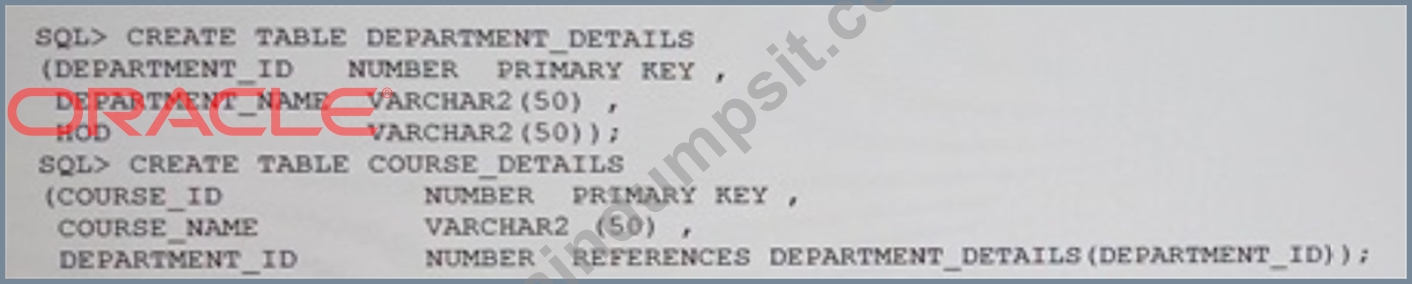
You want to generate a list of all department IDs that do not exist in the COURSE_DETAILS table. You execute the SQL statement:
What is the outcome?
- A. It fails because the ON clause condition is not valid
- B. It executes successfully and displays the required list.
- C. it fails because the Join type used is Incorrect
- D. It executes successfully but displays an incorrect list.
Answer: C
NEW QUESTION 169
The PRODUCT_INFORMATIONtable has a UNIT_PRICEcolumn of data type NUMBER (8, 2).
Evaluate this SQL statement:
SELECT TO_CHAR(unit_price, '$9,999') FROM product_information;
Which two statements are true about the output? (Choose two.)
- A. A row whose UNIT_PRICEcolumn contains the value 10235.99will be displayed as #######.
- B. A row whose UNIT_PRICEcolumn contains the value 10235.99will be displayed as $1,0236.
- C. A row whose UNIT_PRICEcolumn contains the value 1023.99will be displayed as $1,024.
- D. A row whose UNIT_PRICEcolumn contains the value 10235.99will be displayed as $1,023.
- E. A row whose UNIT_PRICEcolumn contains the value 1023.99will be displayed as $1,023.
Answer: A,E
NEW QUESTION 170
View the Exhibits and examine PRODUCTS and SALES tables.
Exhibit 1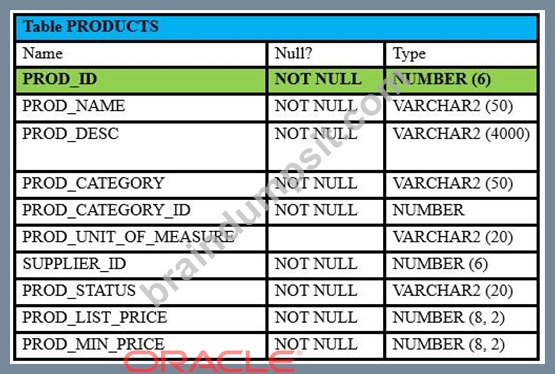
Exhibit 2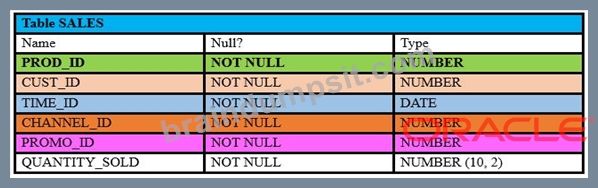
You issue the following query to display product name the number of times the product has been sold:
What happens when the above statement is executed?
- A. The statement executes successfully and produces the required output.
- B. The statement produces an error because ITEM_CNT cannot be displayed in the outer query.
- C. The statement produces an error because a subquery in the FROM clause and outer- joins cannot be used together.
- D. The statement produces an error because the GROUP BY clause cannot be used in a subquery in the FROM clause.
Answer: A
NEW QUESTION 171
View the Exhibit and examine the details of PRODUCT_INFORMATIONtable.
PRODUCT_NAME CATEGORY_ID SUPPLIER_ID
Inkjet C/8/HQ 12 102094
Inkjet C/4 12 102090
LaserPro 600/6/BW 12 102087
LaserPro 1200/8/BW 12 102099
Inkjet B/6 12 102096
Industrial 700/ID 12 102086
Industrial 600/DQ 12 102088
Compact 400/LQ 12 102087
Compact 400/DQ 12 102088
HD 12GB /R 13 102090
HD 10GB /I 13 102071
HD 12GB @7200 /SE 13 102057
HD 18.2GB @10000 /E 13 102078
HD 18.2GB @10000 /I 13 102050
HD 18GB /SE 13 102083
HD 6GB /I 13 102072
HD 8.2GB@5400 13 102093
You have the requirement to display PRODUCT_NAMEfrom the table where the CATEGORY_IDcolumn has values 12or 13, and the SUPPLIER_IDcolumn has the value 102088. You executed the following SQL statement:
SELECT product_name
FROM product_information
WHERE (category_id = 12 AND category_id = 13) AND supplier_id = 102088; Which statement is true regarding the execution of the query?
- A. It would not execute because the same column has been used in both sides of the ANDlogical operator to form the condition.
- B. It would execute but the output would return no rows.
- C. It would execute and the output would display the desired result.
- D. It would not execute because the entire WHEREclause condition is not enclosed within the parentheses.
Answer: B
NEW QUESTION 172
Which two tasks can be performed by using Oracle SQL statements?
- A. starting up a database instance
- B. changing the password for an existing database user
- C. executing operating system (OS) commands in a session
- D. querying data from tables across databases
- E. connecting to a database instance
Answer: B,D
Explanation:
Explanation
References:
http://www.techonthenet.com/oracle/password.php
https://docs.oracle.com/cd/B28359_01/server.111/b28324/tdpii_distdbs.htm
NEW QUESTION 173
Which two statements are true regarding the UNION ALL operators?
- A. The names of columns selected in each SELECT statement must be identical.
- B. NULLS are not ignored during duplicate checking.
- C. The number of columns selected in each SELECT statement must be identical
- D. Duplicates are eliminated automatically by the UNION ALL operator
- E. The output is sorted by the UNION ALL operator.
Answer: B,C
NEW QUESTION 174
View the Exhibit and examine the structure of the PRODUCT table.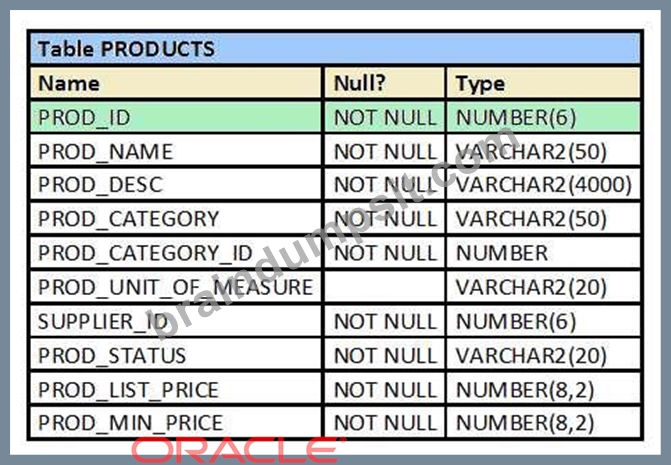
Which two tasks would require subqueries? (Choose two.)
- A. display the number of products whose PROD_LIST_PRICE is more than the average PROD_LIST_PRICE.
- B. display all products whose PROD_MIN_PRICE is more than the average PROD_LIST_PRICE of all products, and whose status is orderable
- C. display suppliers whose PROD_LIST_PRICE is less than 1000
- D. display the minimum PROD_LIST_PRICE for each product status
- E. display the total number of products supplied by supplier 102 and have product status as 'OBSOLETE'
Answer: A,B
NEW QUESTION 175
View the Exhibit and examine the structure of the PROMOTIONS table.
Evaluate the following SQL statement:
Which statement is true regarding the outcome of the above query?
- A. It shows COST_REMARK for all the promos in the promo category 'TV'.
- B. It produces an error because subqueries cannot be used with the CASE expression.
- C. It shows COST_REMARK for all the promos in the table.
- D. It produces an error because the subquery gives an error.
Answer: C
NEW QUESTION 176
View the exhibit and examine the description of the DEPARTMENTSand EMPLOYEEStables.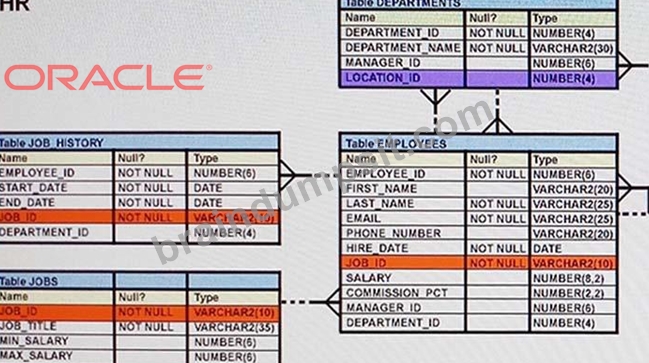
You wrote this SQL statement to retrieve EMPLOYEE_ID, FIRST_NAME, and DEPARTMENT NAME, for all employees:
SELECT employee_id, first_name, department_name
FROM employees
NATURAL JOIN departments;
The desired output is not obtained after executing the above SQL statement. What could be the reason for this?
- A. The NATURAL JOINclause is missing the USINGclause.
- B. The table prefix is missing for the column names in the SELECTclause.
- C. The EMPLOYEESand DEPARTMENTStables have more than one column with the same column name and data type.
- D. The DEPARTMENTStable is not used before the EMPLOYEEStable in the FROMclause.
Answer: C
Explanation:
Explanation/Reference:
Explanation:
Natural join needs only one column to be the same in each table. The EMPLOYEESand DEPARTMENTS tables have two columns that are the same (Department_ID and Manager_ID)
NEW QUESTION 177
View the Exhibit and examine the structure of the PRODUCT_INFORMATION table. (Choose the best answer.)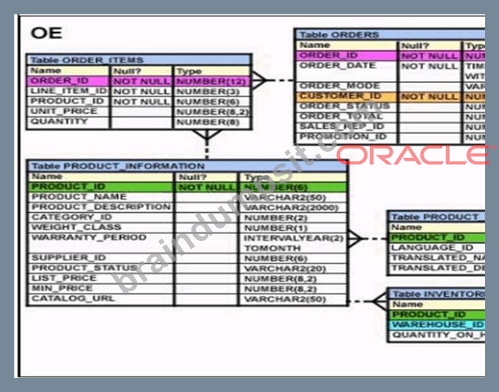
PRODUCT_ID column is the primary key.
You create an index using this command:
SQL > CREATE INDEX upper_name_idx
ON product_information(UPPER(product_name));
No other indexes exist on the PRODUCT_INFORMATION table.
Which query would use the UPPER_NAME_IDX index?
- A. SELECT UPPER(product_name)
FROM product_information
WHERE product_id = 2254; - B. SELECT UPPER(product_name)
FROM product_information; - C. SELECT product_id, UPPER(product_name)
FROM product_information
WHERE UPPER(product_name) = 'LASERPRO' OR list_price > 1000; - D. SELECT product_id
FROM product_information
WHERE UPPER(product_name) IN ('LASERPRO', 'CABLE');
Answer: D
NEW QUESTION 178
View the Exhibit and examine the structure in the DEPARTMENTS tables. (Choose two.) Examine this SQL statement:
SELECT department_id "DEPT_ID", department_name, 'b' FROM
departments
WHERE departments_id=90
UNION
SELECT department_id, department_name DEPT_NAME, 'a' FROM
departments
WHERE department_id=10
Which two ORDER BY clauses can be used to sort output?
- A. ORDER BY DEPT_NAME;
- B. ORDER BY DEPT_ID;
- C. ORDER BY 'b';
- D. ORDER BY 3;
Answer: B,D
NEW QUESTION 179
View the Exhibit and examine the structure of the ORDERS table. The ORDER_ID column is the PRIMARY KEY in the ORDERS table.
Evaluate the following CREATE TABLE command:
CREATE TABLE new_orders(ord_id, ord_date DEFAULT SYSDATE, cus_id)
AS
SELECT order_id.order_date,customer_id
FROM orders;
Which statement is true regarding the above command?
- A. The NEW_ODRDERS table would not get created because the column names in the CREATE TABLE command and the SELECT clause do not match.
- B. The NEW_ODRDERS table would get created and all the constraints defined on the specified columns in the ORDERS table would be passed to the new table.
- C. The NEW_ODRDERS table would not get created because the DEFAULT value cannot be specified in the column definition.
- D. The NEW_ODRDERS table would get created and only the NOT NULL constraint defined on the specified columns would be passed to the new table.
Answer: D
NEW QUESTION 180
Which statement will return a comma-separated list of employee names in alphabetical order for each department in the EMP table?
- A. SELECT deptno,LISTAGG(ename, ', ') WITHIN GROUP (ORDER BY ename) AS employee_list FROM emp GROUP BY deptno;
- B. SELECT deptno,LISTAGG(ename, ' , ') WITHIN GROUP AS employee_list FROM emp GROUP BY deptno;
- C. SELECT deptno,LISTAGG(ename, ', ') WITHIN GROUP (GROUP BY deptno) AS employee_list FROM emp ORDER BY ename;
- D. SELECT deptno,LISTAGG(ename, ', ') WITHIN GROUP AS employee_list FROM emp GROUP BY deptno ORDER BY ename;
Answer: A
NEW QUESTION 181
The SALES table has columns PROD_IDand QUANTITY_SOLDof data type NUMBER.
Which two queries execute successfully? (Choose two.)
SELECT prod_id FROM sales WHERE quantity_sold > 55000 GROUP BY prod_id HAVING
- A. COUNT(*) > 10;
SELECT prod_id FROM sales WHERE quantity_sold > 55000 AND COUNT(*) > 10 GROUP - B. BY COUNT(*) > 10;
SELECT COUNT(prod_id) FROM sales GROUP BY prod_id WHERE quantity_sold > 55000; - C. SELECT prod_id FROM sales WHERE quantity_sold > 55000 AND COUNT(*) > 10 GROUP
- D. BY prod_id HAVING COUNT(*) > 10;
SELECT COUNT(prod_id) FROM sales WHERE quantity_sold > 55000 GROUP BY prod_id; - E.
Answer: A,C
NEW QUESTION 182
View the exhibit and examine the description of SALES and PROMOTIONS tables.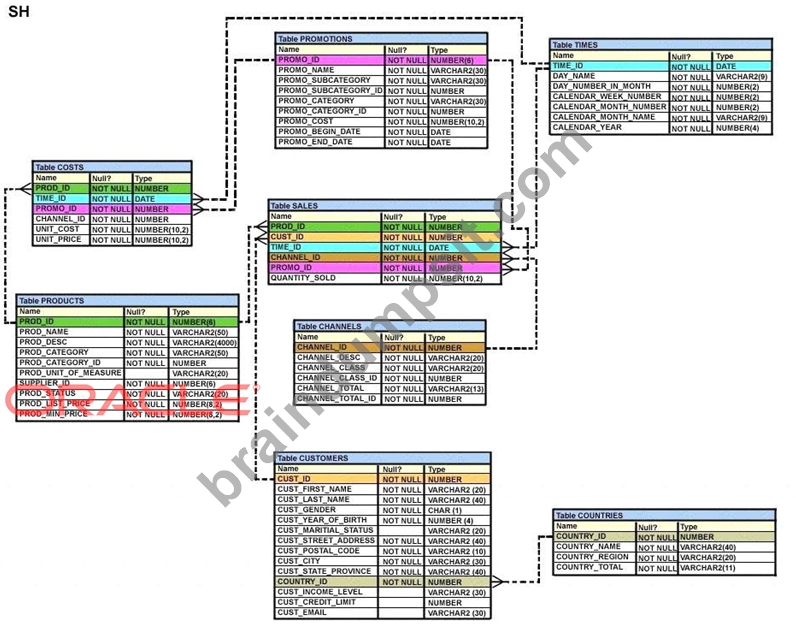
You want to delete rows from the SALES table, where the PROMO_NAME column in the PROMOTIONS table has either blowout sale or everyday low price as values.
Which three DELETE statements are valid? (Choose three.)
- A. DELETEFROM salesWHERE promo_id = (SELECT promo_idFROM promotionsWHERE promo_name = 'blowout sale')OR promo_name = 'everyday low price');
- B. DELETEFROM salesWHERE promo_id = (SELECT promo_idFROM promo_name = 'blowout sale')AND promo_id = (SELECT promo_idFROM promotionsWHERE promo_name = 'everyday low price')FROM promotionsWHERE promo_name = 'everyday low price');
- C. DELETEFROM salesWHERE promo_id = (SELECT promo_idFROM promotionsWHERE promo_name = 'blowout sale')OR promo_id = (SELECT promo_idFROM promotionsWHERE promo_name = 'everyday low price')
- D. DELETEFROM salesWHERE promo_id IN (SELECT promo_idFROM promotionsWHERE promo_name IN = 'blowout sale','everyday low price'));
Answer: A,C,D
NEW QUESTION 183
......
Updated PDF (New 2021) Actual Oracle 1z0-071 Exam Questions: https://www.braindumpsit.com/1z0-071_real-exam.html
Dumps Moneyack Guarantee - 1z0-071 Dumps Approved Dumps: https://drive.google.com/open?id=1vw1L6drU0ABZwwJGwehYLI3MMo7uVrEA