


Download the Latest JN0-251 Dumps - 2024 JN0-251 Exam Questions
Latest Juniper JN0-251 Certification Practice Test Questions
To be eligible for the JN0-251 exam, candidates must have a basic understanding of wireless networking technologies and protocols, such as IEEE 802.11 standards, TCP/IP, and routing and switching concepts. They should also have hands-on experience in configuring and managing wireless networks using Juniper Mist AI technology. Upon passing the JN0-251 exam, candidates will be certified as Juniper Mist AI, Associate (JNCIA-MistAI) and will have the skills and knowledge to design, implement, and troubleshoot wireless networks using Juniper Mist AI technology.
NEW QUESTION # 39
Which protocol does the REST API use?
- A. syslog
- B. HTTP
- C. SNMP
- D. SSL
Answer: B
Explanation:
Reference:
The protocol that the REST API uses is HTTP. HTTP stands for Hypertext Transfer Protocol and is a standard protocol for exchanging information between different applications or services over the internet. HTTP defines a set of methods, such as GET, POST, PUT, and DELETE, that specify the type of action to be performed on a resource. HTTP also defines a set of status codes, such as 200 OK, 404 Not Found, and 500 Internal Server Error, that indicate the outcome of the request.
The REST API is an application programming interface that conforms to the design principles of the REST, or representational state transfer, architectural style. REST APIs provide a flexible, lightweight way to integrate applications and to connect components in microservices architectures. REST APIs rely on HTTP to transfer a representation of the state of the resource to the requester or endpoint. The representation can be in various formats, such as JSON, XML, HTML, or plain text.
NEW QUESTION # 40
Which statement is correct about Marvis Actions?
- A. It automatically issues an RMA for an AP.
- B. It summarizes all of the misconfigured WLANs at a site.
- C. It summarizes user trouble tickets and detected AP problems.
- D. It automatically detects and reports network problems.
Answer: D
Explanation:
Reference:
According to the web search results, Marvis Actions is a feature that automatically detects and reports network problems that affect the user experience in an organization1. Marvis Actions uses the Mist AI to identify the root cause of issues and provide recommended solutions or automated fixes1. Marvis Actions can provide insight into issues across the wired, WAN, and wireless networks, at the managed service provider (MSP) level, organization level, and site level1. Marvis Actions can help network administrators monitor, troubleshoot, and optimize their network by providing real-time and historical data and analytics1.
NEW QUESTION # 41
What are three alert levels used in the Mist UI? (Choose three.)
- A. warning
- B. error
- C. notice
- D. informational
- E. critical
Answer: A,C,E
NEW QUESTION # 42
How does Mist detect rogue APs?
- A. by using Radio Resource Management (RRM)
- B. by using the AP's 5 GHz radio band
- C. by using the AP's third dedicated radio
- D. by using the AP's 2.4 GHz radio band
Answer: C
NEW QUESTION # 43
Click the Exhibit button.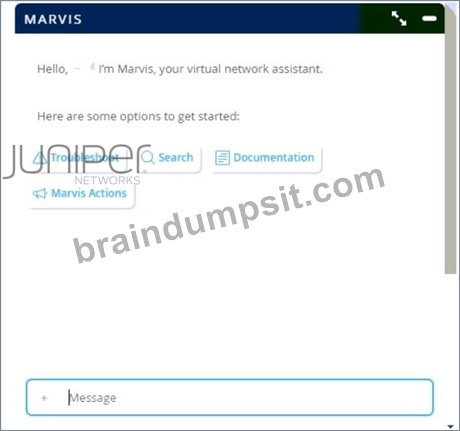
Referring to the exhibit, which Marvis language would you use to query Mist about an issue?
- A. Python
- B. query language
- C. SQL
- D. natural language
Answer: B
NEW QUESTION # 44
Which Mist location-based feature would be used for wayfinding?
- A. Asset Visibility
- B. Wi-Fi 6
- C. Wi-Fi Location
- D. vBLE Engagement
Answer: C
NEW QUESTION # 45
You are asked to invite a new user to administer specific sites in read-only mode.
Which two roles are available to the new user? (Choose two.)
- A. Observer
- B. Installer
- C. Helpdesk
- D. Network Admin
Answer: A,C
Explanation:
https://www.mist.com/documentation/administrator-roles/
The two roles that are available to the new user to administer specific sites in read-only mode are Helpdesk and Observer. These roles have read-only access to the allowed sites and can view the site-level features, such as monitor, clients, access points, location, analytics, and network. However, they cannot configure or modify any organization-level features or claim APs.
NEW QUESTION # 46
How should APs be deployed for location-based services (LBS)?
- A. with the LED facing the floor
- B. with the LED facing a wall
- C. with the LED facing the ceiling
- D. with the AP mounted on a wall
Answer: A
NEW QUESTION # 47
You are inviting a new administrator into a Mist organization.
In this scenario, which two roles are valid? (Choose two.)
- A. Observer
- B. Installer
- C. Advanced
- D. Custom
Answer: A,C
NEW QUESTION # 48
Mist cloud supports single sign-on in which two scenarios? (Choose two.)
- A. account login used for NETCONF
- B. admin login to the Mist portal
- C. account login used for the RESTful API
- D. Wi-Fi guest login access
Answer: C,D
NEW QUESTION # 49
vBLE engagement works on transmit mode and has 1 m to 3 m accuracy using which feature?
- A. Wi-Fi IoT sensors
- B. a BLE radio
- C. the Mist location SDK
- D. Wi-Fi enabled devices
Answer: C
Explanation:
Reference:
The correct answer is D. the Mist location SDK. vBLE engagement is a feature that uses virtual Bluetooth LE (vBLE) technology and cloud-based machine learning to send personalized notifications and offers to users based on their location and preferences1. vBLE engagement works on transmit mode, which means that the Juniper Mist APs transmit vBLE signals to the users' devices, and the devices use the Mist location SDK to calculate their own location and receive the notifications1. The Mist location SDK is a software development kit that allows developers to integrate the vBLE engagement feature into their own mobile applications1. The Mist location SDK can achieve 1 m to 3 m accuracy using the vBLE signals from the APs1.
NEW QUESTION # 50
A user device sends signal information to the Mist Location Engine.
In this scenario, what is expected from the Mist Location Engine?
- A. login splash page
- B. coordinates
- C. sensor device information
- D. product advertisements
Answer: B
NEW QUESTION # 51
Mist Insights will provide detailed information about which two categories? (Choose two.)
- A. Organization
- B. Templates
- C. Client
- D. AP
Answer: C,D
Explanation:
Mist Insights is a feature that provides detailed information about the network performance and user experience of your Mist-managed sites, access points (APs), and clients1. You can use Mist Insights to monitor, troubleshoot, and optimize your network by accessing various types of data and analytics collected by the Mist cloud1.
Mist Insights allows you to view insights for different contexts, such as the entire site, a specific AP, or a specific client2. You can select the context from the dropdown menu on the Insights dashboard in the Mist portal2. Depending on the context, you can see different sections of information and insights, such as site events, client events, AP events, applications, network servers, pre-connection and post-connection metrics, current site properties, current WLANs, access points, clients, and wired switches2.
Therefore, AP and client are two categories that Mist Insights will provide detailed information about. You can learn more about Mist Insights from the Juniper Networks documentation or the Mist documentation.
NEW QUESTION # 52
Which two SLEs report DHCP problems? (Choose two.)
- A. Time to Connect
- B. Capacity
- C. Throughput
- D. Successful Connects
Answer: A,C
NEW QUESTION # 53
Which characteristic describes Mist's cloud software architecture?
- A. monolithic code
- B. shard based
- C. controller based
- D. microservices based
Answer: D
Explanation:
Reference:
The correct answer is A. microservices based. This is the characteristic that describes Mist's cloud software architecture. Mist's cloud software architecture is based on microservices, which are small, independent, and loosely coupled software components that communicate with each other through APIs1. Microservices allow for faster development, deployment, scaling, and maintenance of cloud applications, as well as improved reliability, performance, and security1. Mist's cloud software architecture leverages microservices to provide AI-driven network management and operations, as well as innovative features such as vBLE engagement, Marvis Virtual Network Assistant, and Wi-Fi Assurance2.
NEW QUESTION # 54
How does Mist detect rogue APs?
- A. by using Radio Resource Management (RRM)
- B. by using the AP's 5 GHz radio band
- C. by using the AP's third dedicated radio
- D. by using the AP's 2.4 GHz radio band
Answer: C
Explanation:
Reference:
According to the web search results, Mist detects rogue APs by using the AP's third dedicated radio, which is used for scanning the wireless spectrum and detecting unauthorized APs on both 2.4 GHz and 5 GHz radio bands1. A rogue AP is an unauthorized access point that is installed on a network without the knowledge or consent of the network administrator1. A rogue AP can pose a serious security threat to a network, as it can allow attackers to bypass the network's security policies and gain access to sensitive data or launch other attacks1. A rogue AP can also interfere with the performance of the legitimate APs and cause network congestion or degradation1.
Mist APs have three radios: one for 2.4 GHz, one for 5 GHz, and one for scanning1. The scanning radio is used for detecting rogue, neighbor, and honeypot APs on both 2.4 GHz and 5 GHz radio bands1. This means that regardless of which radios you have enabled on your AP (2.4 GHz or 5 GHz), it will still be able to detect unauthorized APs at any frequency using the scanning radio1. The scanning radio can also provide other benefits, such as monitoring the network performance, optimizing the channel selection, and enhancing the location services1.
Therefore, based on the web search results, Mist detects rogue APs by using the AP's third dedicated radio, which is used for scanning the wireless spectrum and detecting unauthorized APs on both 2.4 GHz and 5 GHz radio bands.
NEW QUESTION # 55
What is a Mist Coverage SLE based upon?
- A. a summary of user minutes
- B. a summary of switch data
- C. an average of client data
- D. an average across APs
Answer: A
Explanation:
Reference:
A Mist Coverage SLE is based upon a summary of user minutes. A user minute is defined as one minute of active client connection to the wireless network. A Mist Coverage SLE tracks the number of user minutes that a client's received signal strength indicator (RSSI) as measured by the access point is below the threshold configured by the network administrator. The RSSI is a measure of how well a client can hear the access point's signal. A low RSSI indicates poor coverage and can result in low throughput, high latency, or dropped connections.
The Mist Coverage SLE allows the network administrator to monitor and troubleshoot the coverage issues on the wireless network. The Mist Coverage SLE also provides classifiers that identify the root causes of poor coverage, such as asymmetry, interference, or low transmit power. The network administrator can use the Mist portal, the Marvis virtual network assistant, or the Mist API to view and manage the Mist Coverage SLE.
NEW QUESTION # 56
......
Verified JN0-251 Dumps Q&As - 1 Year Free & Quickly Updates: https://www.braindumpsit.com/JN0-251_real-exam.html
Get 2024 Updated Free Juniper JN0-251 Exam Questions and Answer: https://drive.google.com/open?id=15u7jevNL7_LbIisX_eU1v-cPJyprrPPs