


Real ISTQB CTAL-TTA Exam Questions [Updated 2025]
CTAL-TTA Exam Dumps Pass with Updated 2025 Certified Tester Advanced Level Technical Test Analyst
NEW QUESTION # 35
Which option below BEST explains the value of a test charter in exploratory testing"5 SELECT ONE OPTION
- A. It provides expected test outcomes against which defects, if found, can be reported.
- B. It provides a way to prevent a test session's timebox from being exceeded
- C. it provides bi-directional traceability to aspects of the epic or story under test
- D. It provides guidance for the tester at the beginning of a test session
Answer: D
Explanation:
The value of a test charter in exploratory testing is that it provides guidance for the tester at the beginning of a test session. This helps structure the exploratory testing process by defining objectives, scope, and potential test ideas, while still allowing the flexibility inherent in this testing approach .
NEW QUESTION # 36
You are responsible for planning the non-functional testing for a new product. You will be responsible for the performance testing and you have determined that you will need a simulator to complete your work, Which of the following are considerations when purchasing a simulator?
1.Path testing of the tool
2.Time to test the tool
3.cost of hmng specialists
4.Susceptibility to the "probe effect"
5.Method and bme to upgrade and retest the tool as the software changes
6.Control flow analysis
- A. 1,4,6
- B. 4, 5,6
- C. 1,2, 3, 4, 6
- D. 2, 3, 5
Answer: D
Explanation:
When purchasing a simulator for performance testing, considerations should include:
* Time to test the tool - How long it will take to validate the simulator itself.
* Cost of hiring specialists - The financial aspect of requiring specialized knowledge to operate or customize the simulator.
* Method and time to upgrade and retest the tool as the software changes - How the simulator can be kept up-to-date with the software it is meant to simulate and the effort involved in retesting it after updates.
These points focus on practical and economic aspects of using a simulator in testing environments.
NEW QUESTION # 37
A unit test should be isolated Which option correctly describes the meaning of 'isolated' as a characteristic of a unit test?
SELECT ONE OPTION
Whenever it is run under the same conditions, it should produce the same results.
- A. it should provide immediate feedback.
- B. It should test only the code for which it was originally written
- C. It should only test the functionality related to it.
Answer: B
Explanation:
The term 'isolated' as a characteristic of a unit test means that it should test only the code for which it was originally written. This ensures that the unit test is focused, minimizes dependencies on other parts of the codebase, and errors can be traced back to specific units without ambiguity .
NEW QUESTION # 38
Consider the pseudo code provided below:
Given the following tests, what additional test(s) (if any) would be needed in order to achieve 100% statement coverage, with the minimum number of tests?
Test 1: A = 7, B = 7, Expected output: 7
Test 2: A = 7, B = 5, Expected output: 5
- A. A=6, B=12, Expected output: Bingo!
- B. A=7, B=9, Expected output: 7
- C. No additional test cases are needed to achieve 100% statement coverage.
- D. A=6, B=12, Expected output: Bingo! and A=7, B=9, Expected output: 7
Answer: C
Explanation:
100% statement coverage means that every line of code is executed at least once during testing. Based on the provided pseudo-code and the test cases given:
* Test 1 executes the MIN = B statement when A and B are equal.
* Test 2 executes the MIN = A statement and skips the inner IF since B is not equal to 2*A.
All statements within the code have been executed by these two tests, hence no additional test cases are needed to achieve 100% statement coverage.
NEW QUESTION # 39
Given the following pseudo code for a program to solve quadratic equations:
program Quadratic Formula
integer: a, b, c, d
floating point: r1, r2
READ (a)
READ (b)
READ (c)
d := (b * b) - (4 * a * c)
IF d < 0 THEN
PRINT ("Imaginary Roots")
ELSE
r1 := (-b + sqrt(d)) / (2 * a)
r2 := (-b - sqrt(d)) / (2 * a)
PRINT ("first root is: " r1)
PRINT ("second root is: " r2)
ENDIF
END program Quadratic_Formula
Which of the following checklist items is MOST likely to indicate a problem in this program?
- A. Does the code avoid comparing floating point numbers for equality?
- B. Are divisors tested for zero or noise?
- C. Are there any redundant or unused variables?
- D. Are all variables properly defined with meaningful, consistent and clear names?
Answer: B
Explanation:
Analysis:
The given pseudo code for solving quadratic equations includes operations that involve division. One of the critical issues in such operations is ensuring that the divisor is not zero, which would result in a division by zero error.
Checklist Item:
D: Are divisors tested for zero or noise?:
* This checklist item addresses the potential problem of dividing by zero. In the pseudo code, the variable a is used as a divisor in the formula (-b ± sqrt(d)) / (2 * a). If a is zero, this will result in a division by zero error. Therefore, it is crucial to test whether a is zero before performing the division.
Explanation of Incorrect Options:
* A. Does the code avoid comparing floating point numbers for equality?:
* This is important but not directly relevant to the given pseudo code's primary issue.
* B. Are all variables properly defined with meaningful, consistent and clear names?:
* This is good practice but does not address the critical issue of division by zero.
* C. Are there any redundant or unused variables?:
* Identifying unused variables is helpful for code clarity but does not address the primary functional issue in the pseudo code.
References:
The ISTQB CTAL-TTA syllabus and standard code review practices emphasize the importance of ensuring safe arithmetic operations, particularly avoiding division by zero.
Sources:
* ISTQB-CTAL-TTA Syllabus
* General knowledge on code review and arithmetic operations.
NEW QUESTION # 40
You are working on a new product that will provide an online pizza ordering service. Not everyone wants to create a frequent-eater pizza account, so the user can either log in to their existing account, create an account or proceed as a "guest" user. People with existing accounts have the option to update their accounts including changing address, changing credit card information and changing phone number. New account creation requires the user to enter their address, credit card information and phone number. This information Is validated to be sure the address matches the credit card information.
Once the user logs in, they are able to order their pizza. They can request up to five different pizzas and can select different ingredients on each. A user is allowed to pick up to 10 different ingredients per pizza. They can also select from a pre-defined set of ingredients as follows: "meat lovers", "all veggie', "cheese please', and
"throw it all on".
The busiest day of the year for this product will be the day of the final football game of the professional season. In addition to the normal high load, the company will also be running a special on the "cheese please" pizza (buy 3 get 2 more free). The new product will need to handle a load that Is expected to be twice as high as the load on the old product last year. Given this information, what is an important item that should be addressed In the architectural specification?
- A. Data replication
- B. Transaction concurrency
- C. Caching
- D. Lazy instantiation
Answer: B
Explanation:
Considering the high load expected on the busiest day, particularly with a promotional offer like "buy 3 get 2 more free" on a pizza, addressing transaction concurrency in the architectural specifications is crucial. This ensures the system can handle multiple and simultaneous user transactions efficiently without data loss or service degradation. Proper handling of transaction concurrency is essential to maintain system integrity and responsiveness during peak times, which is a critical requirement for the online pizza ordering system on such a high-traffic day.
NEW QUESTION # 41
Your Agile team is developing a web-based system that will allow users to browse and buy online from a store's shopping catalogue. Continuous Integration has been implemented and technically it is working well, running several times per day, but each run is taking almost as much time as the team is prepared to allow. It is clear that after a few more iterations, as the number of tests needed grows with the product, it will be taking too much time.
Which of the four options contains a pair of solutions that will BOTH help to solve this problem?
a.Only include unit and component integration tests in the automated Cl runs.
b.Schedule low priority tests to be the first ones executed in each run, in order to provide rapid build verification.
c.Reduce the extent to which the automated tests go through the user interface, using technical interfaces instead.
d.Reduce the number of Cl cycles run each day.
e.Select a subset of automated tests for the daytime Cl runs, and run as many of the other tests as possible in an overnight cycle.
SELECT ONE OPTION
- A. c and e
- B. a and c
- C. b and d
- D. d and e
Answer: A
Explanation:
The correct option for addressing the issue of increasing test run times in a Continuous Integration (CI) environment is option C: reducing the extent to which automated tests go through the user interface, and selecting a subset of automated tests for the daytime CI runs while running many of the other tests in an overnight cycle.
* Reducing User Interface Tests: By reducing the extent of tests that go through the user interface (UI) and using technical interfaces instead, you can significantly decrease the time each test takes. UI tests are generally slower due to rendering and user interaction simulations.
* Optimizing Test Scheduling: By selecting only a subset of tests for daytime CI runs and scheduling extensive testing for overnight runs, the team can manage the test load better without compromising the frequency of integration, thus ensuring continuous testing does not become a bottleneck.
This dual approach effectively manages both the execution time of individual tests and the overall test process across the development cycle, maintaining the agility of the CI process without sacrificing the breadth of testing necessary for quality assurance .
NEW QUESTION # 42
A project to replace your company's sales and merchandising system has begun. The old system is still in production but is poorly documented and expensive to maintain: changing it has often produced a large quantity of defects. The new version will be developed using modern techniques and technology.
Requirements include:
* Loading sales data, sent electronically from the stores each evening, into a central database where it is then available for other applications.
* Producing sales reports for the merchandisers, whose job is to manage stock levels in stores.
* Predictions of future demand for each product, based on a combination of sales history and forecasting parameters.
Requirements 1 and 2 are satisfied by the existing system and will be rewritten with no significant changes.
Requirement 3 is new: these forecasting reports will be run overnight, and users will request them by entering simple parameters online during the day.
The sales data are loaded in an overnight batch run. There have been problems at peak periods when this run has taken longer than scheduled, so that dependent jobs could not finish before the start of the working day.
As a Technical Test Analyst, you have been asked to contribute to the project's Master Test Plan. The concerns expressed by stakeholders during risk identification include the length of the batch job runs, ease of parameter entry for the users, unauthorized access to stored sales data, and limited time for testing. With these in mind, which TWO of the following quality characteristics sub-characteristics are likely to contain the highest levels of technical risk?
A) Operability.
B) Time behavior.
C) Interoperability.
D) Security.
E) Testability.
- A. c and e
- B. a and b
- C. b and e
- D. b and d
Answer: D
Explanation:
In this scenario, the project's stakeholders have expressed concerns about several risk factors related to the new sales and merchandising system. As a Technical Test Analyst, it's essential to identify the quality characteristics that contain the highest levels of technical risk.
Stakeholder Concerns:
* Length of the Batch Job Runs:
* This directly impacts the time behavior of the system, which is a sub-characteristic of performance efficiency.
* Ease of Parameter Entry for Users:
* This impacts operability, a sub-characteristic of usability, but considering the given options, it's not the highest technical risk compared to others.
* Unauthorized Access to Stored Sales Data:
* This is a critical concern under security, which involves protecting the system from unauthorized access and ensuring data integrity and confidentiality.
* Limited Time for Testing:
* This relates to testability, which is the ease with which the system can be tested, but it's less critical compared to time behavior and security in this context.
Quality Characteristics with Highest Technical Risk:
* Time Behavior (Option B):
* The efficiency of batch job runs is crucial since delays can impact other dependent jobs and overall system performance. Ensuring that batch jobs complete within the scheduled time is vital to maintain system reliability and performance efficiency.
* Security (Option D):
* Unauthorized access to sales data is a significant risk. Ensuring robust security measures to protect sensitive data is essential to prevent data breaches and maintain data integrity.
Explanation of Incorrect Options:
* A. Operability: While ease of use is important, it's not the highest technical risk compared to performance and security.
* C. Interoperability: This relates to how well the system interacts with other systems, which is not a primary concern based on the given stakeholder issues.
* E. Testability: Although important, the limited testing time is less critical compared to the risks associated with system performance and data security.
References:
The ISTQB CTAL-TTA syllabus discusses quality characteristics and their sub-characteristics, emphasizing the importance of understanding different types of risks in software testing. In this case, performance efficiency (time behavior) and security are the most critical aspects given the stakeholder concerns.
Sources:
* ISTQB-CTAL-TTA Syllabus
* General knowledge on quality characteristics in software testing.
NEW QUESTION # 43
The following epic has been written:
As a vehicle driver
I want to find an available space In a car park
So that I can pay in advance to reserve that space
This epic will be used to develop user stories for a new National Car Parking application Both public and private car park owners will be able to utilise the system, allowing drivers of all kinds to guarantee an available car parking space on arrival at their chosen car park, according to the kind of vehicle that they may drive There will be multiple stakeholders including different car park owners, different user groups including disabled drivers and different vehicle types such as car. van and motorbike.
From this epic, multiple user stories will be written. The following acceptance criteria have been written for the epic, and will be applicable to all user stories (each user story will also have its own acceptance cntena):
1.End-to-end response time for any individual request submitted by a user must not exceed 5 seconds
2.All correspondence with stakeholders must be via email and text message
3.The application must be accessible on most mobile technology
4.A user cannot submit a form unless all mandatory fields are entered
5.Payment method can be made using the most popular electronic options
Applying the INVEST technique to this epic, including its acceptance criteria, which of the following statements is correct?
SELECT ONE OPTION
- A. The Independent and Small criteria of INVEST have not been satisfied
- B. The Testable and Valuable criteria of INVEST have not been satisfied
- C. The invest criteria have all been satisfied by this epic
- D. The Testable and Small criteria of INVEST have not been satisfied
Answer: A
Explanation:
The epic described has broad and overarching objectives that span multiple user groups and stakeholders, making it inherently dependent on other functionalities within the same system. This fails the 'Independent' criterion of INVEST, which suggests features should be self-contained. Moreover, the epic's scope suggests it's quite large, likely requiring splitting into smaller, more manageable stories, thus not meeting the 'Small' criterion. INVEST aims for manageable, independent increments that can be developed and validated quickly .
NEW QUESTION # 44
You are defining the test approach for an Agile project release focused on significantly overhauling the user interface of a golf club's booking system. Additional features will allow more flexible bookings across three courses. These changes are driven by numerous customer complaints about the current system's confusing design and limited options. The release will consist of six two-week sprints.
Stakeholders have performed a risk assessment and consider the impact of system failure as high due to potential customer loss. A regression-averse strategy is recommended due to the extensive changes expected in screen design and functionality.
Which option below represents the BEST test approach for this release? Please use the following symbols consistently:
* + (highly recommended)
* (recommended)
* o (neutral/optional)
* * (not recommended)
* - (not to be used)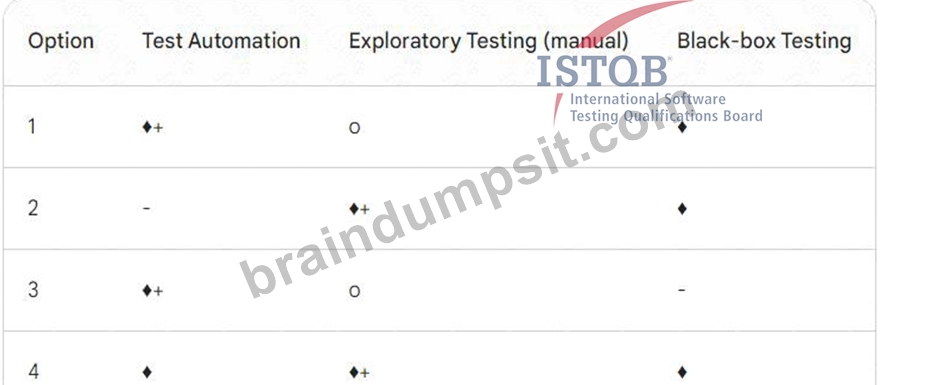
SELECT ONE OPTION
- A. 0
- B. 1
- C. 2
- D. 3
Answer: D
Explanation:
In addressing the scenario described in the question, the primary considerations for choosing a test approach include the focus on overhauling the user interface, adding new features, and addressing customer complaints in a high-risk environment due to potential customer loss. A regression-averse strategy is also highlighted as critical due to significant changes in design and functionality.
Option D (2) is marked with + for Exploratory Testing (manual) and for Black-box Testing, with Test Automation marked as not to be used (). This selection aligns best with the project's needs for several reasons:
* Exploratory Testing (Highly Recommended): This type of testing is crucial in Agile projects, especially when dealing with UI changes and new functionalities. Exploratory testing allows testers to interact with the system in ways that typical scripted testing may not cover, making it ideal for catching unforeseen issues in new interfaces and features.
* Black-box Testing (Recommended): This testing focuses on the functionality of the application without needing to understand the internal workings. Given the UI overhaul and feature additions, ensuring that the system behaves as expected from an end-user's perspective is necessary.
* Avoidance of Test Automation (Not to be Used): While automation is valuable, focusing primarily on manual testing techniques like exploratory testing is suggested for this specific release due to the extensive UI changes and the need for creative and intuitive testing approaches that adapt quickly to newly developed features.
By using Option D, the test approach supports the dynamic and user-focused nature of the release, addressing both the technical aspects of functionality and the user experience enhancements that are central to this overhaul .
NEW QUESTION # 45
Given the following decision: IF X < 5 OR Y > 10 THEN
And the following test inputs: X=6 and Y=12, X=5 and Y=10
Which of the following additional sets of test inputs will ensure that full Multiple Condition coverage is achieved?
- A. X=2 and Y=12
X=6 and Y=4 - B. X=4 and Y=7
X=10 and Y=15
X=8 and Y=8 - C. X=3 and Y=10
X=0 and Y=15 - D. X=0 and Y=10
X=4 and Y=4
Answer: A
Explanation:
For Multiple Condition Coverage, each combination of conditions must be tested to ensure all possible outcomes are covered. Given the decision IF X < 5 OR Y > 10 THEN and the test inputs X=6 and Y=12 and X=5 and Y=10, we need to find additional test cases to achieve full coverage. The conditions are:
* Condition 1: X < 5
* Condition 2: Y > 10
Let's examine the options:
* Option A:
* X=4 and Y=7 (X < 5 is true, Y > 10 is false; overall decision true)
* X=10 and Y=15 (X < 5 is false, Y > 10 is true; overall decision true)
* X=8 and Y=8 (X < 5 is false, Y > 10 is false; overall decision false) This set covers all possible outcomes but does not provide the minimal set for MC/DC.
* Option B:
* X=0 and Y=10 (X < 5 is true, Y > 10 is false; overall decision true)
* X=4 and Y=4 (X < 5 is true, Y > 10 is false; overall decision true)
This set does not fully achieve multiple condition coverage as it misses the combination where X < 5 is false and Y > 10 is true.
* Option C:
* X=2 and Y=12 (X < 5 is true, Y > 10 is true; overall decision true)
* X=6 and Y=4 (X < 5 is false, Y > 10 is false; overall decision false) This set, combined with the initial inputs (X=6 and Y=12, X=5 and Y=10), ensures that all condition combinations are tested, achieving full multiple condition coverage.
* Option D:
* X=3 and Y=10 (X < 5 is true, Y > 10 is false; overall decision true)
* X=0 and Y=15 (X < 5 is true, Y > 10 is true; overall decision true)
This set does not fully achieve multiple condition coverage as it does not test the combination where both conditions are false.
Therefore, the correct answer is C. X=2 and Y=12, X=6 and Y=4.
NEW QUESTION # 46
Which of the following elicitation techniques is BEST usedwhen questioning a large number of stakeholders specifically to obtain information for non-functional acceptance criteria?
SELECT ONE OPTION
- A. Quantitative Questionnaires
- B. Qualitative Questionnaires
- C. Qualitative Review
- D. Quality Analysis
Answer: A
Explanation:
Quantitative Questionnaires are the best elicitation technique for questioning a large number of stakeholders specifically to obtain information for non-functional acceptance criteria. This method allows for collecting measurable, numerical data from a broad audience efficiently, which is crucial for understanding and defining non-functional requirements such as performance, scalability, and usability
NEW QUESTION # 47
Which statement is correct with respect to fault injection tools?
- A. They inject defects into the SUT in order to test the error handling capabilities of test automation software
- B. They deliberately introduce incorrect inputs to a system to ensure it can withstand and recover from error conditions
- C. They modify the code under test in order to check the coverage achieved by specified tests
- D. They can detect memory leaks and wild pointers when a component is executing
Answer: B
Explanation:
Analysis:
Fault injection tools are used to introduce faults into a system to test its robustness and error-handling capabilities.
B: They deliberately introduce incorrect inputs to a system to ensure it can withstand and recover from error conditions:
* This statement correctly describes the purpose of fault injection tools, which is to introduce faults or errors to evaluate how well the system can handle and recover from these conditions.
Explanation of Incorrect Options:
* A: They modify the code under test in order to check the coverage achieved by specified tests:
* This describes code coverage tools, not fault injection tools.
* C: They inject defects into the SUT to test the error handling capabilities of test automation software:
* Fault injection tools test the system under test (SUT) itself, not the test automation software.
* D: They can detect memory leaks and wild pointers when a component is executing:
* This describes dynamic analysis tools, not fault injection tools.
References:
The ISTQB CTAL-TTA syllabus covers the use of fault injection tools and their role in testing the robustness of systems.
Sources:
* ISTQB-CTAL-TTA Syllabus
* General knowledge on fault injection tools.
NEW QUESTION # 48
You have been assigned to perform a review on code provided below:
Which type of defect should you report as part of the code review?
- A. Too many nested levels
- B. Unreachable code
- C. No defects should be reported, code is correct.
- D. Endless loop
Answer: D
Explanation:
The code provided contains a potential endless loop. The loop is conditioned on the variable 'E' being less than
1 (IF E < 1), but within the loop, there is no operation that modifies the value of 'E'. Therefore, once the loop is entered, if the condition A > B holds true, the value of 'E' remains unchanged, leading to an endless loop situation. The decrement of 'A' in line 15 does not guarantee an exit condition for the loop, as it does not affect the value of 'E'. This is a control flow defect that could cause the program to hang or crash.
NEW QUESTION # 49
Consider the pseudo code provided below:
Given the following tests, what additional test(s) (if any) would be needed in order to achieve 100% statement coverage, with the minimum number of tests?
Test 1: A = 7, B = 7, Expected output: 7
Test 2: A = 7, B = 5, Expected output: 5
- A. A=6, B=12, Expected output: Bingo!
- B. A=7, B=9, Expected output: 7
- C. No additional test cases are needed to achieve 100% statement coverage.
- D. A=6, B=12, Expected output: Bingo! and A=7, B=9, Expected output: 7
Answer: C
Explanation:
100% statement coverage means that every line of code is executed at least once during testing. Based on the provided pseudo-code and the test cases given:
* Test 1 executes the MIN = B statement when A and B are equal.
* Test 2 executes the MIN = A statement and skips the inner IF since B is not equal to 2*A.
All statements within the code have been executed by these two tests, hence no additional test cases are needed to achieve 100% statement coverage.
NEW QUESTION # 50
Consider the following code segments.
Segment 1:
If a > b then setc = 12
elseif c >7 set c = 5
endif
Segment 2: setc= 12 for n = 1 to c
display c
endfor
Segment 3:
If (a > b) or (c < d) then
set c = 12
else
set c = 5
endlf
Segment 4:
set y = 4
call (segments)
segments:
start
for I = 1 to y
print y
endfor
end
Which segment would receive the highest cyclomatic complexity value?
- A. Segment 3
- B. Segment 2
- C. Segment 1
- D. Segment 4
Answer: A
Explanation:
Cyclomatic complexity is a measure of the number of linearly independent paths through a program's source code. Segment 3 has two conditions: if (a > b) or (c < d) and the associated else. This structure introduces multiple decision points, thereby increasing the number of potential execution paths. Comparatively, the other segments have fewer conditions and straightforward loops, which contribute to a lower cyclomatic complexity.
Segment 3, with its compound condition and branching logic, likely has the highest cyclomatic complexity.
NEW QUESTION # 51
Consider the following section of code:
If ((A > B) or (C > D)) and (E = F) then
print A;
Endlf
Which of the following sets of test data can be used to achieve multiple condition coverage with the least number of tests?
- A. Set 1
- B. Set 2
- C. Set 3
- D. Set 4
Answer: B
Explanation:
To achieve multiple condition coverage with the least number of tests, the selected test data set must cover all possible combinations of the conditions (A > B) or (C > D) and (E = F). Set 2, where each condition has been tested in both true and false states across the minimal test set, is the most efficient way to ensure coverage. It triggers different paths in the code with minimal redundancy, ensuring that each unique path is verified.
NEW QUESTION # 52
......
CTAL-TTA Exam Dumps, CTAL-TTA Practice Test Questions: https://www.braindumpsit.com/CTAL-TTA_real-exam.html